

Originally Rollo refers to Trein as “Mozus-sensei,” using Trein’s first name, but this was changed in the English-language adaptation to “Professor Trein” instead.
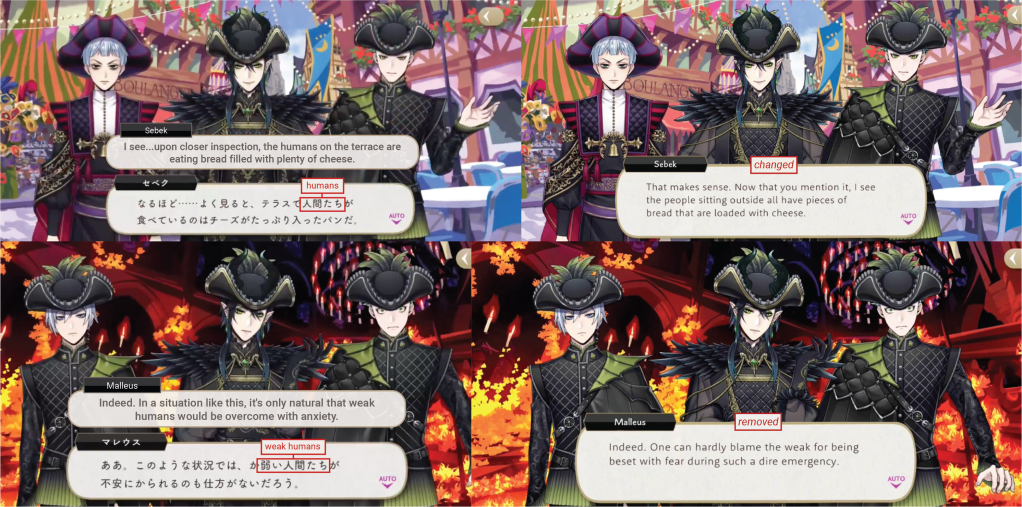
Original Sebek: I see…upon closer inspection, the humans on the terrace are eating bread filled with plenty of cheese.
EN Sebek: That makes sense. Now that you mention it, I see the people sitting outside all have pieces of bread that are loaded with cheese.
Original Malleus: Indeed. In a situation like this, it’s only natural that weak humans would be overcome with anxiety.
EN Malleus: Indeed. One can hardly blame the weak for being beset with fear during such a dire emergency.
Both Sebek and Malleus had the word “humans” removed from their dialogue.

Original Clown: This seems to be a delightful gift from a mischievous egg of a magic user…
EN Clown: It looks like some mischievous fledging mage decided to gift us a little present.
The English-language adaptation has a history of removing the word “egg” from the game, changed to “fledgling” during Glorious Masquerade. More here ->

While EN has technically localized the in-game currency “madol” into “thaumarks,” with the Port Fest event EN received an all-new form of currency that doesn’t exist in the original game: sorcents! They returned in Glorious Masquerade. More here ->
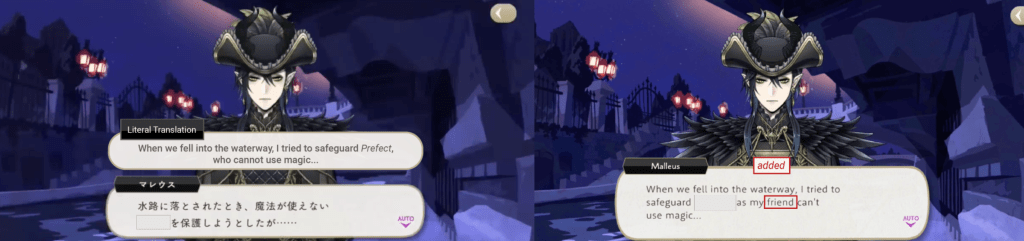
Original Malleus: When we fell into the waterway, I tried to safeguard Prefect, who cannot use magic…
EN Malleus: When we fell into the waterway, I tried to safeguard Prefect, as my friend can’t use magic…
Malleus never refers to the prefect as a friend, which may be significant, as the word seems to be of some importance at NRC. More here ->
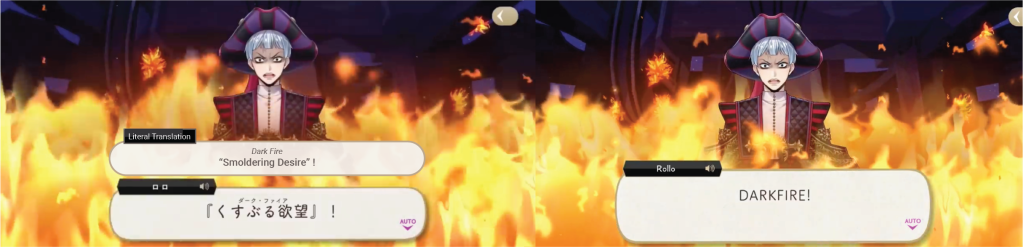
Pronunciation: Dark Fire
Meaning: Smoldering Desire
EN: Darkfire

Idia generally talks with a stutter in the original game, which was removed from the English-language adaptation of Glorious Masquerade.
This seemed like a language limitation, but his stutter has been accurately recreated on EN in other places.
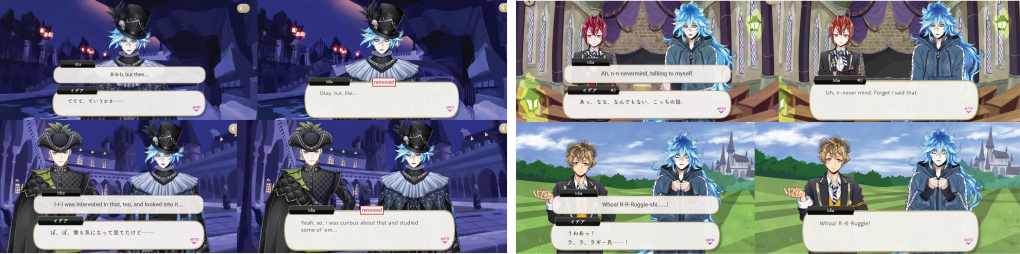
This resulted in lines like “Blue handkerchiefs…ah, ah, th-th-the glass mobiles seem to be less simple than these…” becoming “Plain blue handkerchiefs? Um, no offense, but these look way more basic than those glass mobiles…” and “B-b-b-but then…” becoming “Okay, but, like…,” making the EN adaptation of Idia maybe sound more assertive than the original.
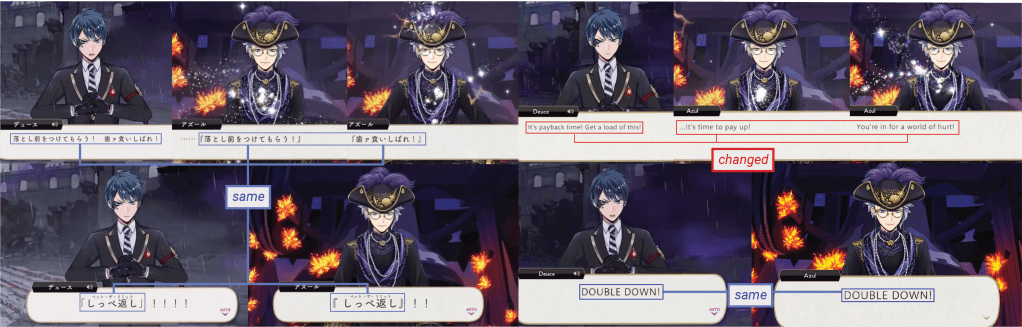
In the original game Azul recites the exact same spell Deuce did in Book 5 in order to summon Deuce’s magic, but the spell used by EN- Deuce is not the same as the one used by EN-Azul.
More on the spells/chants/incantations used in the game, manga and novels, here ->

An interesting language hurdle arose at the end of the game when Malleus addressed the gathered visitors at the ball by the “omae” form of “you”.
The audience responds with discomfort and Jamil explains, “Ordinary students don’t address peers they are meeting for the first time as ‘omae-tachi’…” (Being sensitive to social situations is a part of Jamil’s character, explained in more depth in his third birthday vignette).
Since the English language doesn’t have varying forms of “you,” this comment was removed. More on the various versions of “you” used in Twisted Wonderland, here ▶︎
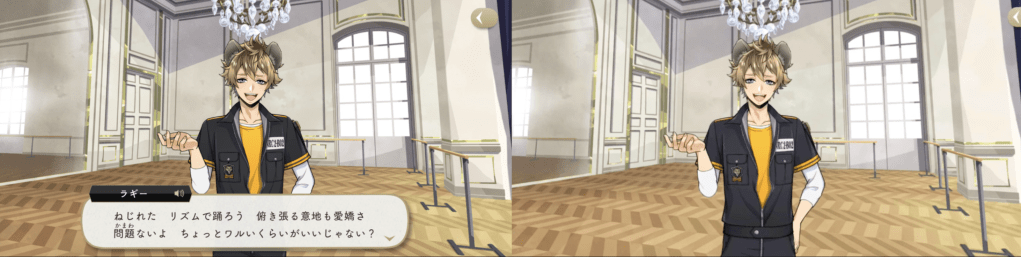
Much like how the lyrics to the song “Piece of My World” were removed from Book 5, the lyrics to Malleus’ song “Wish Resound” were also removed from the English-adaptation of the game.

But whereas Book 5 is voiced Glorious Masquerade is not, so removing the text box entirely would have resulted in Malleus simply standing and staring in silence. To compensate, EN has put “singing” in the text box.

It is a little unfortunate as, during the song, there are repeated cuts back to Rollo’s reactions (Lyric translation can be very complex, this is just one possible interpretation of what the lyrics might sound like in English).
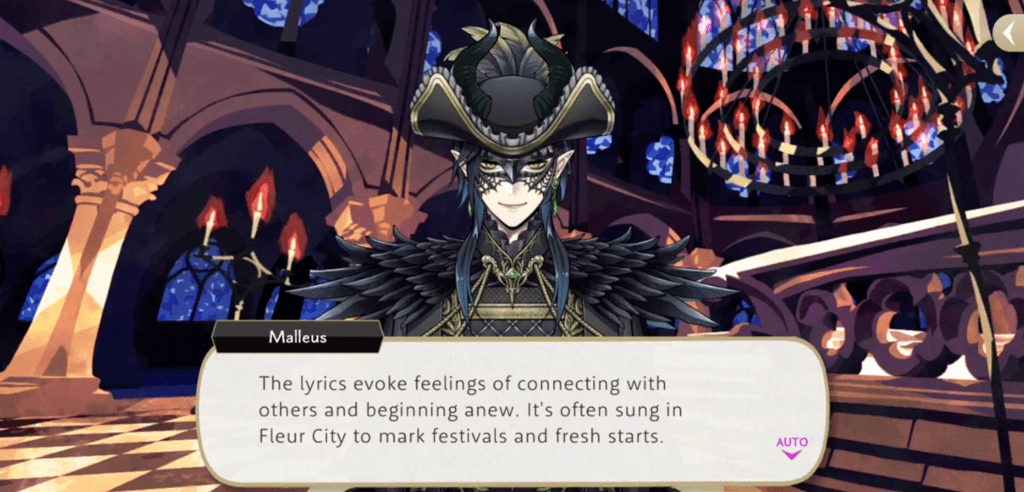
And Malleus makes a point of commenting on the importance of the lyrics (that EN cannot see) that seem to be resonating with Rollo.
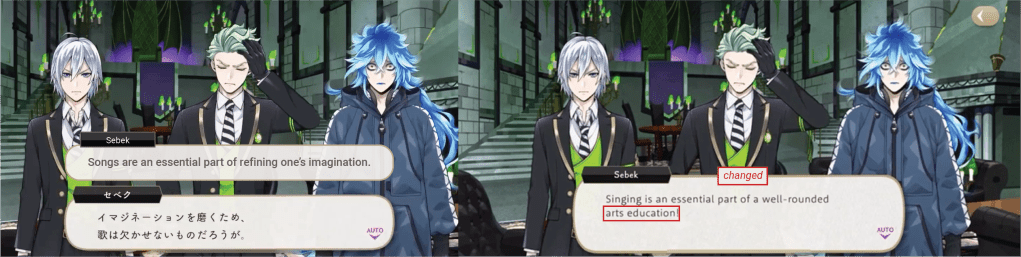
Original Sebek: Songs are an essential part of refining ones imagination.
EN Sebek: Singing is an essential part of a well-rounded arts education.
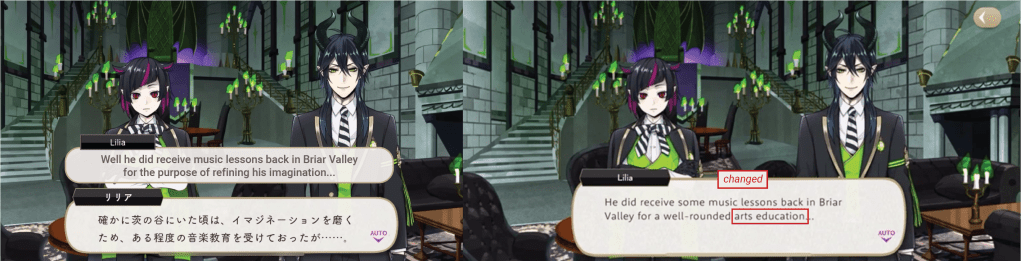
Original Lilia: Well he did receive music lessons back in Briar Valley for the purpose of refining his imagination…
EN Lilia: He did receive some music lessons back in Briar Valley for a well-rounded arts education…
What was originally the English word “imagination” was changed to “arts education” on EN, but this is not the first time that the importance of “imagination” has been mentioned in the game: it also came up in Book 1.
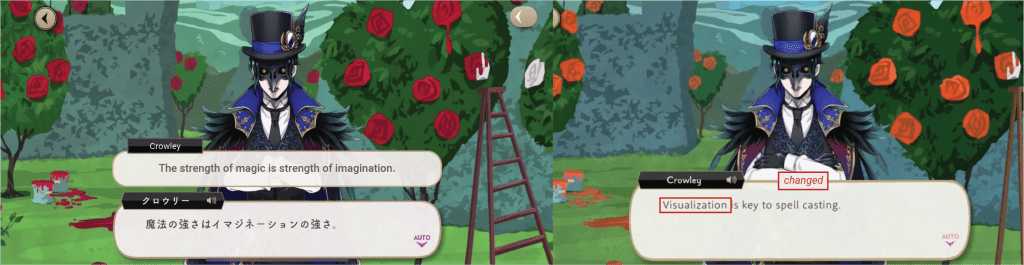
The concept of “imagination” becomes very important in Book 7 of the main story (more here ▶︎), and was also emphasized in the novel:
“’Mm. Well, that’s how it is when you’re a new student. You’ll be fine once you start refining your imagination.’
‘Imagination?’
‘Right. What kind of magic you use, what effects it has. And, above all, what you want to make happen. The more detail you are able to visualize in your mind, the more accurate your magic. And it won’t manifest that well if you can’t.’”
-Twisted Wonderland the first novel
“‘The strength of magic is strength of imagination. The better your ability to envision the effects of your magic, the stronger and more precise your power. Roseheart-kun’s imagination has become much stronger than it was at the time of last year’s duel, and that doesn’t happen overnight. It is quite clear how hard he works each day.’”
-Twisted Wonderland the first novel
“Trey, Cater, and Riddle’s unique magics each reflect their individuality in an interesting way, and each have their own charm. As does Ruggie’s unique magic, though it has caused injuries. The power of magic is the power of imagination.”
-Twisted Wonderland the second novel
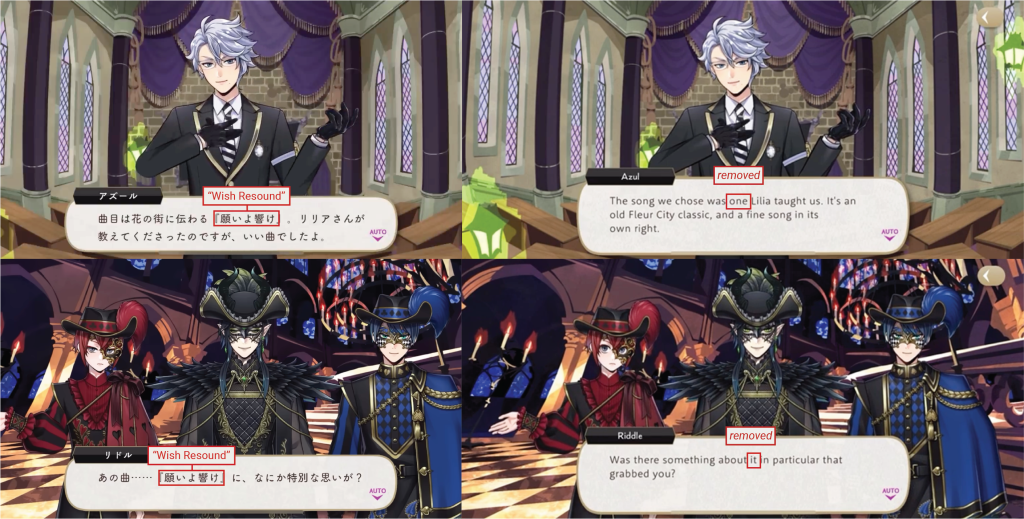
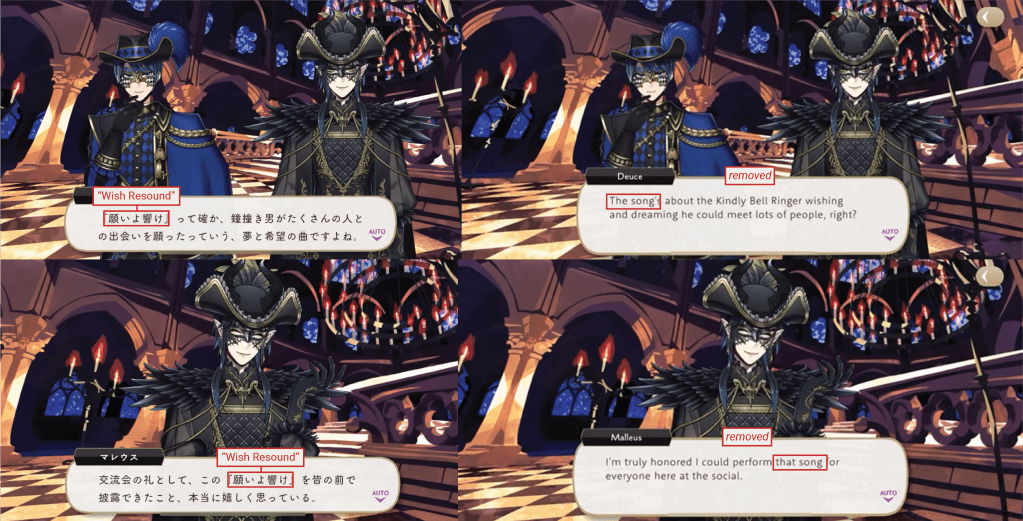
Other changes to the various Glorious Masquerade vignettes include the removal of the title of the song.
(While commonly known within the English-speaking fan community as “Make a Wish,” the title means “Wish Resound.”)
 Twisted Wonderland Reference Note