

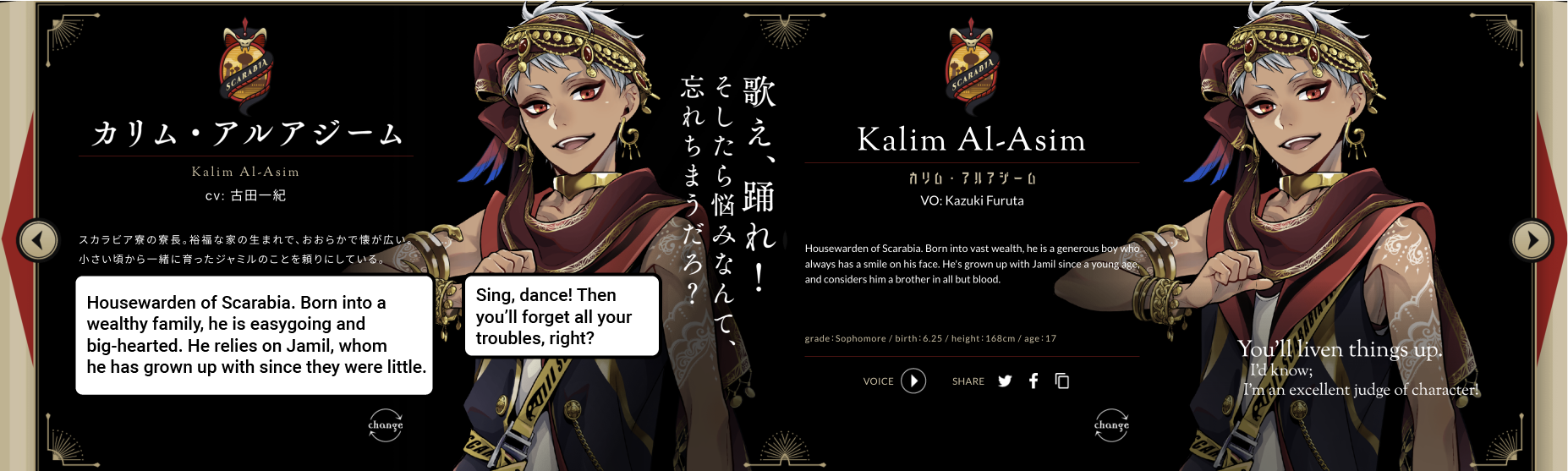
Original Website: He relies on Jamil, whom he has grown up with since they were little.
EN Website: He’s grown up with Jamil since a young age. and considers him a brother in all but blood.
Original Kalim: Sing, dance! Then you’ll forget all your troubles, right?
EN Kalim: You’ll liven things up, l’d know; I’m an excellent judge of character!
Kalim is possibly being re-characterized on EN as being more polite than he actually is. For a small grammar lesson, here is a perfectly accurate localization of Deuce:
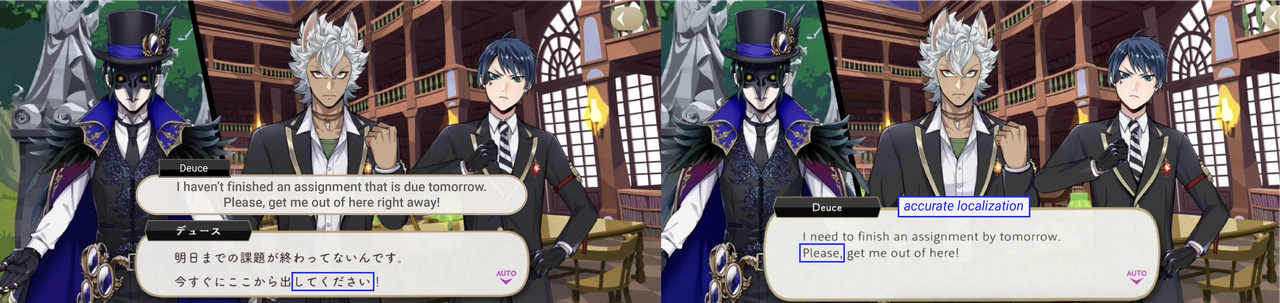
Original Deuce: Please get me out of here!
EN Deuce: Please get me out of here!
With the してください form of Deuce’s sentence he is making a polite request and saying “please,” as would be expected of a student speaking to a teacher.
*Note: there are mostly no personal pronouns so the characters could be saying “get me out” or “get us out.” They have been written to match EN’s interpretation.
Here Kalim is using the exact same verb as Deuce but his verb form is not polite: he is speaking in an authoritative tone:
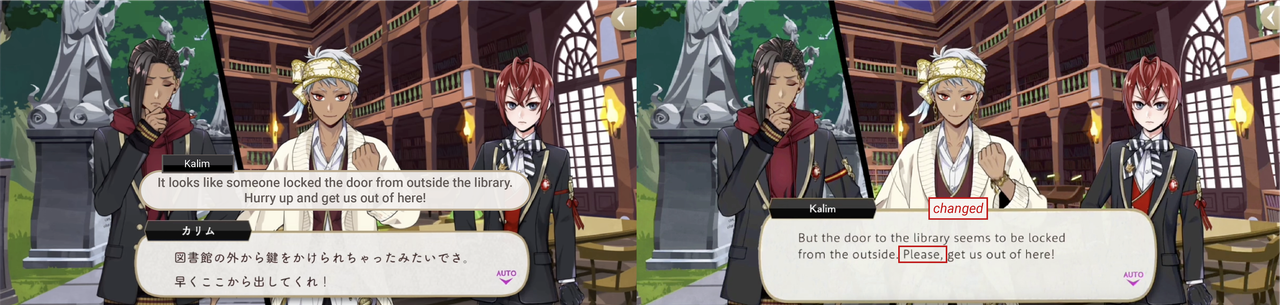
Original Kalim: Hurry up and get us out of here!
EN Kalim: Please, get us out of here!
It is not a request, it is an order, which EN has softened with “please,” which Kalim does not say.
And this is characteristic of Kalim, who has possibly never spoken in polite forms with anyone and also does not use honorifics even with older housewardens.
It makes sense that someone would use such phrasing with a servant but he uses the same verb form with Crowley:
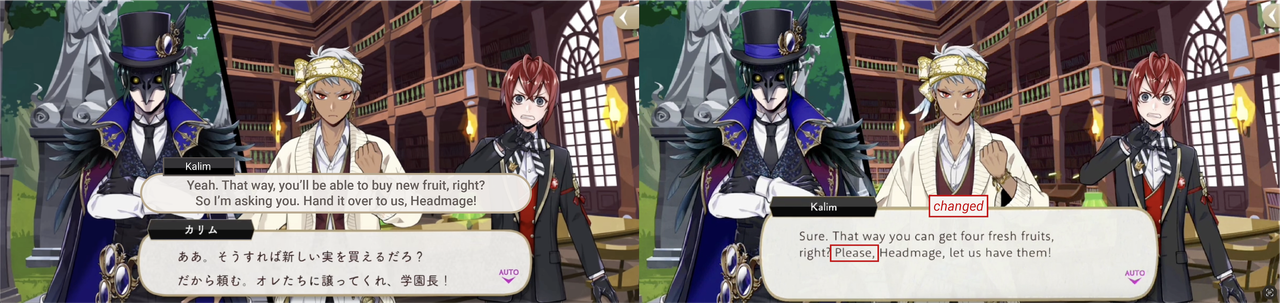
Original Kalim: Hand it over to us
EN Kalim: Please let us have them!
EN again softens his dialogue with “please,” but Kalim does not actually say “please” or use polite phrasing. If Kalim was using polite verb forms then even without saying “please” directly it would make sense for EN to add it to his dialogue in order to get across the same general feeling while compensating for how different the two languages are. But in addition to the lack of “please” he is not speaking politely.
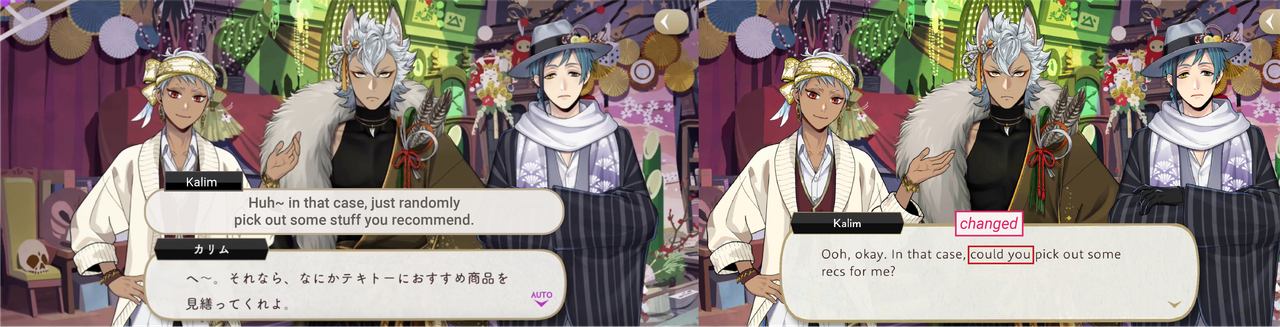
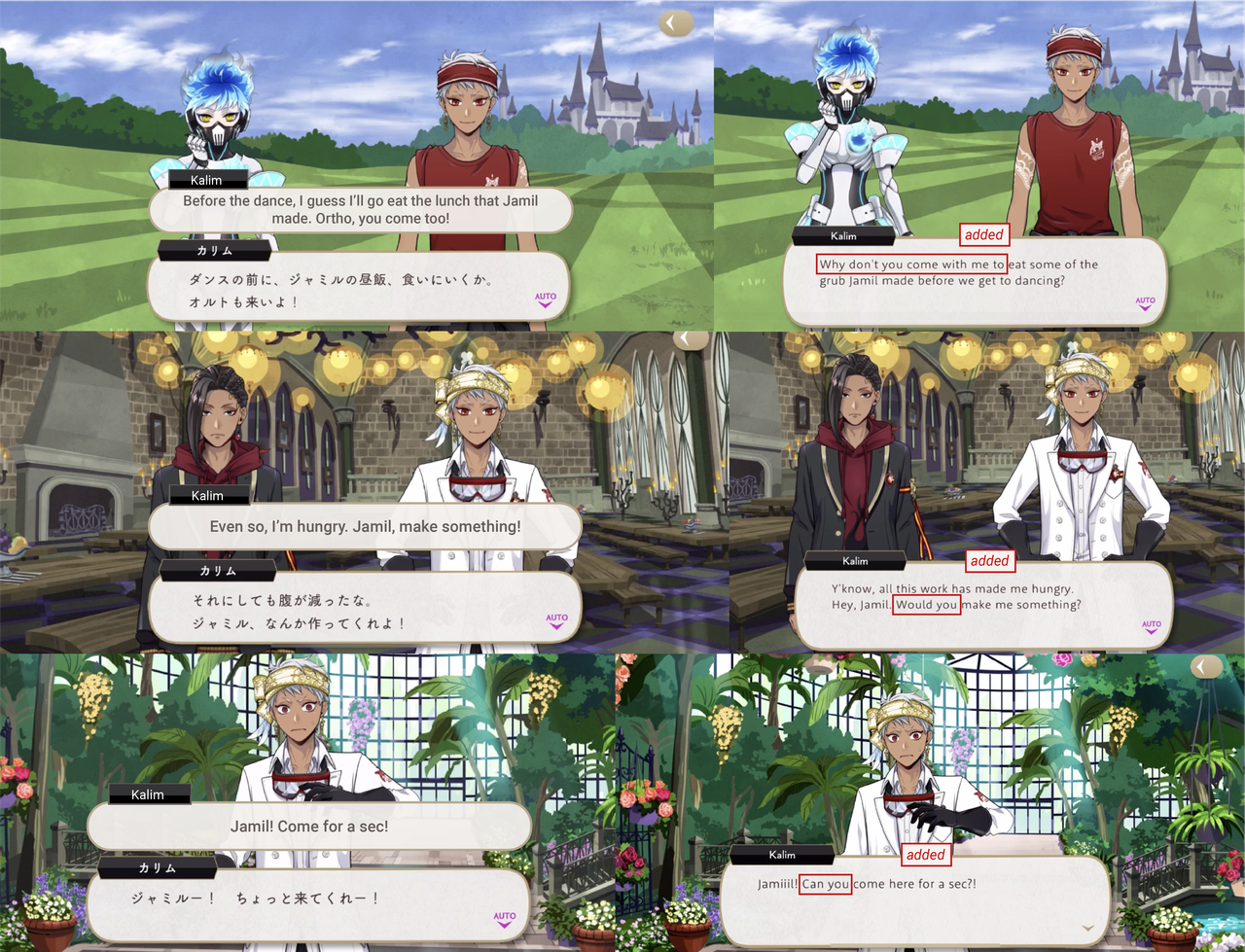
We see this again during New Years 2026, where Kalim tells Floyd to find something in the school store for him to buy. EN localized this line as, “Could you pick out some recs for me?,” but the grammar of his original dialogue is not a request–it is an order–and would be closer to, “Pick out some stuff you recommend.”
These kinds of changes can run the risk of mischaracterizing characters Kalim in subtle ways, making him sounds more polite than he really is.
And Kalim’s rudeness is also important to the plot of the Main Story, with Jamil realizing that he is still in a dream in Book 7 due to a false version of Kalim speaking more humbly and politely that the real Kalim.
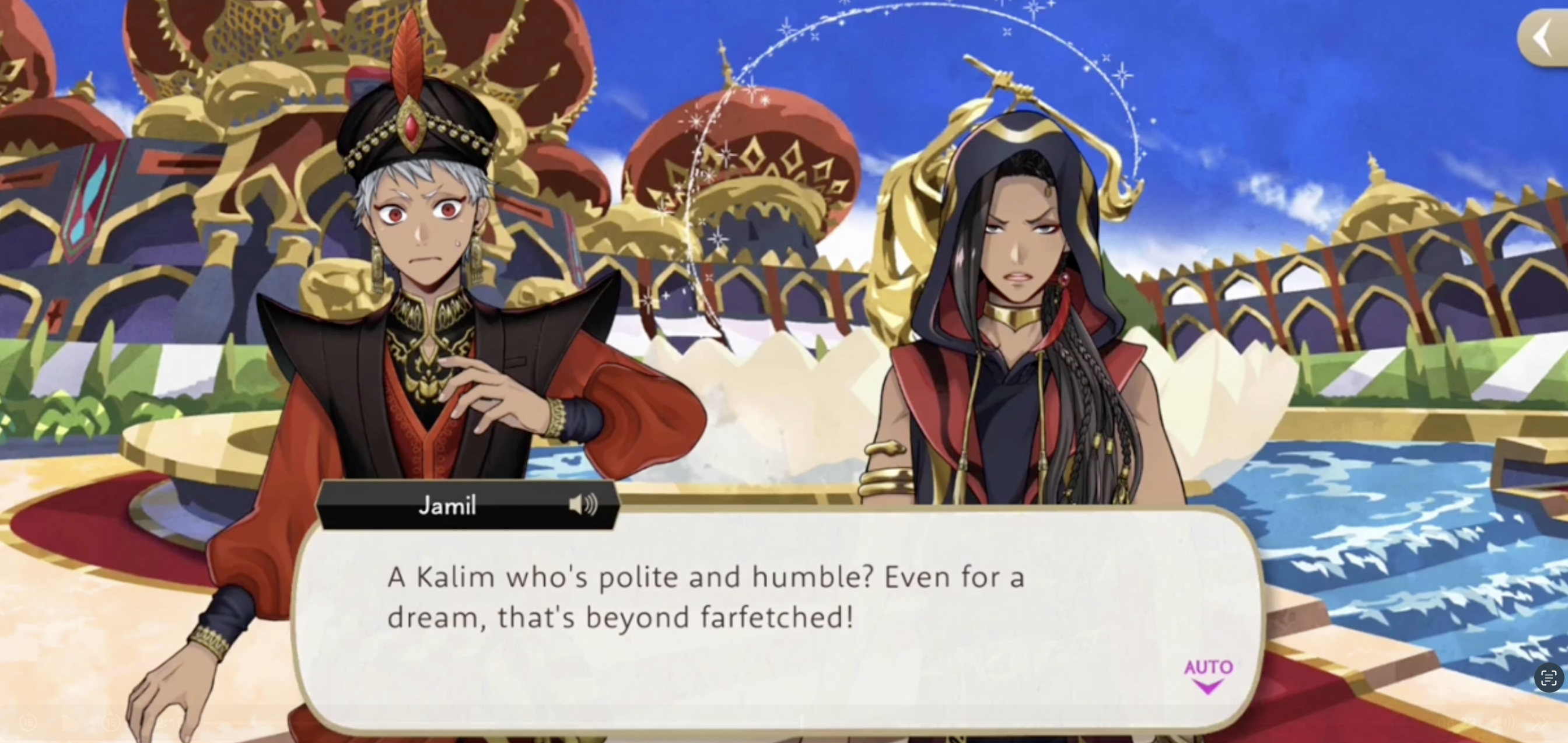
It is possible that Kalim has never actually said “please” at all in the original game:
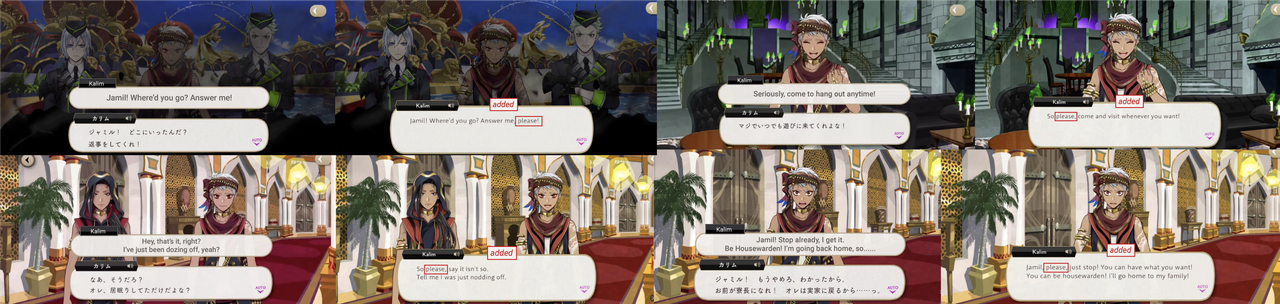
While the word will be added to his dialogue on EN, there are maybe no matching instances in the original game.
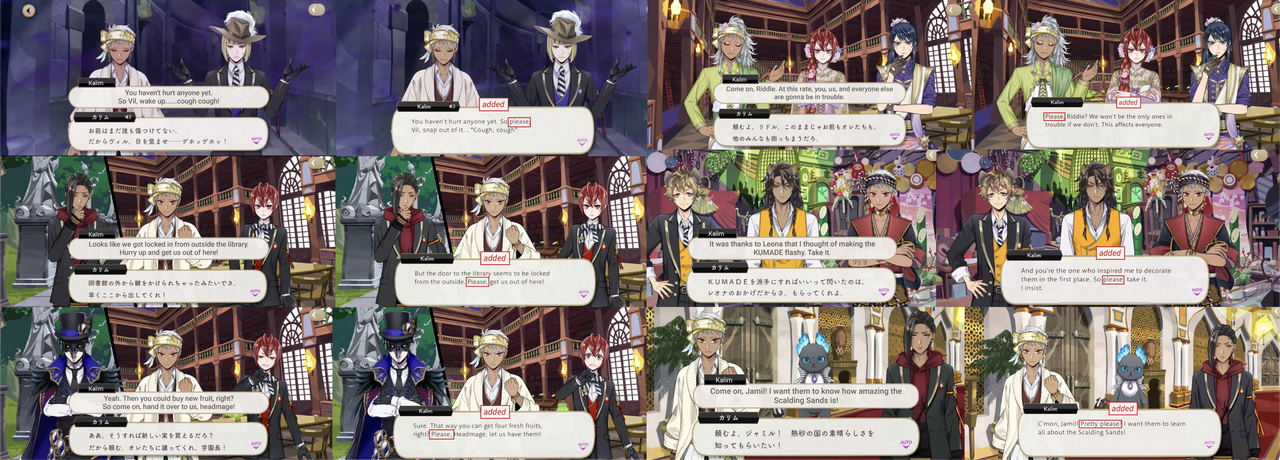
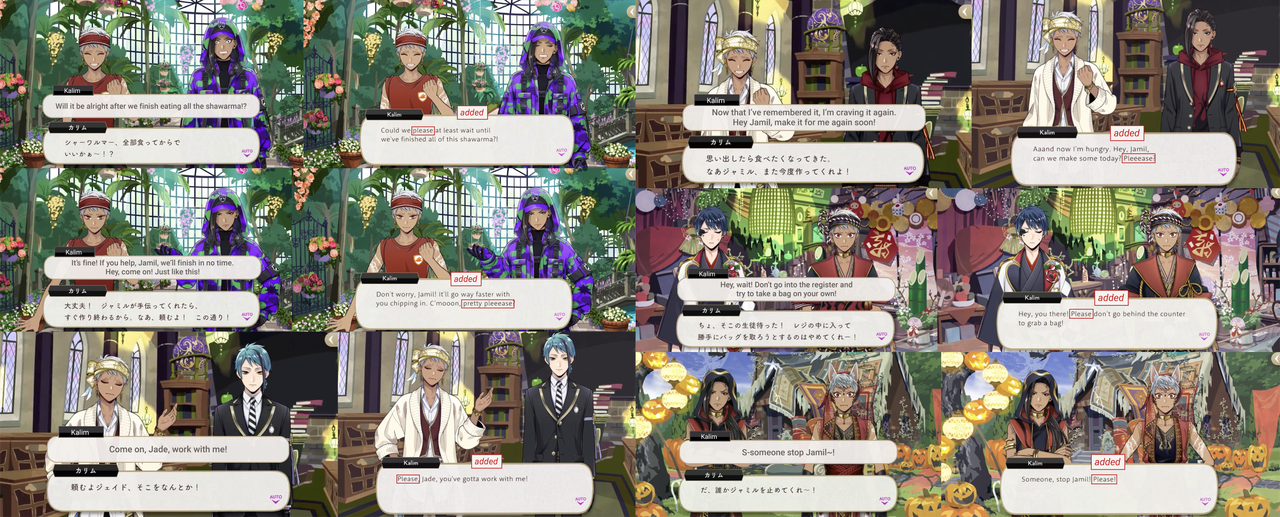
Kalim will often say 頼む (tanomu), which is something close to “Do this for me” or “I need you to do this,” it can even feel pushy/presumptive depending on context, and Kalim himself has said that he knows he can be pushy: it is a part of his character that is being represented through his speech patterns.
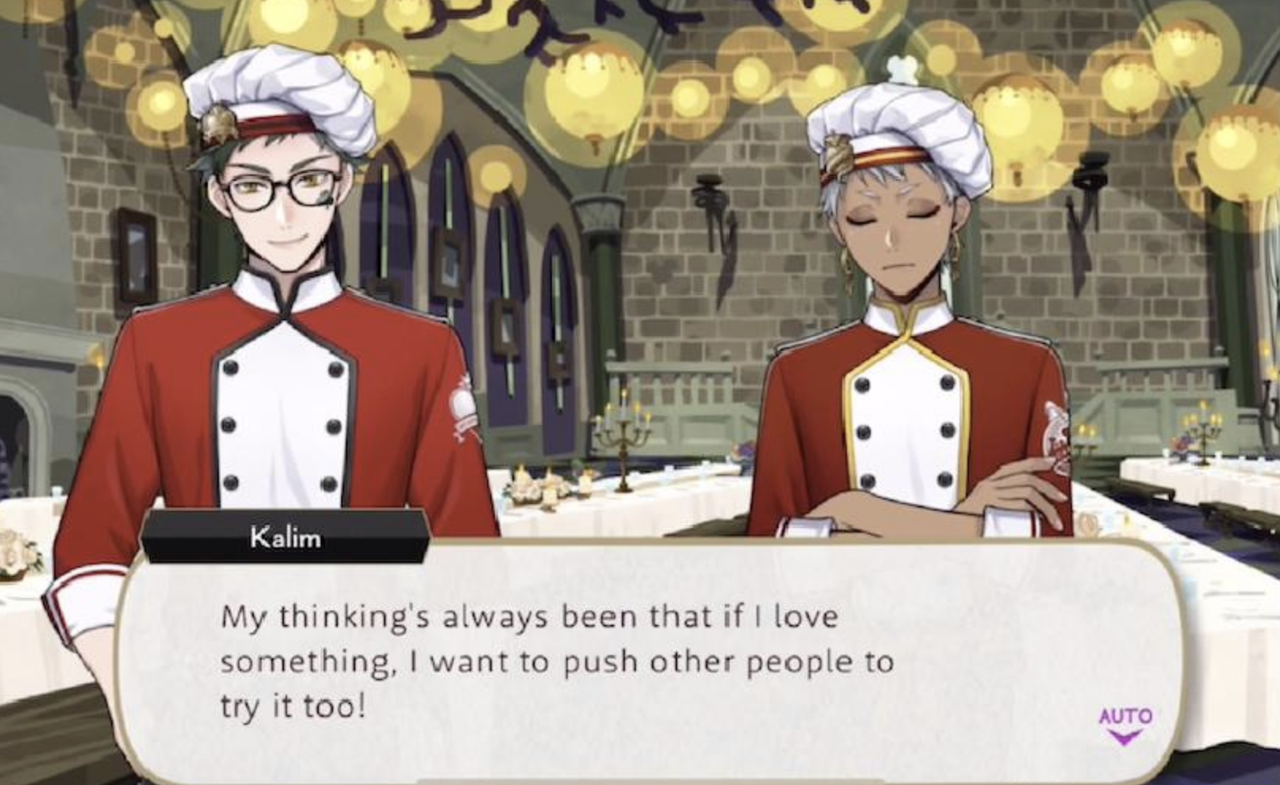
This might not be having the same effect on EN, however, where the word will sometimes be translated as “please,” but “please” is not what it means, and it is also not a polite form of the verb.
Examples:
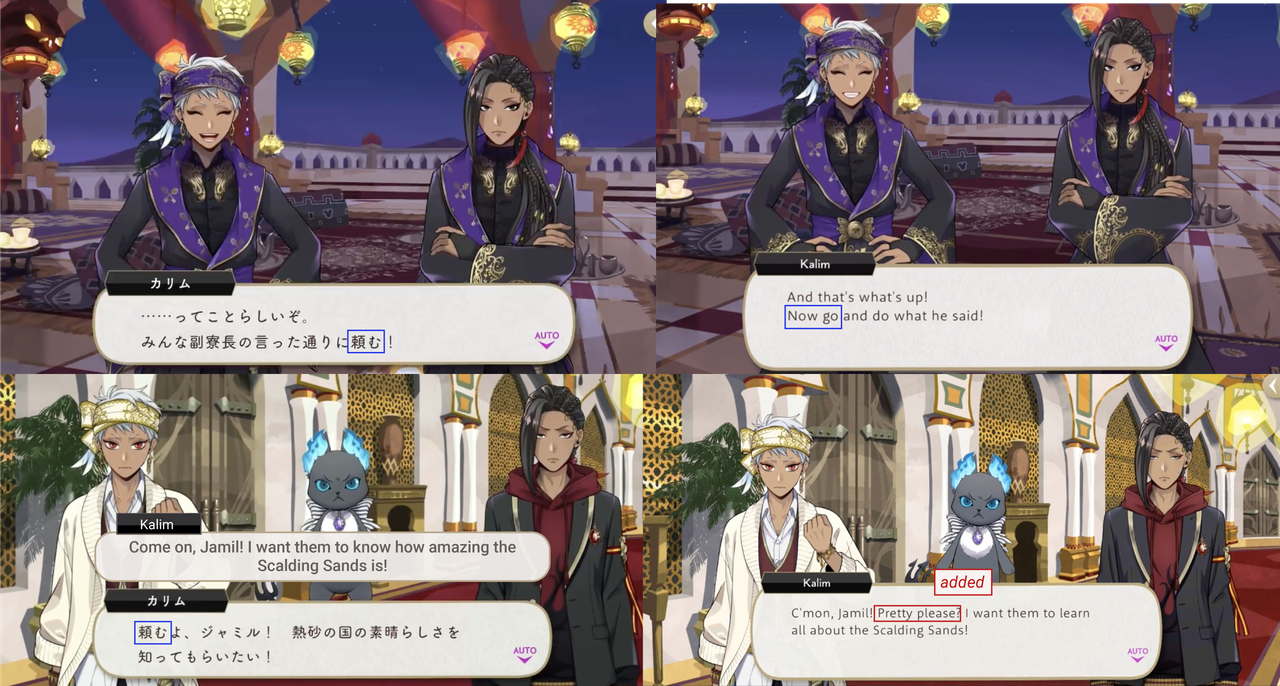
Original Kalim: Come on, Jamil! I want them to know how amazing the Scalding Sands is!
EN Kalim: C’mon, Jamil! Pretty please? I want them to learn all about the Scalding Sands!
Original Kalim: It’s fine! If you help, Jamil, we’ll finish in no time. Hey, come on! Just like this!
EN Kalim: Don’t worry, Jamil! It’ll go way faster with you chipping in. C’mooon, pretty pleeease:
There are ways in Japanese to denote politeness and humility without having to use a literal word for “please” just through polite/formal verb forms and honorifics, which Kalim also does not use.
Kalim’s go-to verb form is 「くれ」 described on this language-study site as, “…sounds rude and is only used by a few elder men.”
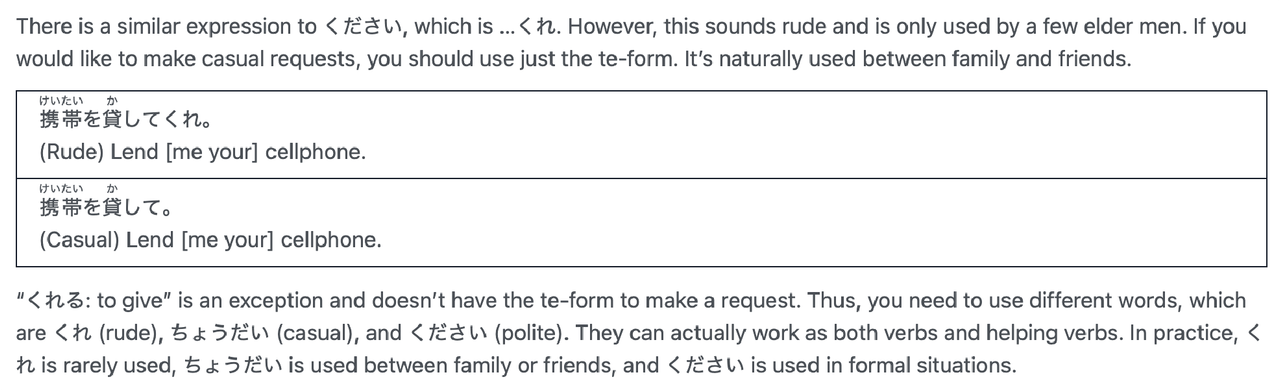
And it is that “rude” verb form that Kalim is using all of the time: as he grew up very wealthy with many servants and is used to having his needs fulfilled immediately, it is possible that his dialogue is being written as Kalim speaking as though he knows he will be obeyed rather than making requests that can be refused, even now that he is surrounded by fellow students instead of servants, because that is all he has ever known.
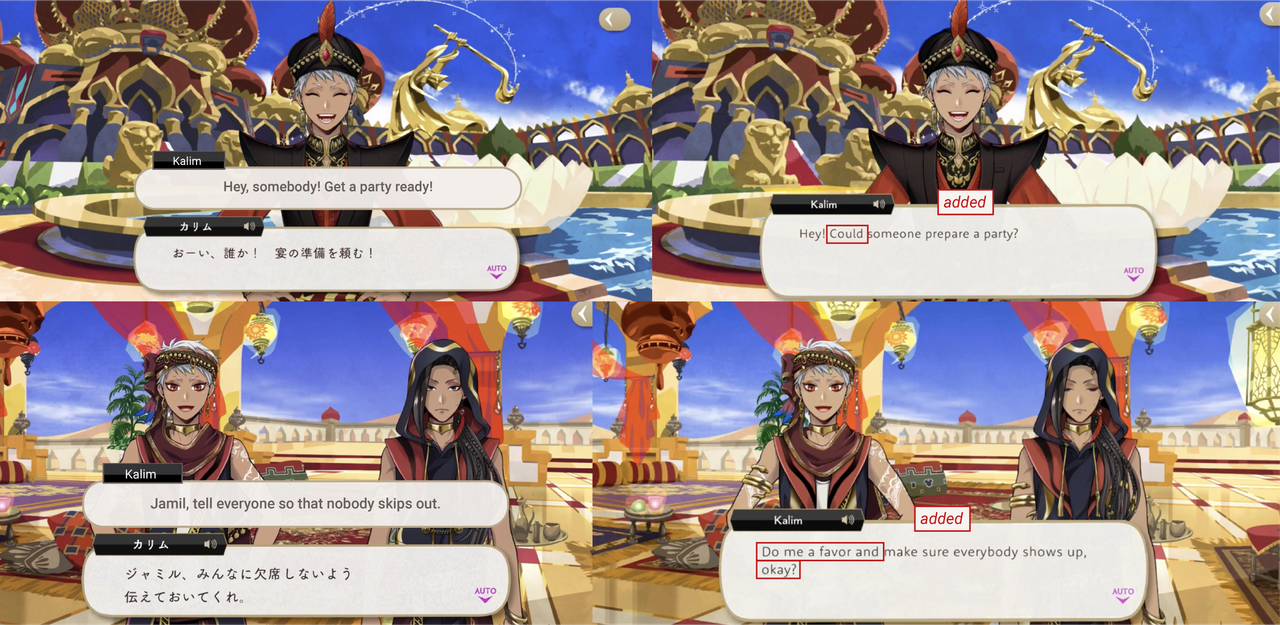
This is important to keep in mind for players on EN server, where Kalim’s dialogue will be made more polite: the localization will not just translate differently but selectively soften identical sentence structures, introducing politeness that doesn’t exist.
Examples:
Original Kalim: Tell everyone so that nobody skips out.
EN Kalim: Do me a favor and make sure everyone show’s up, okay?
Original Kalim: Come to the party.
EN Kalim: I think you should come to the party.
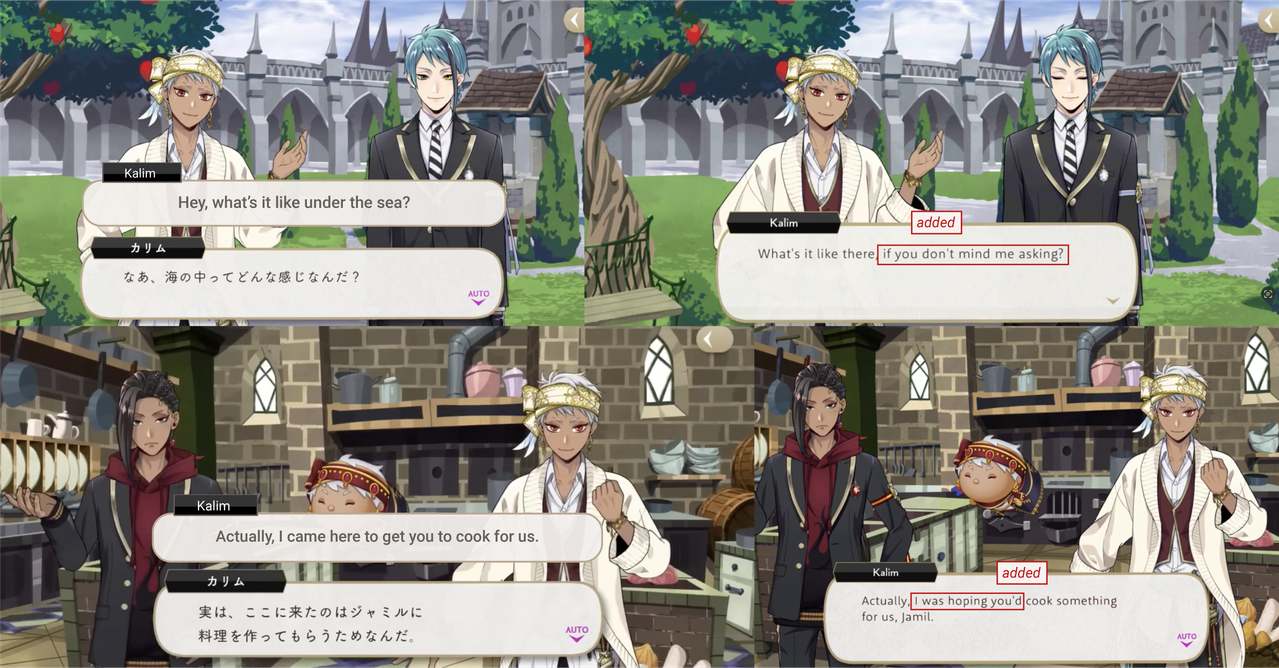
Original Kalim: What’s it like under the sea?
EN Kalim: What’s it like there, if you don’t mind me asking?
Original Kalim: I came here to get you to cook for us.
EN Kalim: I was hoping you’d cook something for us.
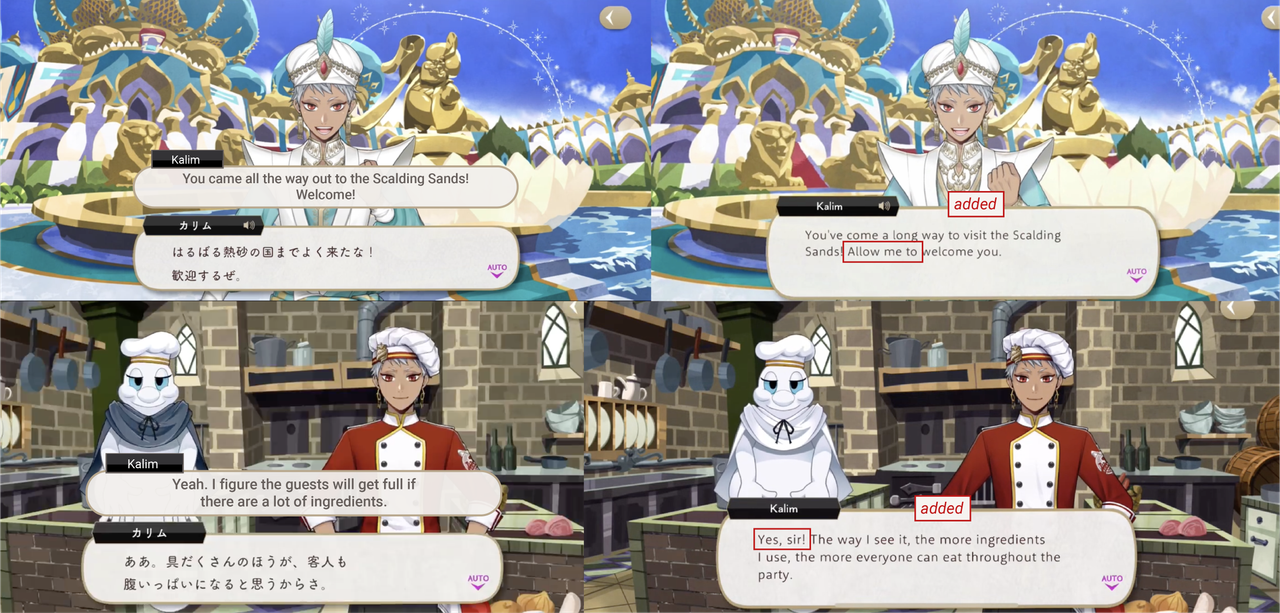
Original Kalim: Yeah.
EN Kalim: Yes, sir!
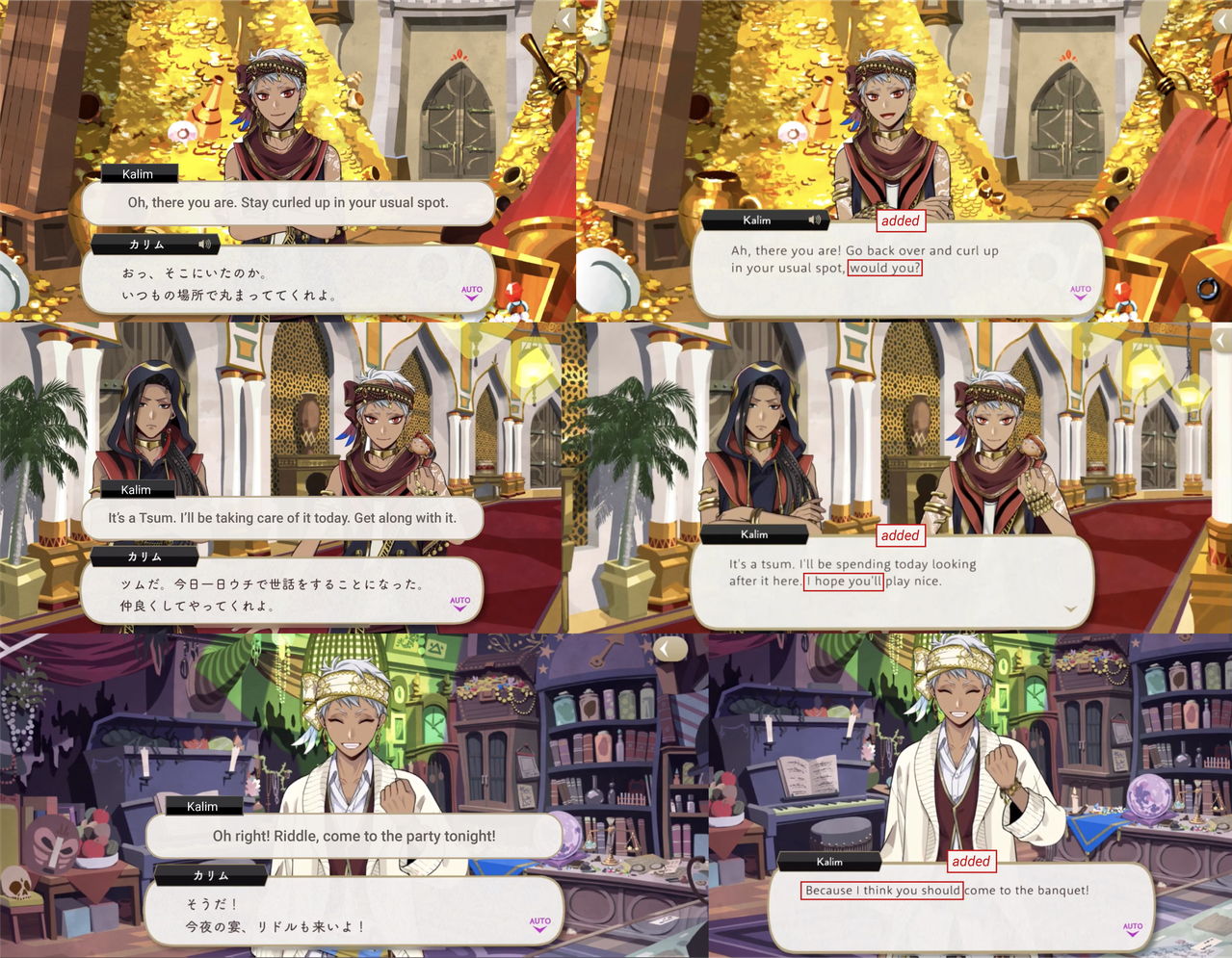
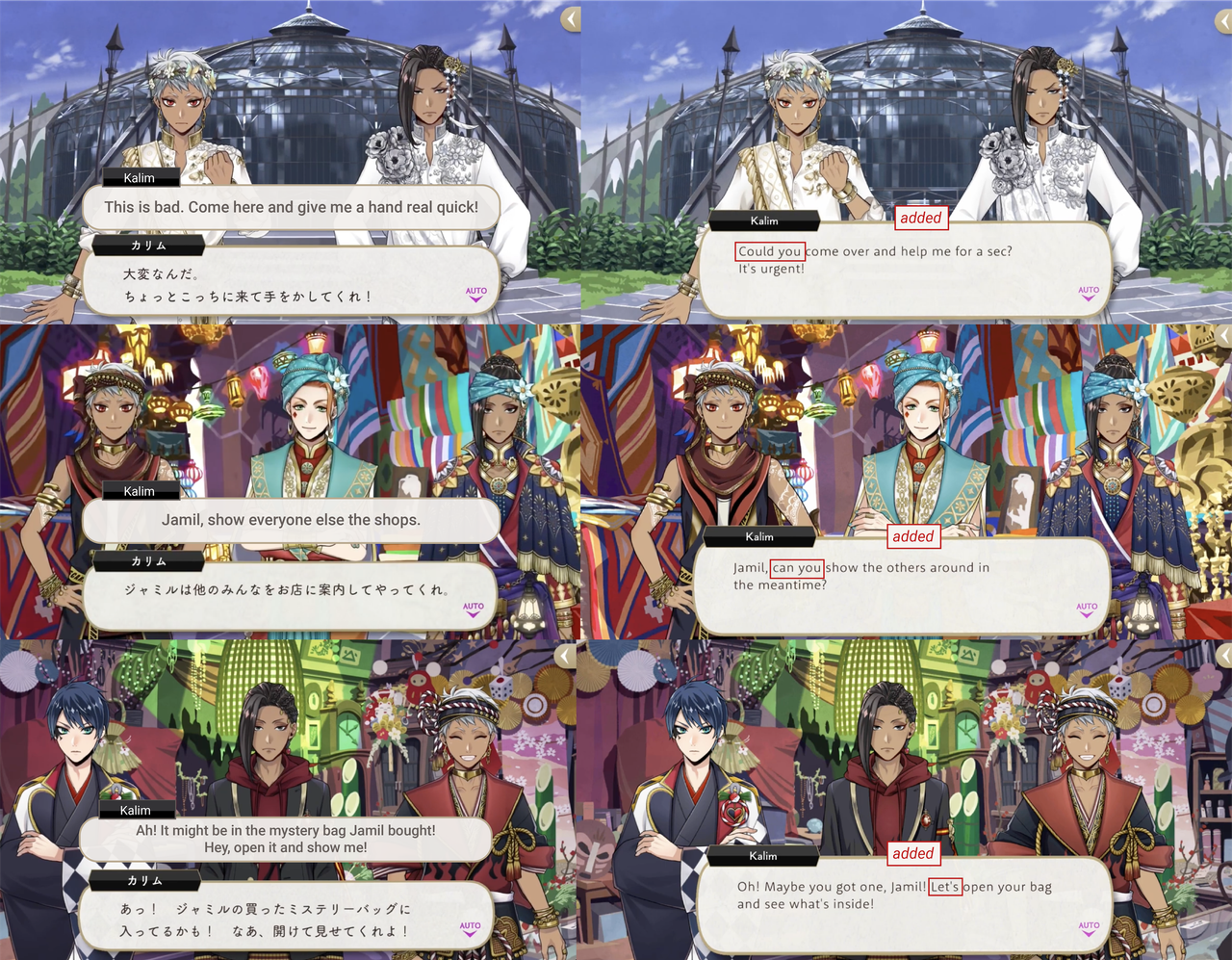
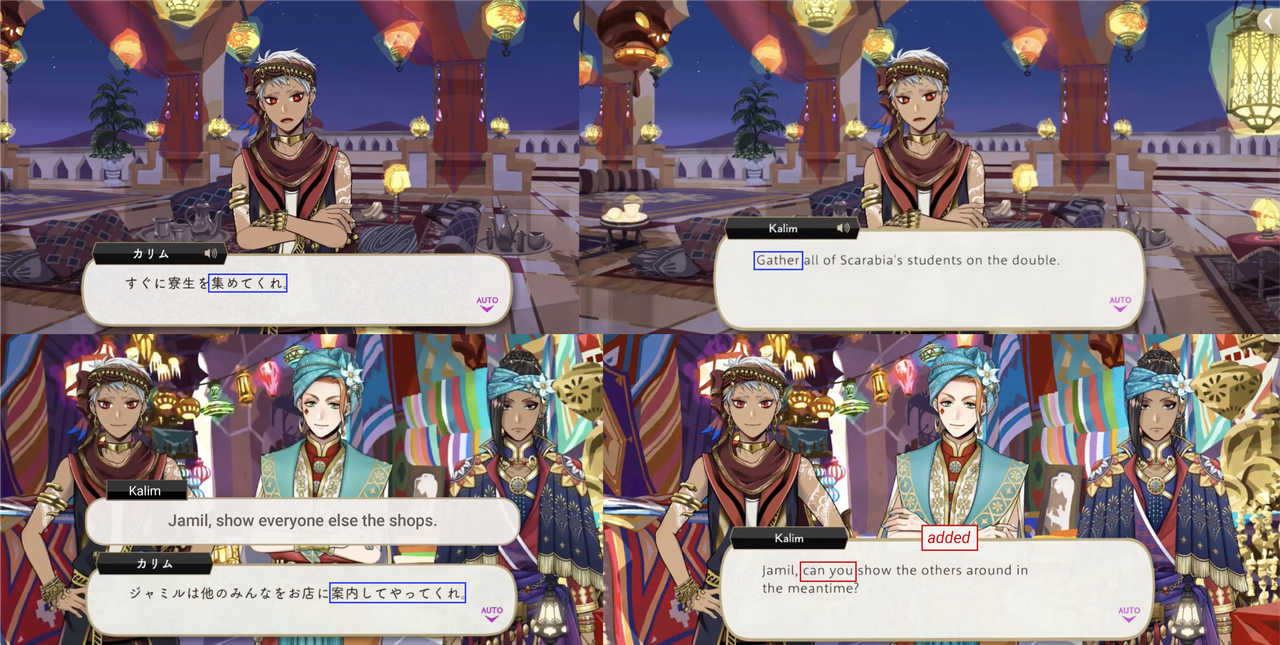
When Kalim is being hypnotized by Jamil his authoritative phrase, “Gather all of Scarabia’s students,” was translated correctly, but when Kalim uses the same verb form in Firelit Sky it was softened to him asking Jamil “Can you (do this)?,” despite being phrased the same way.
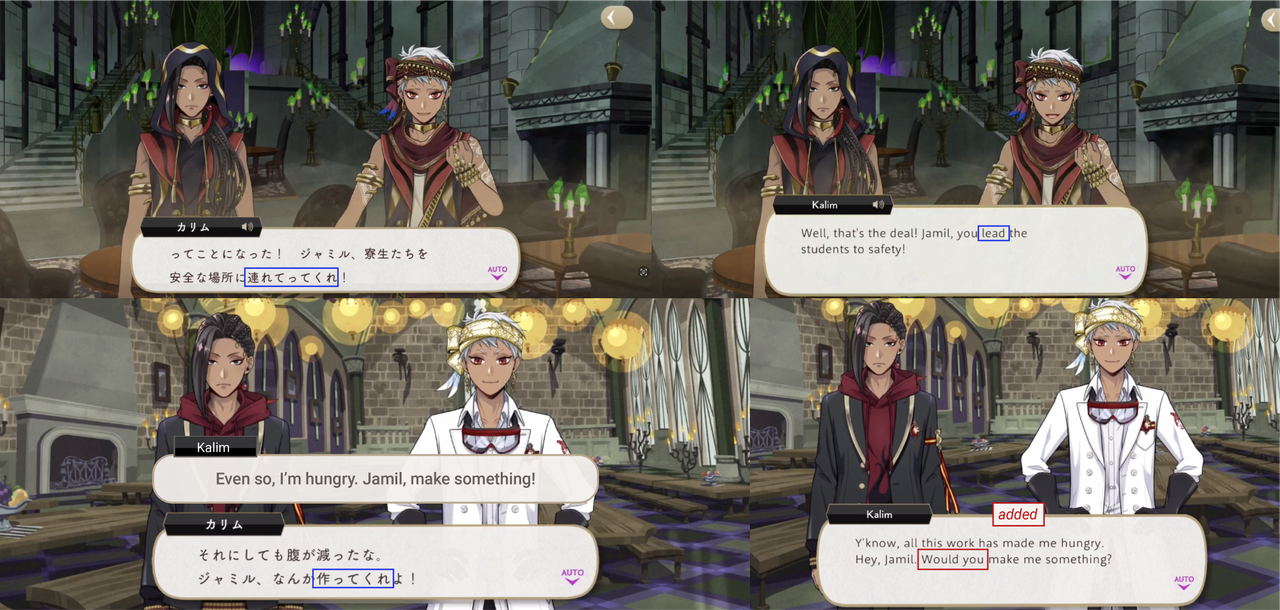
When Kalim tells Jamil to lead the student to safety in Book 7 it was translated accurately for EN, but identical phrasing in a vignette was changed to, “Would you (do this)?”, instead, as though Jamil had the option of refusing, when both times he is speaking with authority in his original dialogue.
At least twice in the game it has been insinuated that the near-constant attempts on Kalim’s life may be coming from within his own family, and Kalim has either intentionally chosen not to acknowledge the possibility or legitimately not heard the comment: except on EN.

When Jamil hears an explosion and asks, “Don’t tell me it was a treacherous scheme by one of your Asim relatives…!” Kalim responds with “Nothing so sinister” on EN, but this was added to his dialogue.
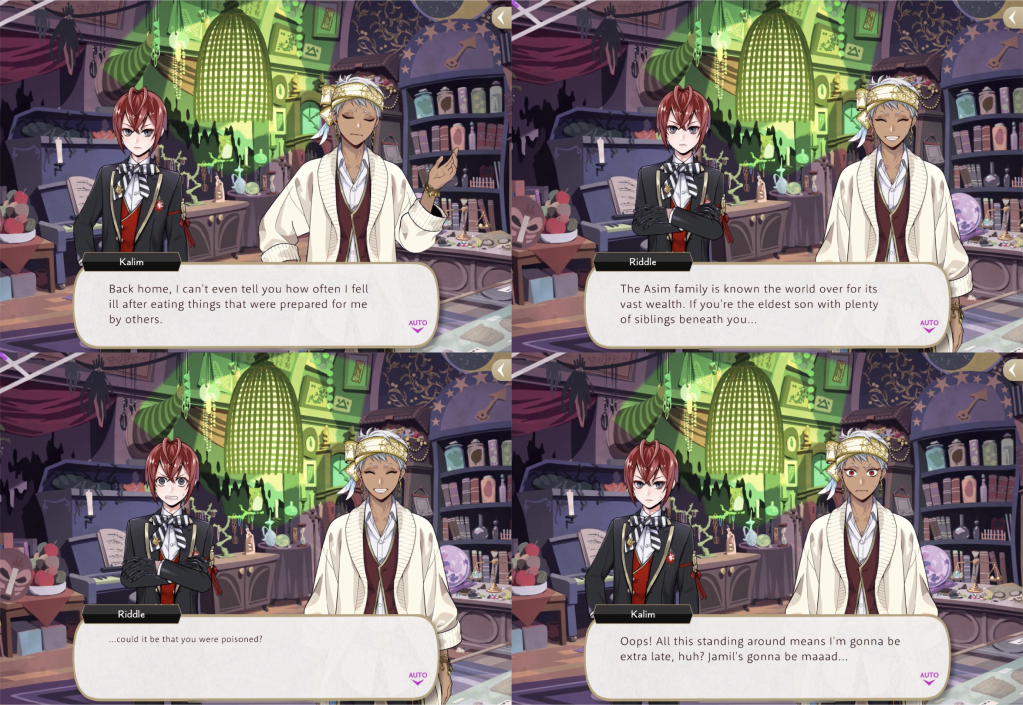
In the original game Kalim does not confirm that he has heard the comment at all. It is possible that he didn’t (and Jamil’s dialogue is written in smaller text to imply a lower tone of voice), but it is also possible that he did and is choosing to ignore it, maybe because he does not wish to acknowledge the possibility that a member of his own family would try to harm him?
(There is a similar pattern in another vignette with Riddle, localized accurately for EN.)
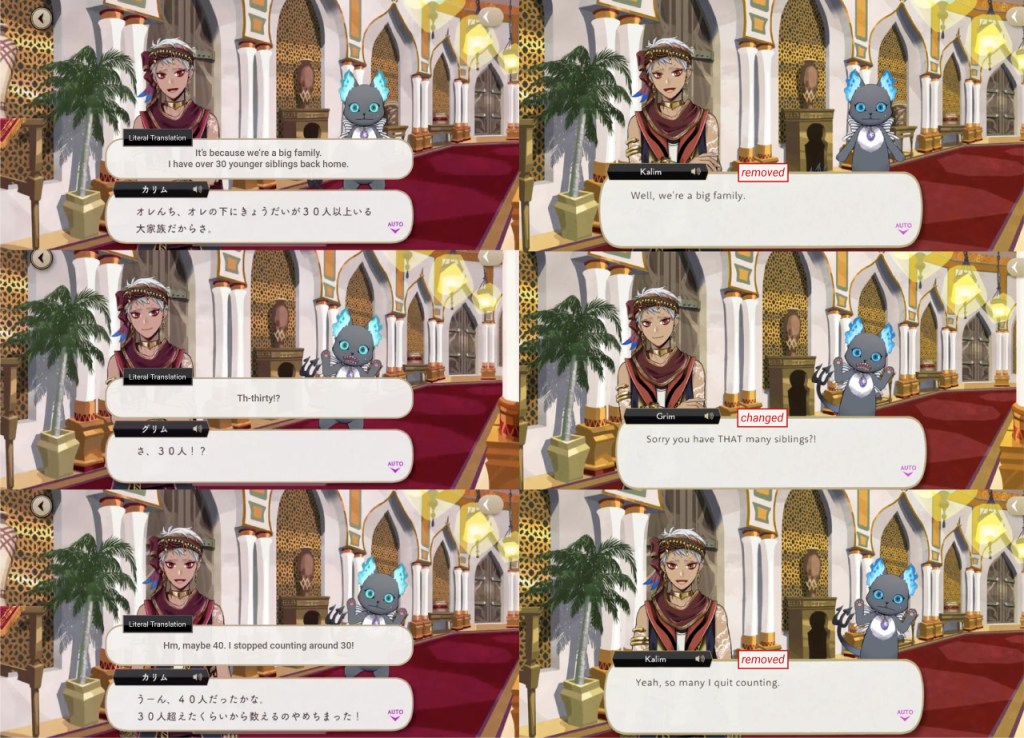
Original Kalim: It’s because we’re a big family. I have over 30 younger siblings back home.
EN Kalim: Well, we’re a big family.
Original Grim: Th-thirty!?
EN Grim: Sorry you have THAT many siblings!?
Original Kalim: Hm, maybe 40. I stopped counting around 30!
EN Kalim: Yeah, so many I quit counting.
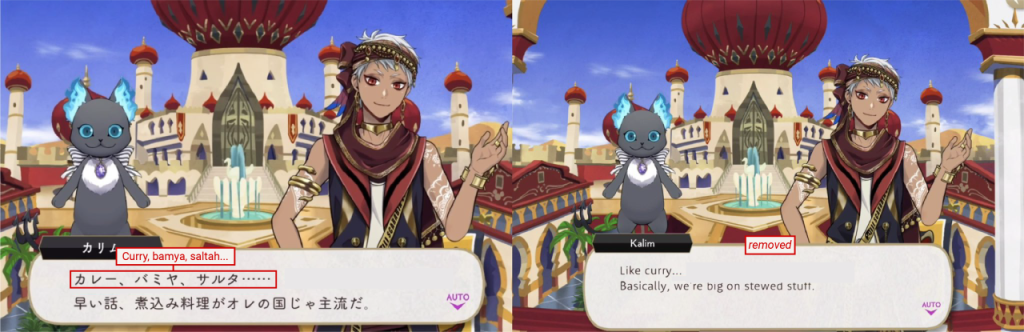
Kalim had “bamya” and “saltah” removed from his dialogue.

Original Kalim: Hello… wait, hey there. What’s wrong? You look really down.
EN Kalim: Whoa, you practically sighed out that hello. You sound about as blue as that hair of yours.
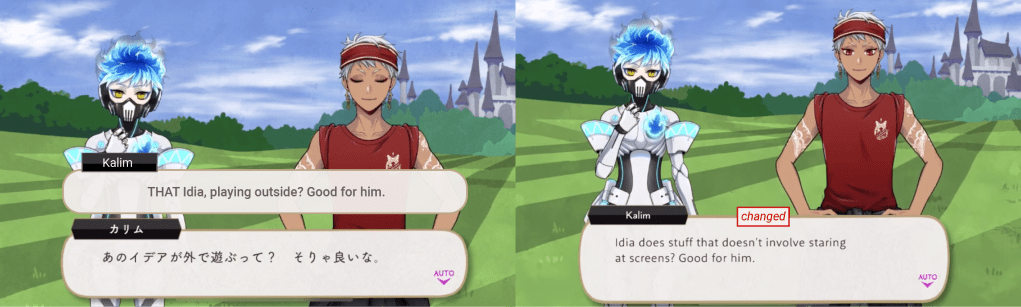
Original Kalim: THAT Idia, playing outside? Good for him.
EN Kalim: Idia does stuff that doesn’t involve staring at screens? Good for him.
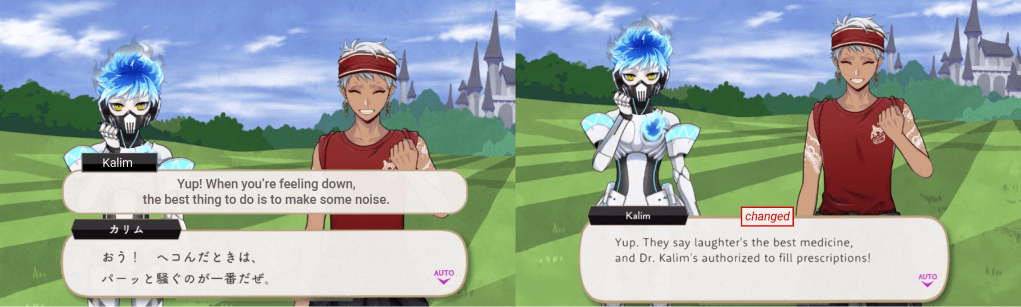
Original Kalim: Yup! When you’re feeling down, the best thing to do is to make some noise.
EN Jalim: Yup. They say laughter’s the best medicine, and Dr. Kalim’s authorized to fill prescriptions!
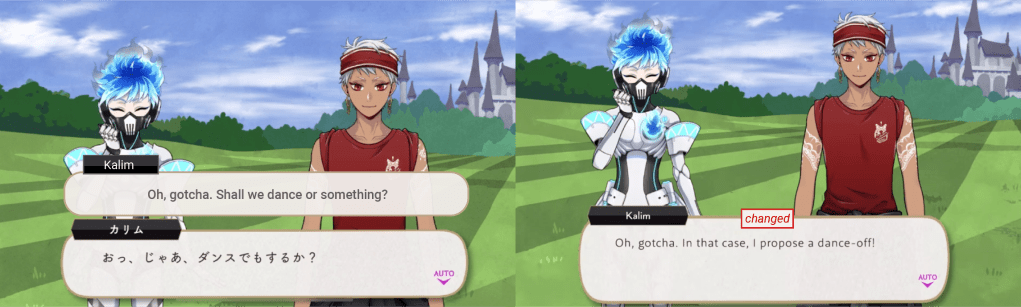
Original Kalim: Oh, gotcha. Shall we dance or something?
EN Kalim: Oh, gotcha. In that case, I propose a dance-off!
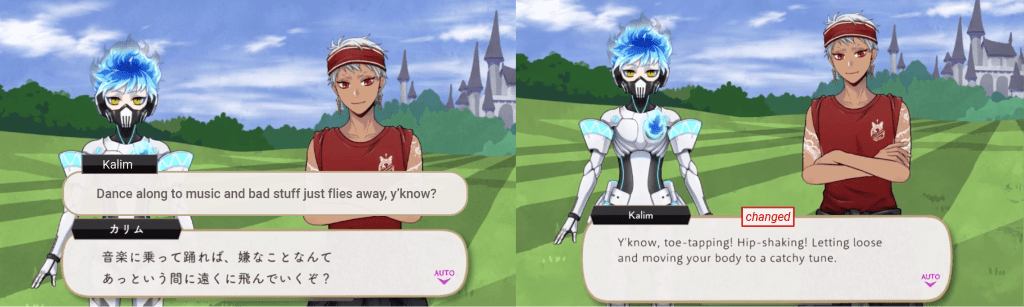
Original Kalim: Dance along to music and bad stuff just flies away, y’know?
EN Kalim: Y’know, toe-tapping! Hip-shaking! Letting loose and moving your body to a catchy tune.
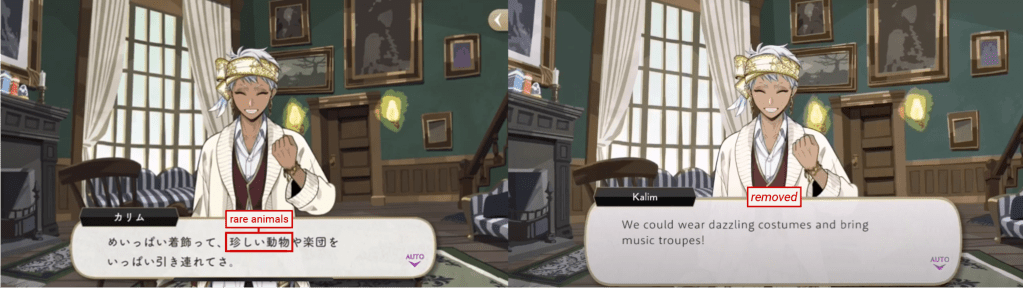
An affinity with animals is a part of Kalim’s character, but his idea of solving the Fairy Gala issue with a parade of rare animals was removed from his dialogue.
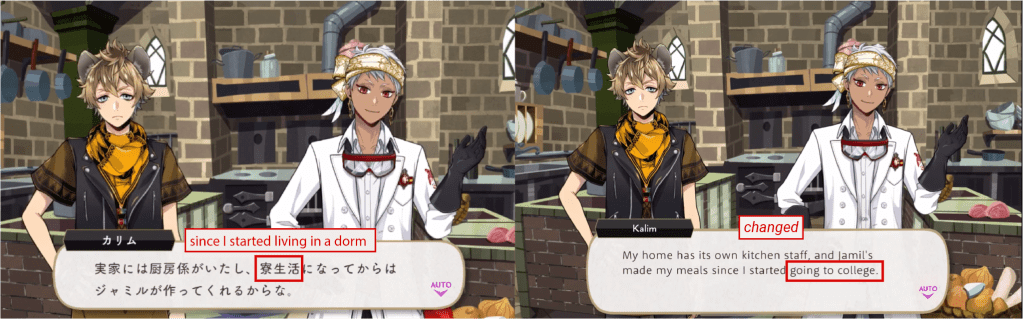
In the English-language adaptation of the game Kalim says that Jamil has been making all of his meals since he “started going to college,” but this was added to his dialogue and is not something he has ever said.
When the characters refer to the school in the original game, they only ever call it a high school. More here →
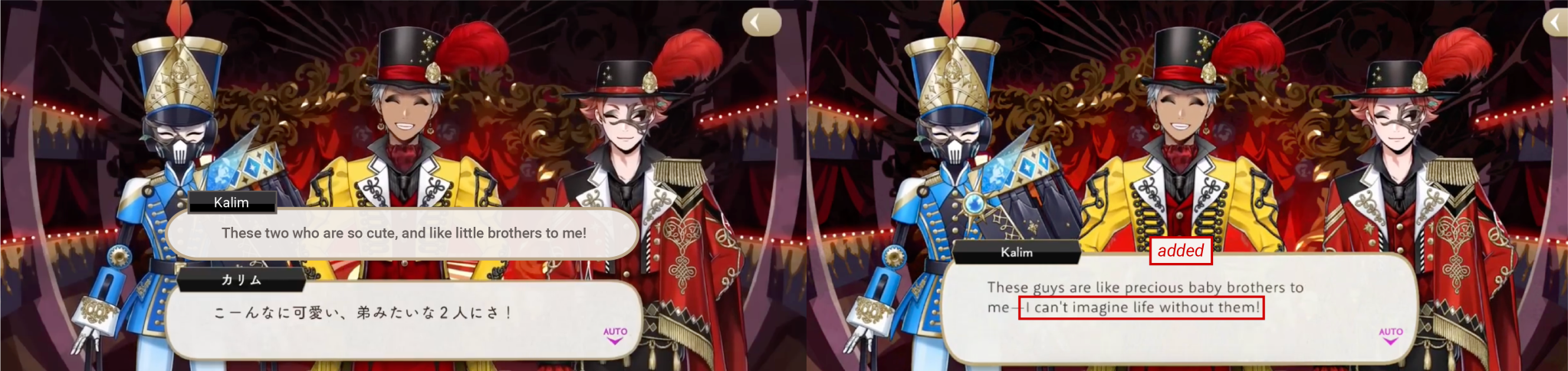
Original Kalim: These two who are so cute, and like little brothers to me!
EN Kalim: These guys are like precious baby brothers to me–I can’t imagine life without them!
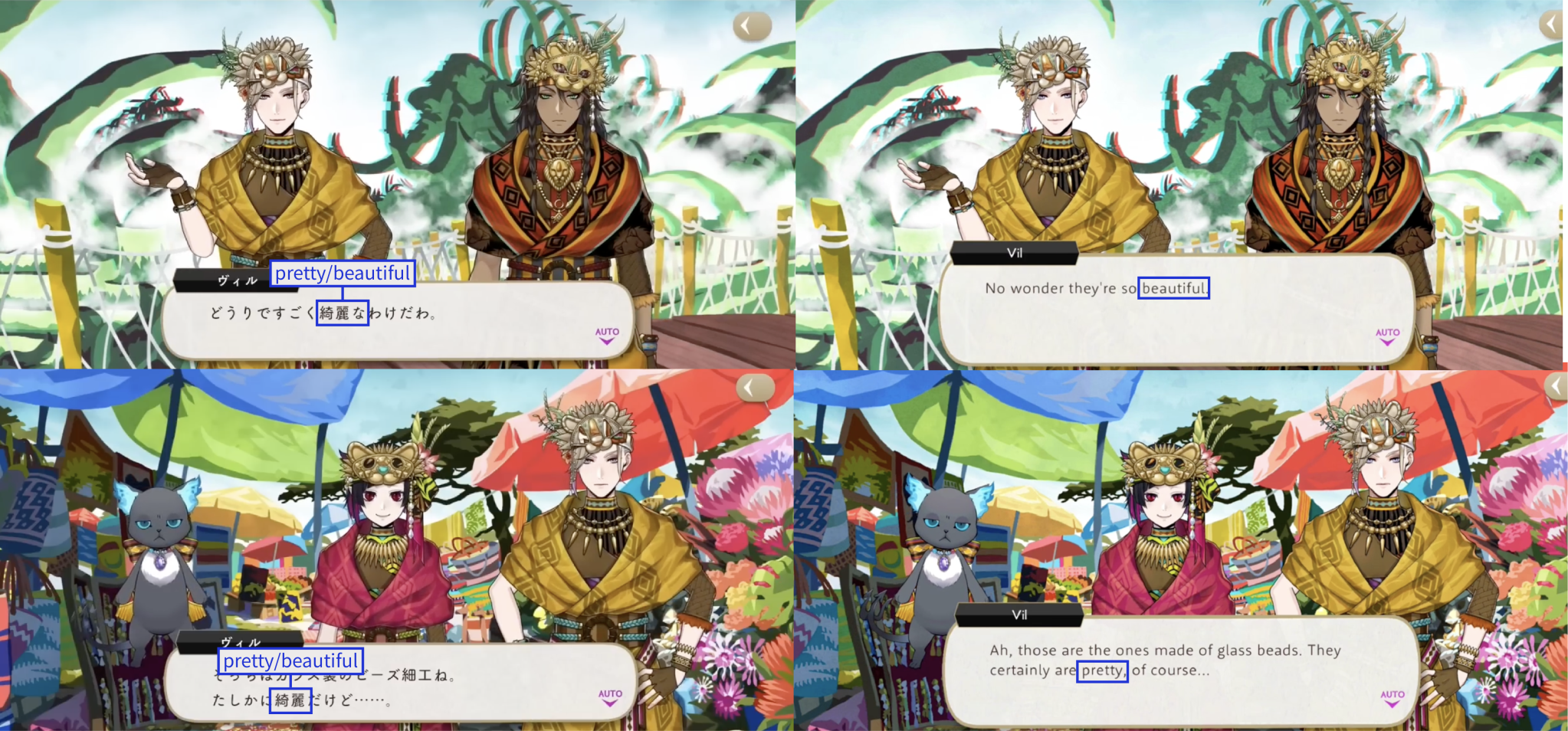
The word 綺麗 (きれい / kirei) can mean beautiful or pretty depending on context, and EN uses both interpretations during the event.
This make the choices made with Kalim’s discovery of bracelets (changed to rings on EN) all the more interesting:

Original Kalim: Ah! This bracelet is so shiny and pretty!
EN Kalim: Wow! Look at this sparkly ring!
Original Lilia: Jamil “too”? Are you giving one to someone else, as well?
EN Lilia: “Especially”? Who else are you getting these rings for?
Original Kalim: Yeah! Receiving something so pretty will make them happy.
EN Kalim: Of course! They love shiny things.
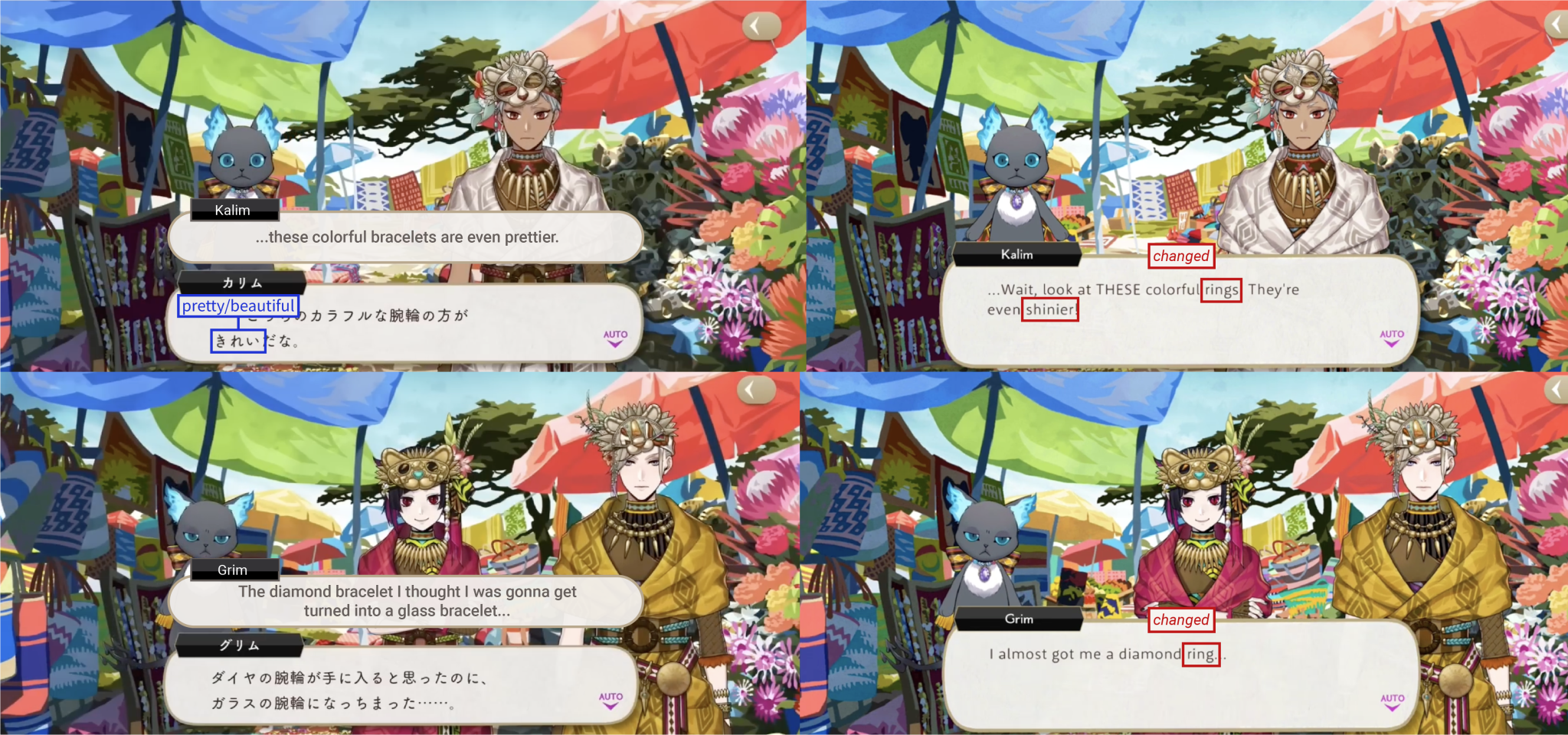
Original Kalim: …these colorful bracelets are even prettier.
EN Kalim: …Wait, look at THESE colorful rings. They’re even shinier!
Original Grim: The diamond bracelet I thought I was gonna get turned into a glass bracelet…
EN Grim: I almost got me a diamond ring…

Original Kalim: They’re all colorful and shiny, so pretty~.
EN Kalim: They’re all colorful and sparkly!
(After removing the word “beautiful/pretty” from Kalim’s dialogue in the Cloudcalling event), it returned in Chapters 2 and 5 of Playfulland.)
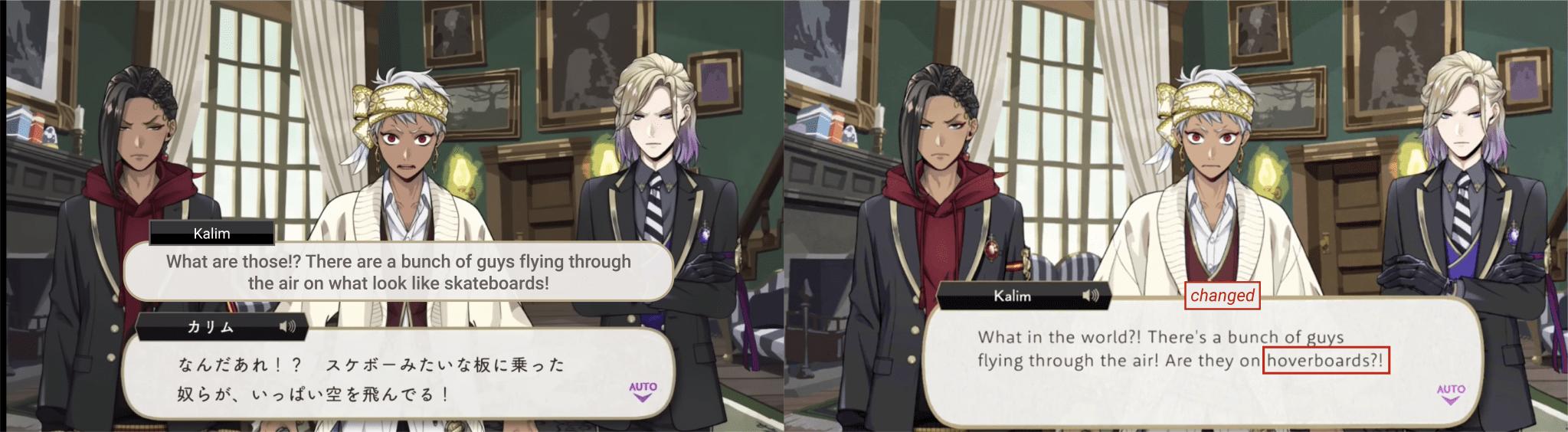
In the English-language game, Kalim references hoverboards as if they are an established technology in the Twisted Wonderland universe. But in the original game Kalim does not seem to know what hoverboards are, and refers to them as flying skateboards.
This may imply that Kalim is unfamiliar with the concept of hoverboards and they may actually be special STYX technology rather than something with which everyone is familiar.

