

Original Cater: ……
EN Cater: Sec. Cay-Cay’s gotchu.

Original Lilia: You humans. You have enraged my master…
EN Lilia: Foolish humans. You have incurred a wrath beyond your reckoning.

Original Lilia: Ma-master?
EN Lilia: W-wrath?
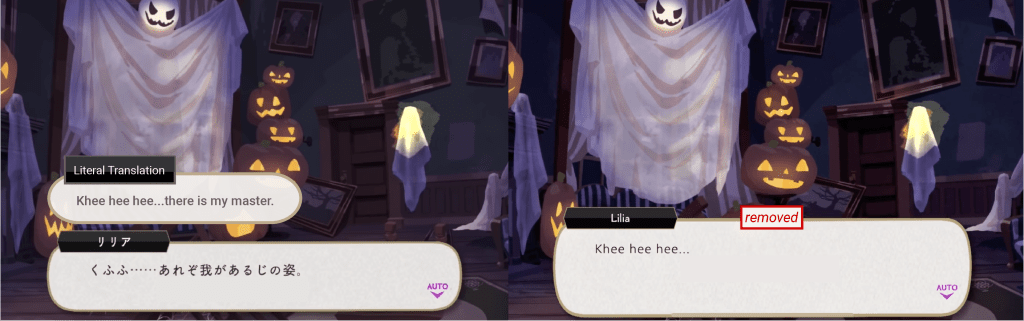
Original Lilia: Khee hee hee… there is my master.
EN Lilia: Khee hee hee…
Lilia isn’t giving just any warning about wrath: it is brilliant wordplay. Lilia’s line is “gekirin ni fureta”, which is an expression that refers to dragons and emperors, adopted from a Chinese proverb (possibly from the Han Feizi itself.
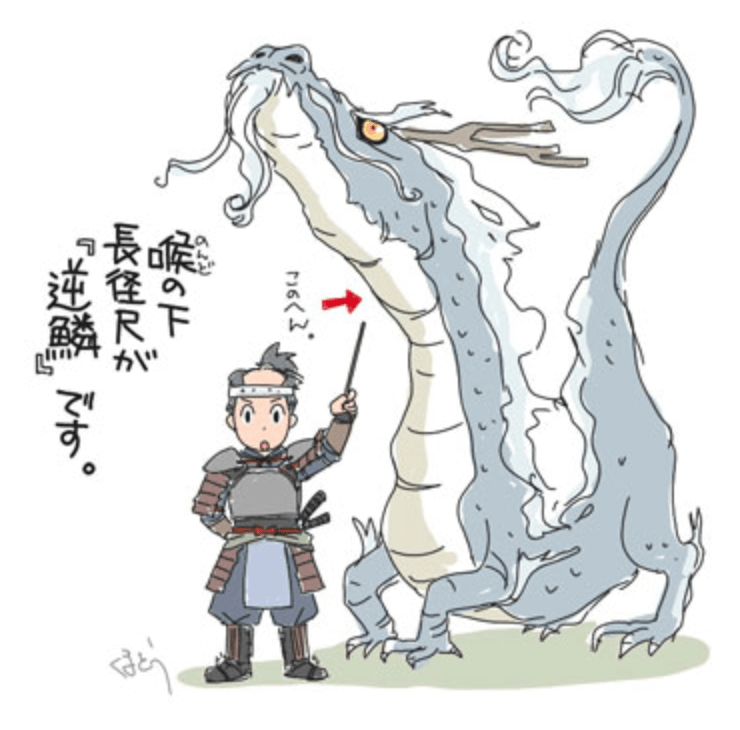
“Gekirin ni fureta” means “to touch the upside down scale,” thus making a dragon violently angry. It is a phrase used to express that someone or something has made one’s superior furious.
The word “dragon” refers to “emperor,” and it is a phrase that anyone can use to refer to their boss being angry, and all it means is just that: something or someone has enraged a figure of authority.
But Malleus is not only Lilia’s superior, he is also an actual king/emperor and a literal dragon dressed as a Chinese long who has become enraged because people touched him, turning this everyday expression into multi-layered wordplay.

Rook does not say “omelette du fromage” before taking the picture of Vil, Malleus, Leona and the party guests, together.
He says “cui cui” which I looked up and Google says that it is both the sound that birds make and what is said by French speakers before taking a picture.

…but, there were only Japanese-language explanations, and no English- or French-language explanations to support it, which was suspicious.
I reached out to a French speaker who told me that “I’ve never heard someone say cui cui before a picture, but it is the sound birds make. An older fashioned way to say you’re taking a picture though is ‘le petit oiseau va sortir’, which means ‘the little bird is coming out’.”
So it seems like it might be a uniquely Japanese-language interpretation of the French-language equivalent of the English-language “say cheese”?
 Twisted Wonderland Reference Note