

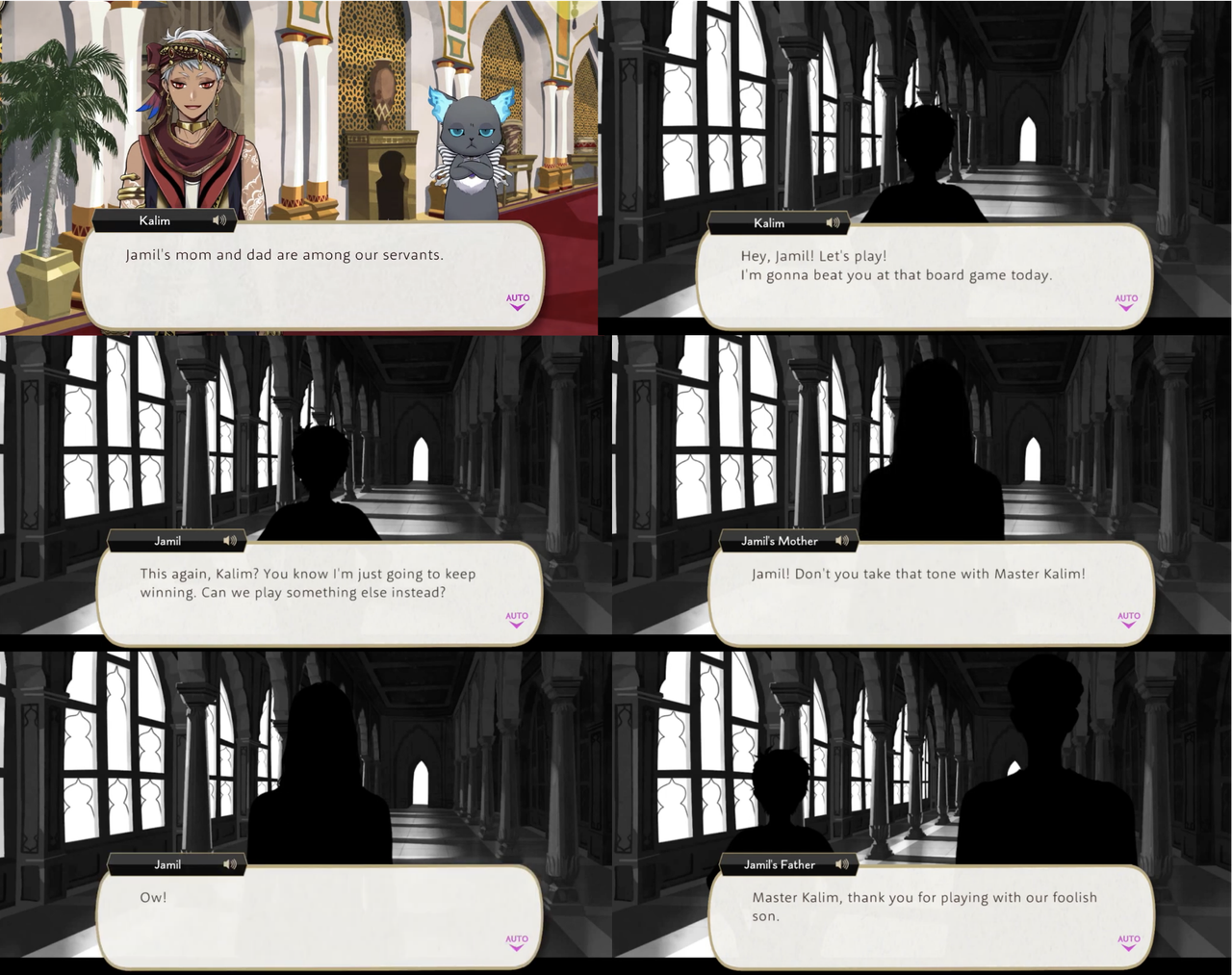
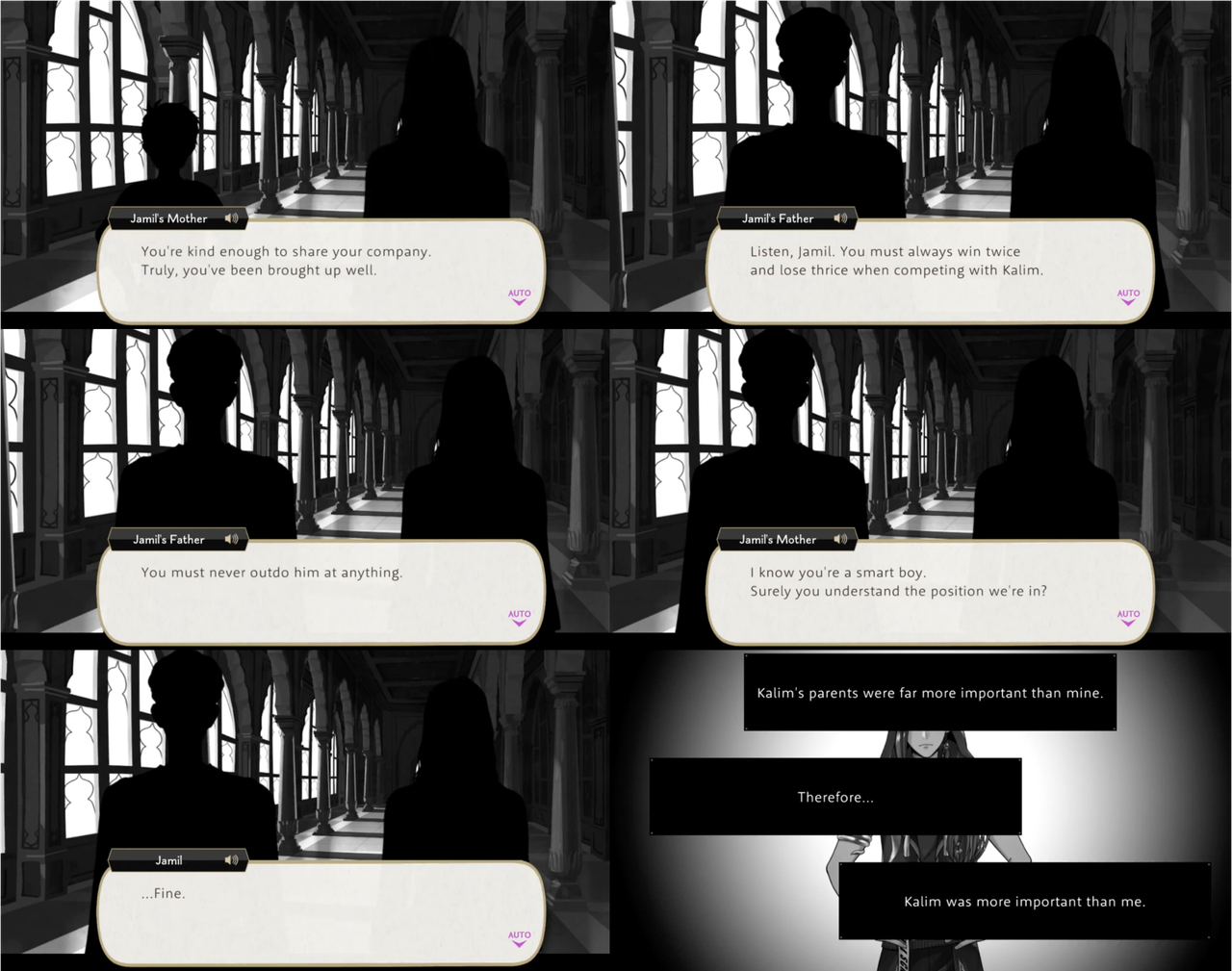
Jamil’s parents are servants for the Asim household, and in a flashback we see them call Jamil “foolish” in front of Kalim, only to turn around and assure Jamil that he is “a smart boy.” This has possibly helped shape Jamil distinguishing between what is said publicly and what is said privately.
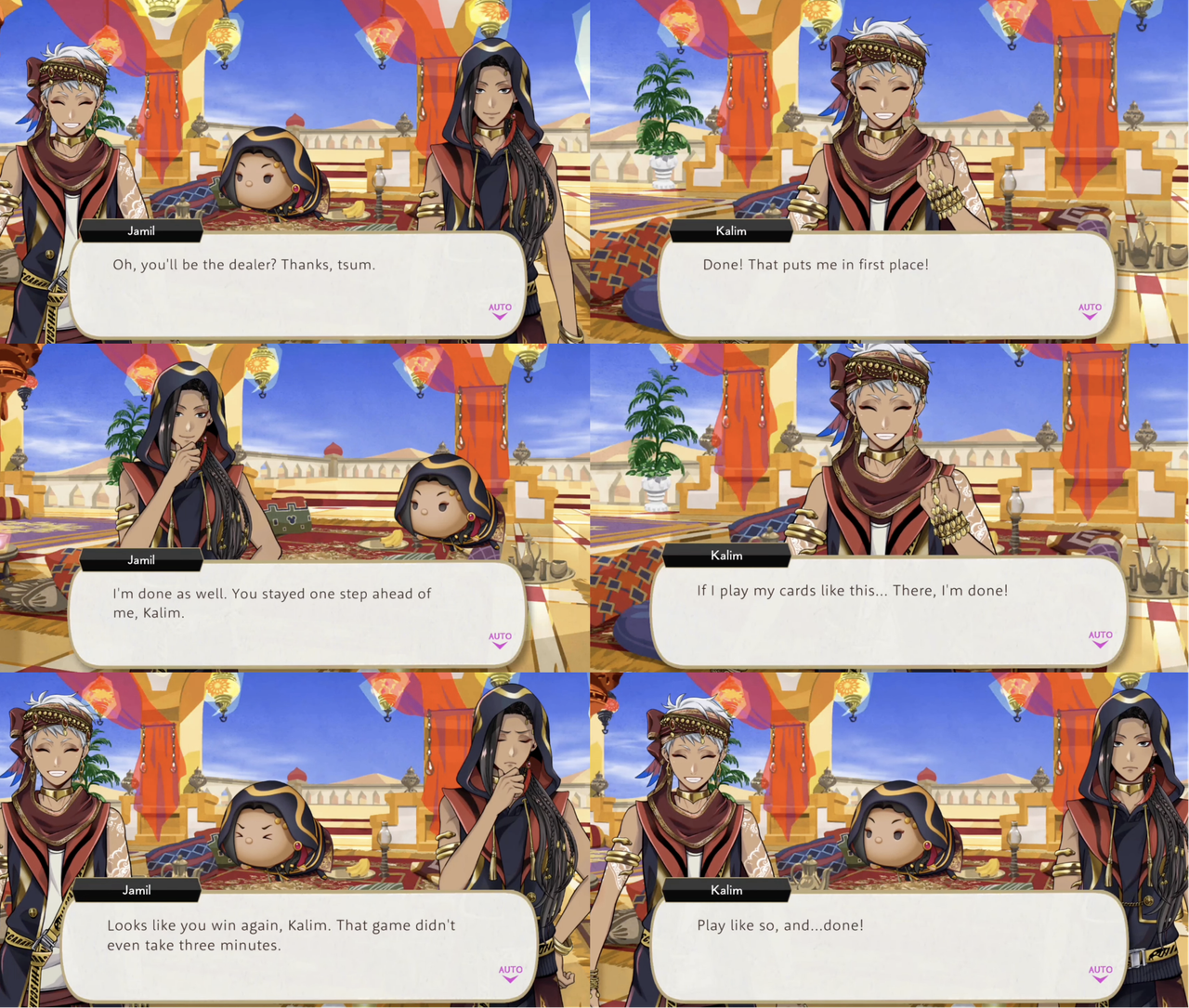
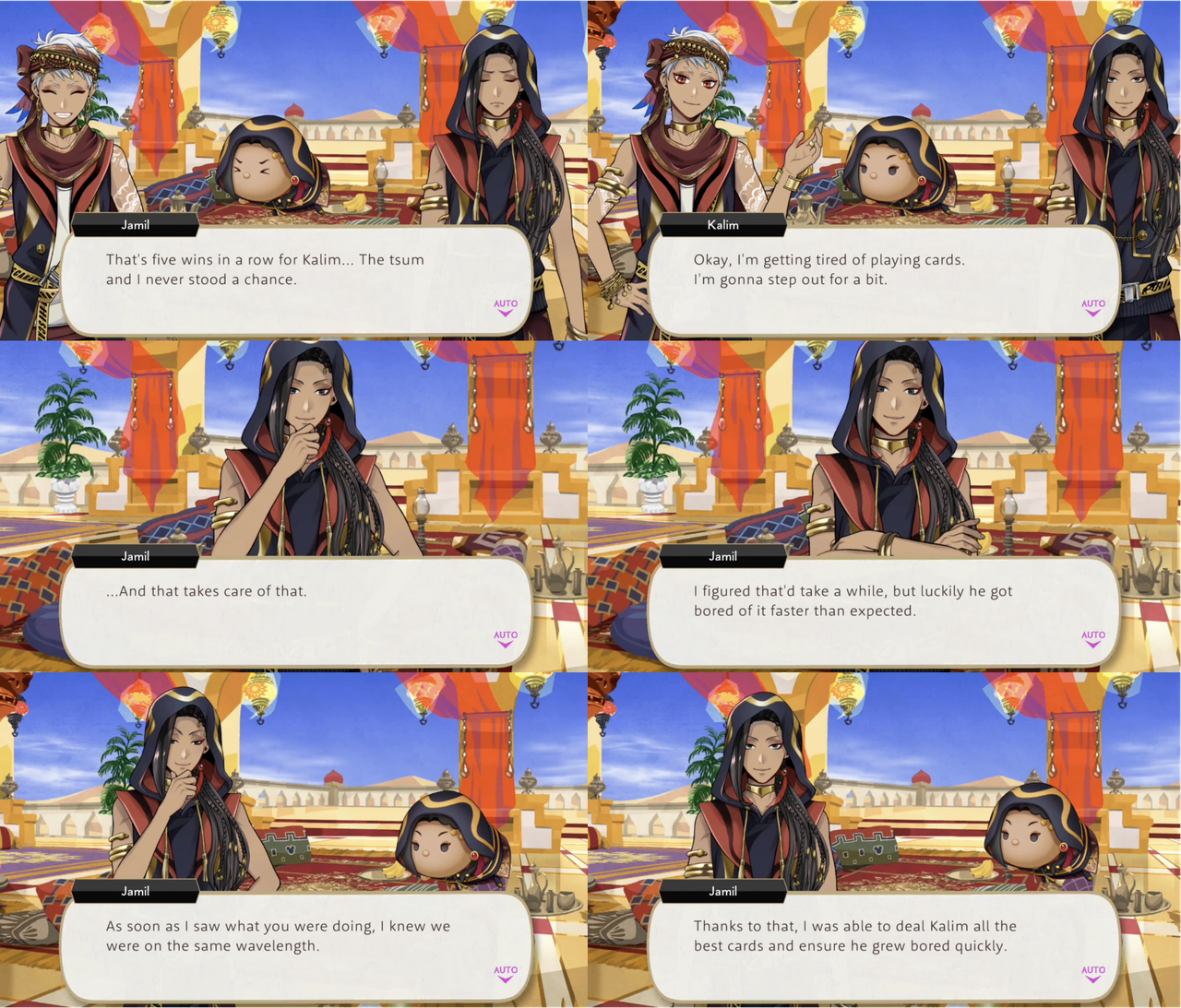
In a Tsumsted vignette we see Jamil compliment Kalim on his card-playing (“The tsum and I never stood a chance”), only to reveal that he and the tsum had been intentionally losing so that Kalim would get bored and quit.
This scene seems to be in close parallel to the flashback where Jamil is scolded for refusing to play a game that he is adept at with Kalim, with his parents ordering him to intentionally lose.
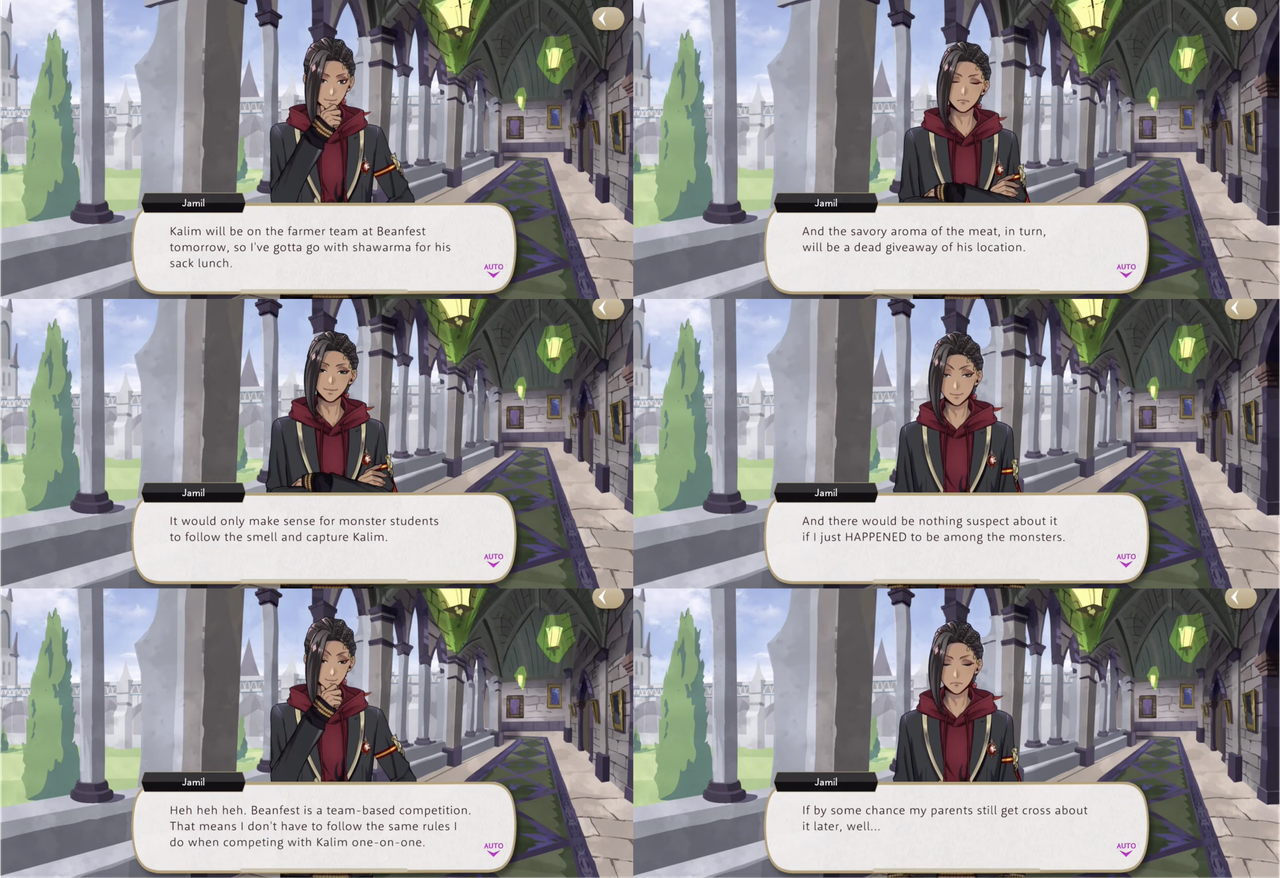
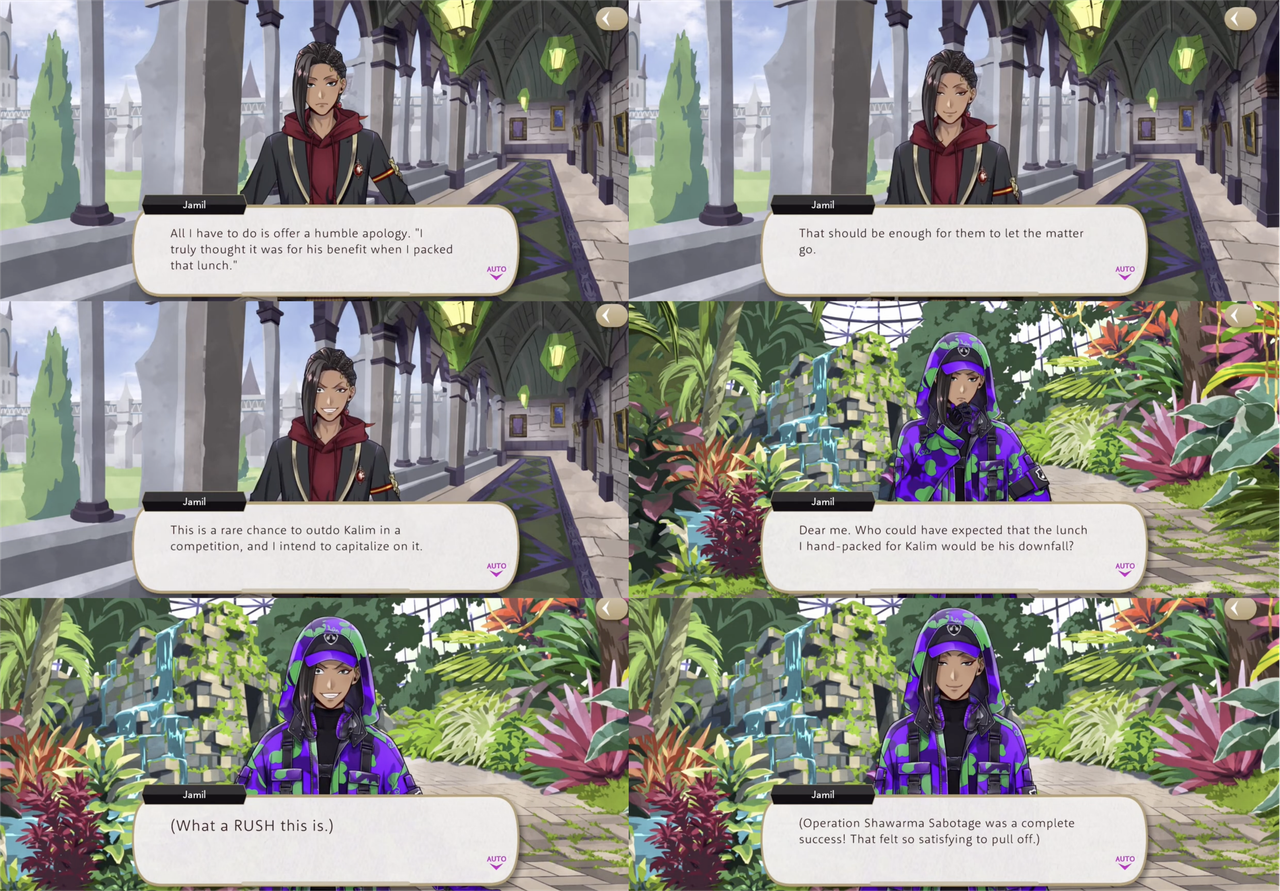
Prior to Beanfest, Jamil puts together a plan to use that methodology against his own parents: he prepares a fragrant lunch for Kalim fully intending it to get Kalim caught by the opposing team, and explains:
“Beanfest is a team-based competition. That means I don’t have to follow the same rules I do when competing with Kalim one-on-one. If by some chance my parents still get cross about it later, well…all I have to do is offer a humble apology. ‘I truly thought it was for his benefit when I packed that lunch.’ That should be enough for them to let the matter go.”
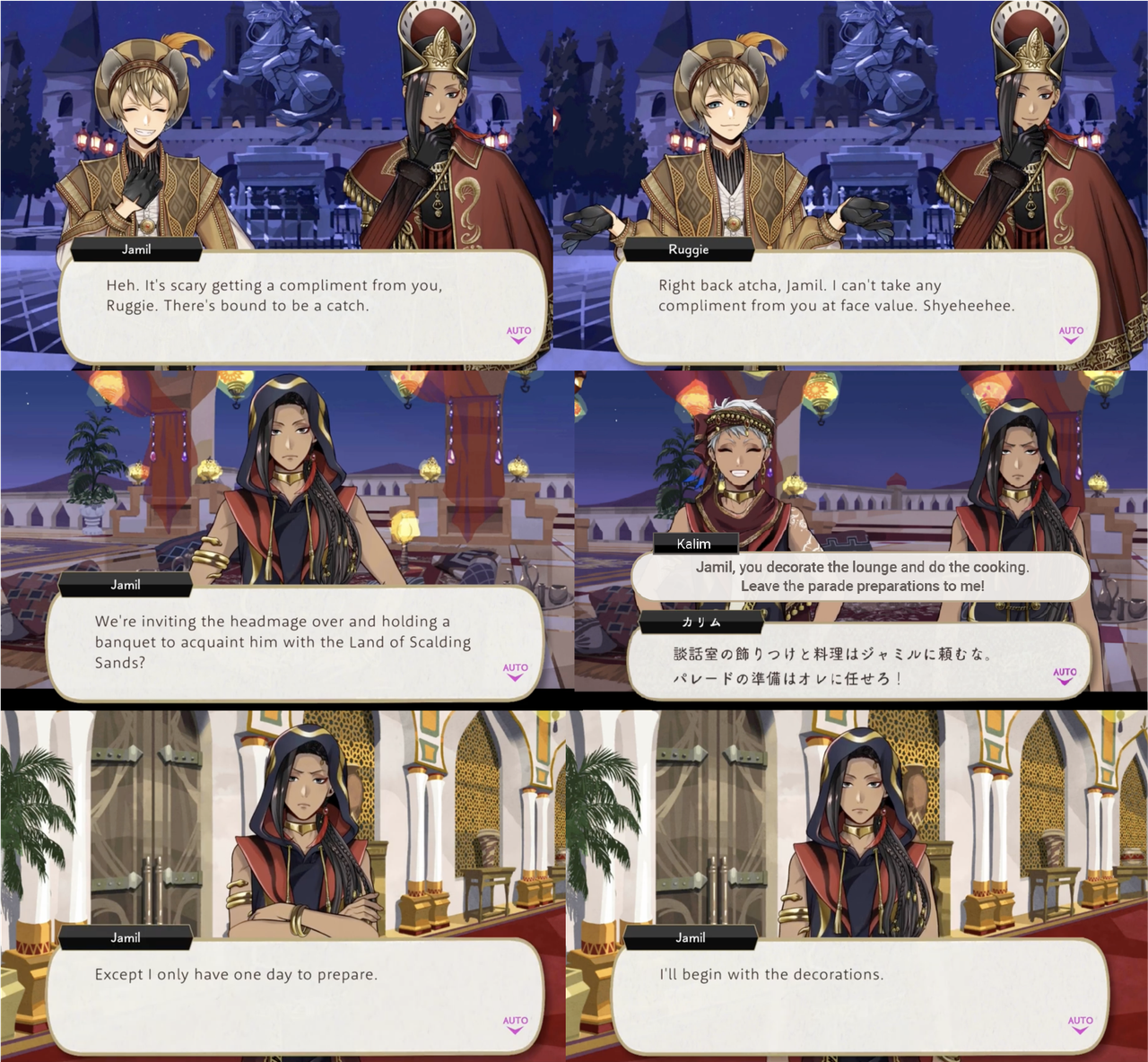

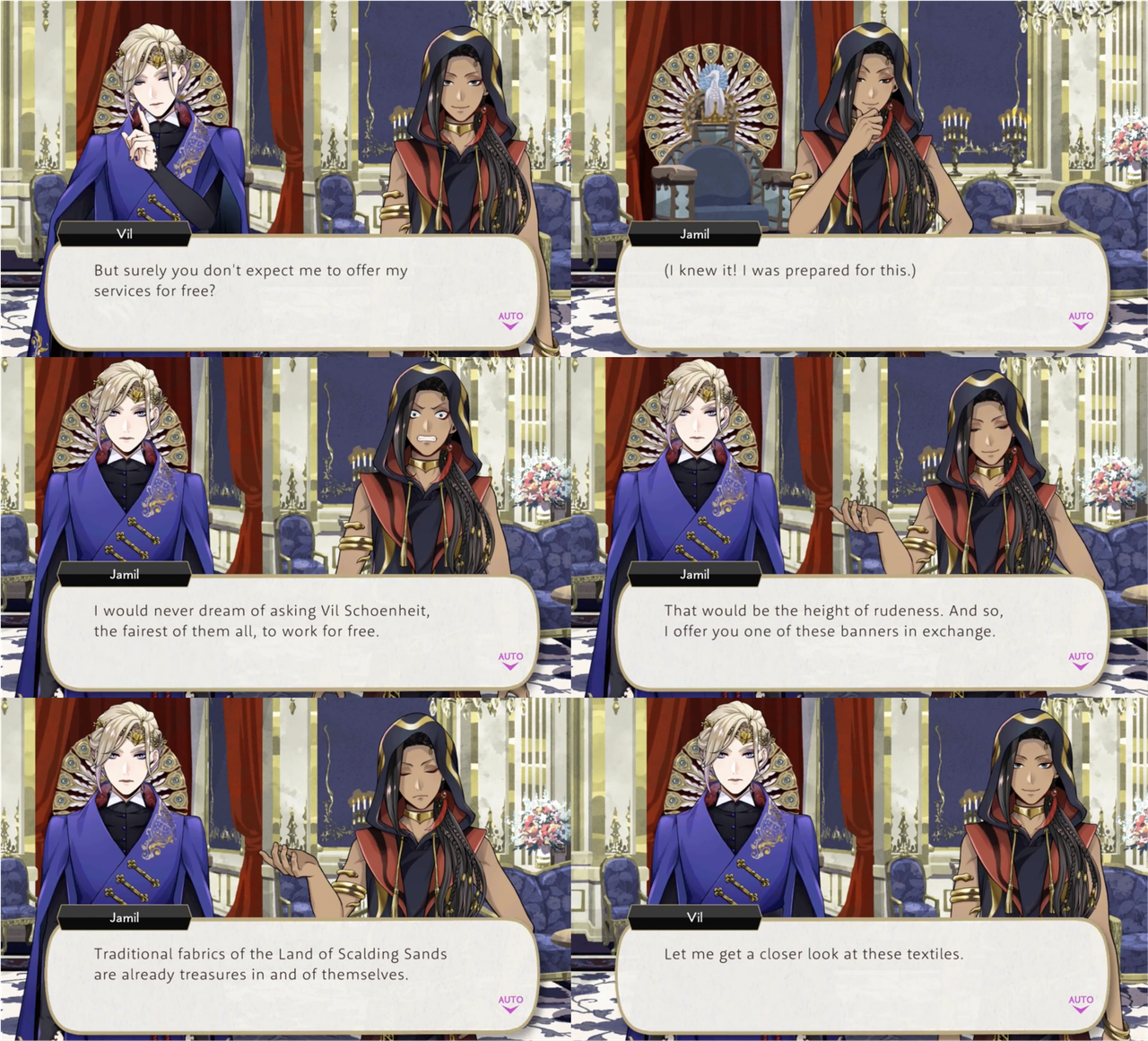
Ruggie says that he can’t take any compliment from Jamil at face value and he is not the only one suspicious of Jamil’s flattery: in a vignette Jamil goes to Vil for help with preparing decorations for one of Kalim’s parties, saying, “You being the expert on all things beautiful, I thought you the perfect person to consult,” “If you would be so kind as to use your superior aesthetic sense to instruct me how to make use of this…” and “I would never dream of asking Vil Schoenheit, the fairest of them all, to work for free.”

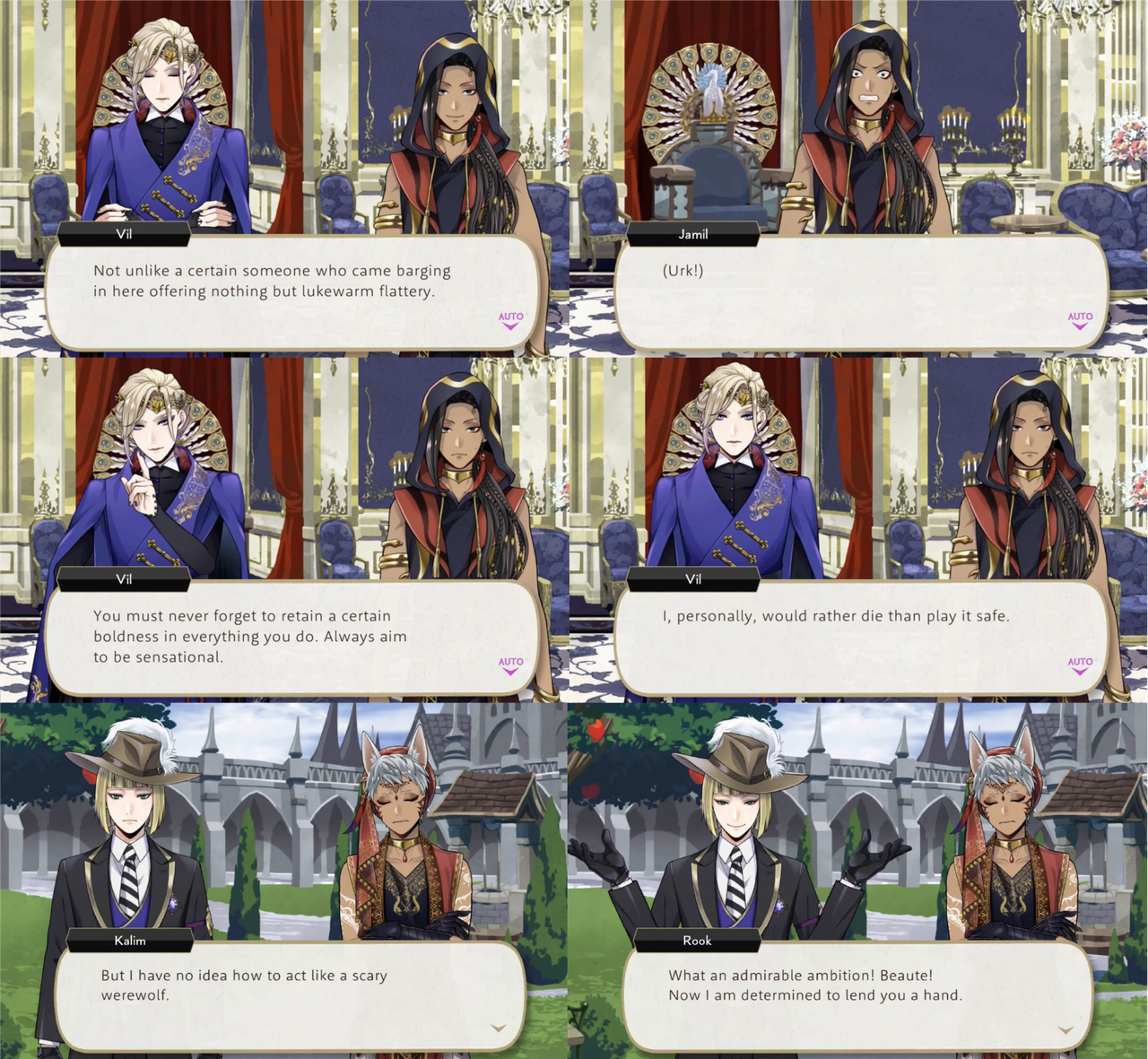

After Vil agrees to assist Jamil seems pleased (“He’ll do the rest on his own. All I need to do is smile and nod”), but after deciding what direction to go in for the decorations Vil says, “Slavish preservation of its original form only ensures that it will never live up to its potential. Not unlike a certain someone who came barging in here offering nothing but lukewarm flattery.”

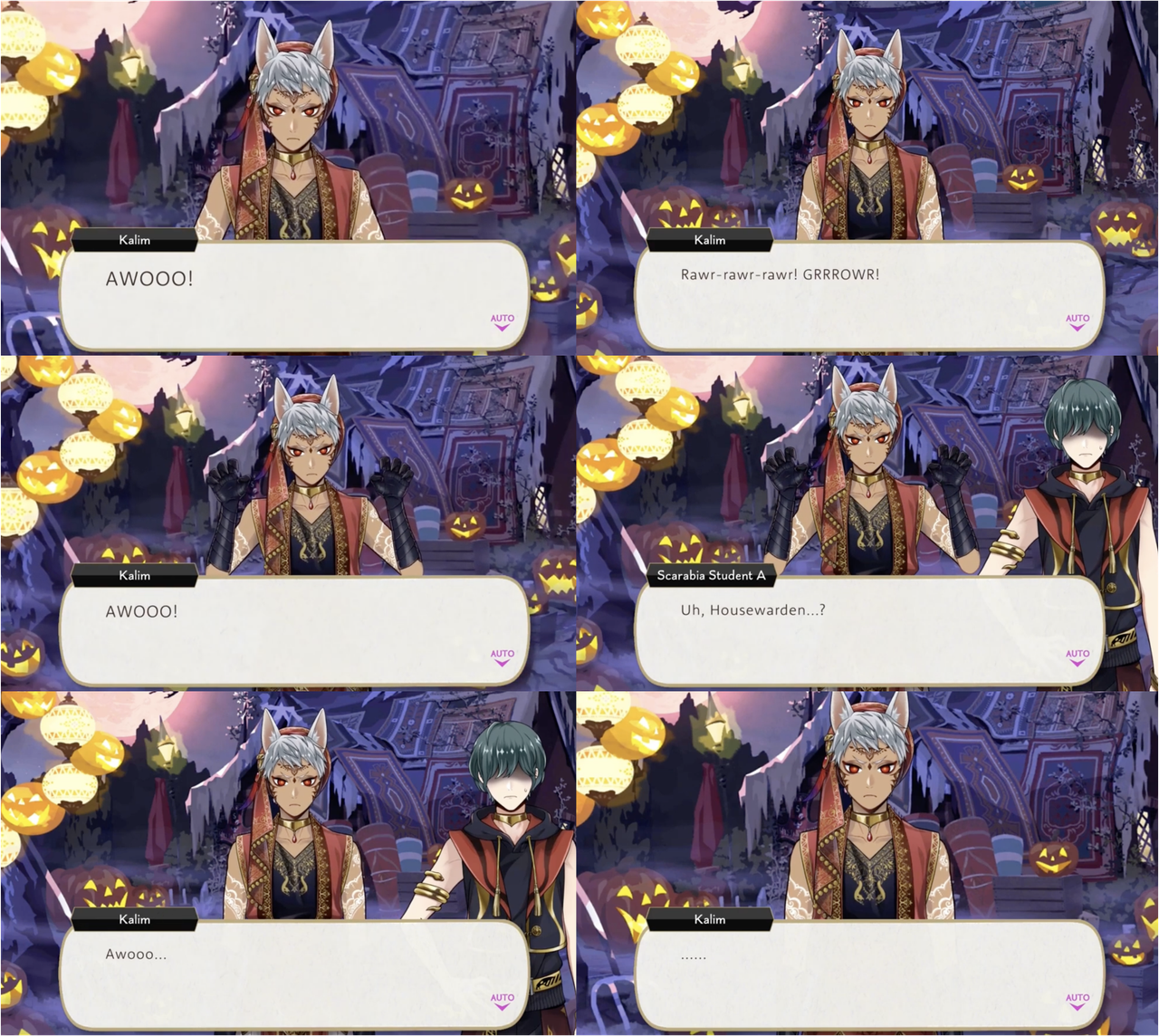
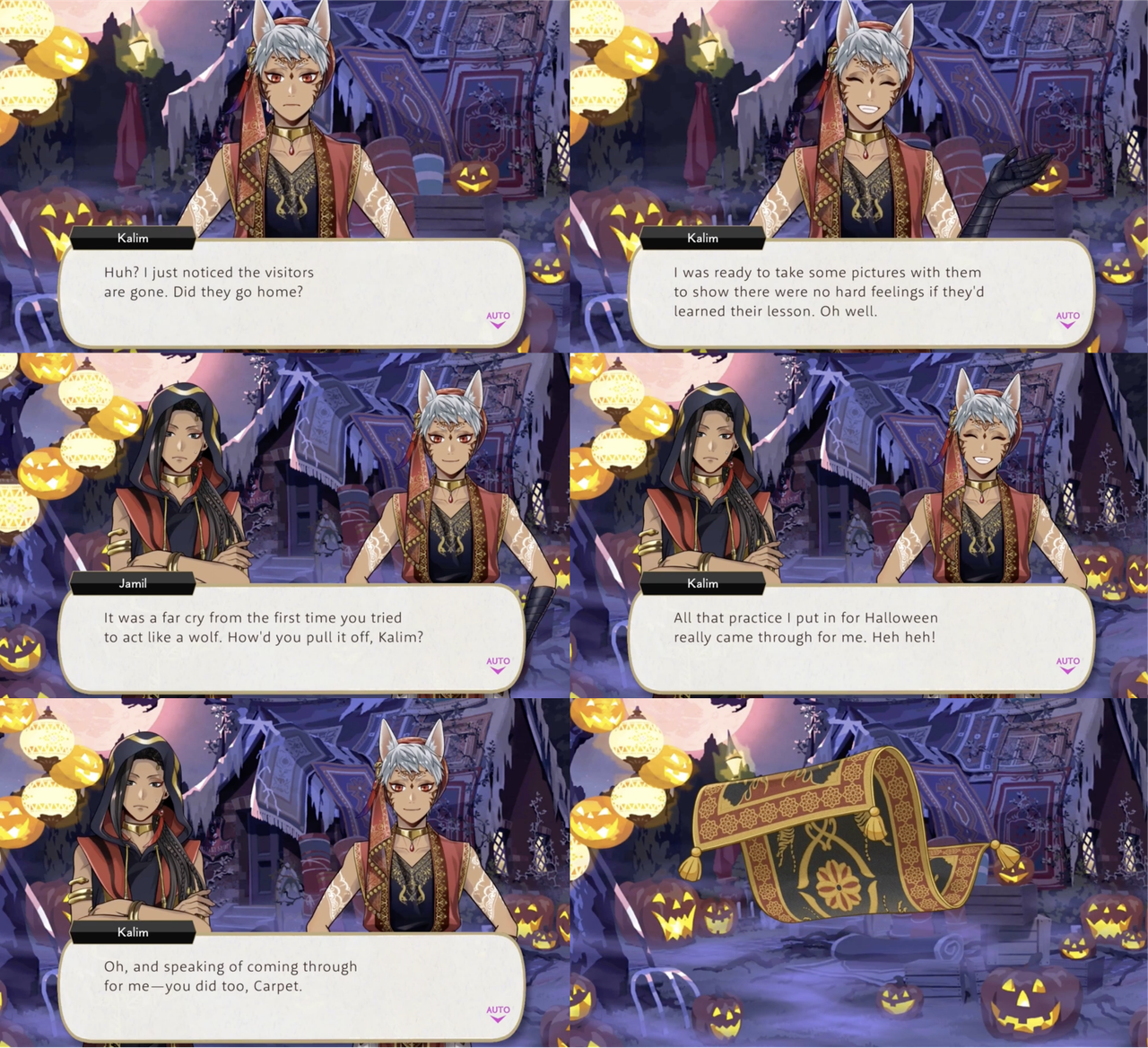
While Rook volunteers to teach Kalim how to be scarier in costume, it is Jamil who sets the scene to frighten Magicam Monsters, Jamil who comes up with the idea to utilize Kalim’s magic carpet to scare them further, and Jamil who likely hypnotizes Kalim into being more frightening, but he still flatters Kalim with, “Formulating a plan with an eye toward the end result, and working unstintingly to achieve it…that’s why Scarabia’s motto is ‘A thorough plan is a good plan.’ You were a credit to your position as housewarden, Kalim.”

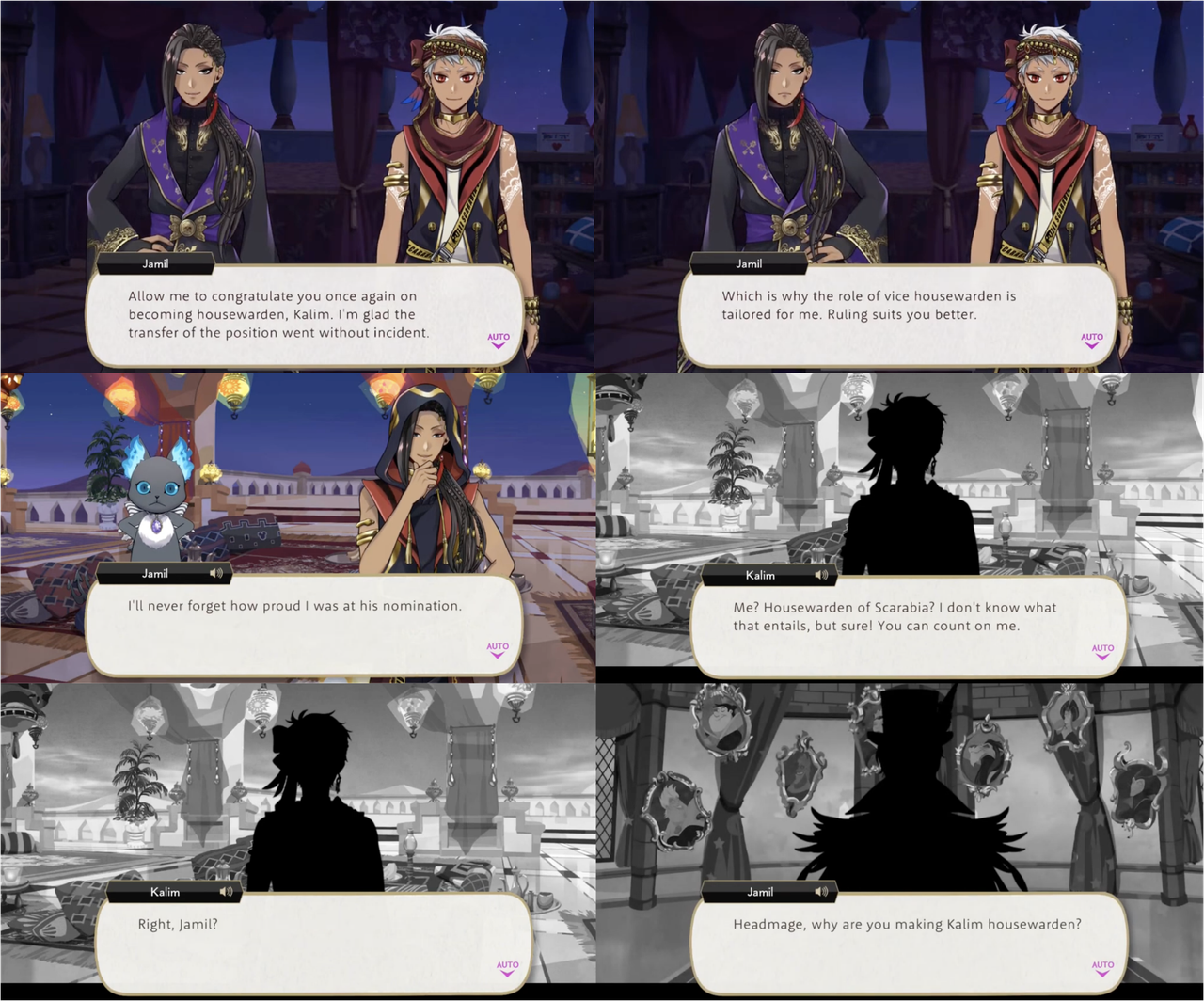
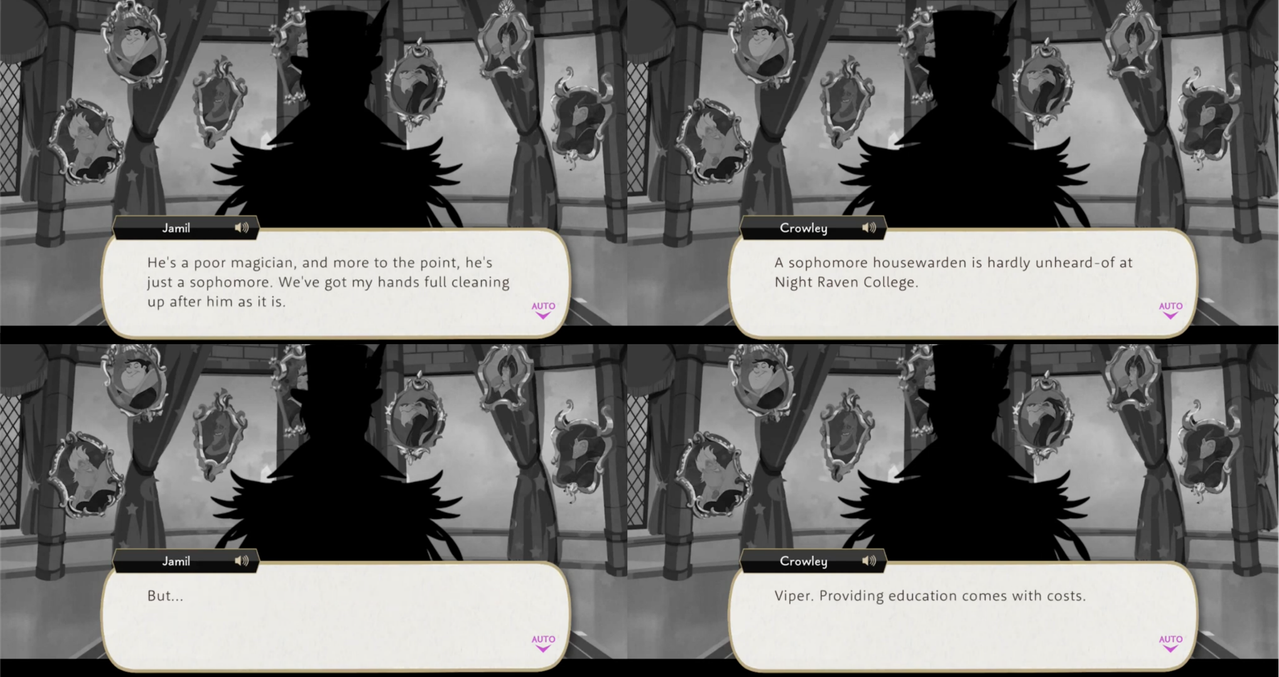
While Jamil congratulates Kalim on his promotion to Housewarden, assures him that “ruling suits (Kalim) better,” and says, “I’ll never forget how proud I was at (Kalim’s) nomination,” it is later revealed that Jamil was so against Kalim’s ascension to Housewarden that he tried to intervene by going to Crowley.
When trying to decide on the color of a tuxedo that Malleus has volunteered to craft from magic for Lilia, Lilia asks Jamil for his opinion. Jamil responds, “That’s a tough question. I think you could make any color work,” aloud, while silently reflecting, “Who cares about the color? I just want to go to bed.”
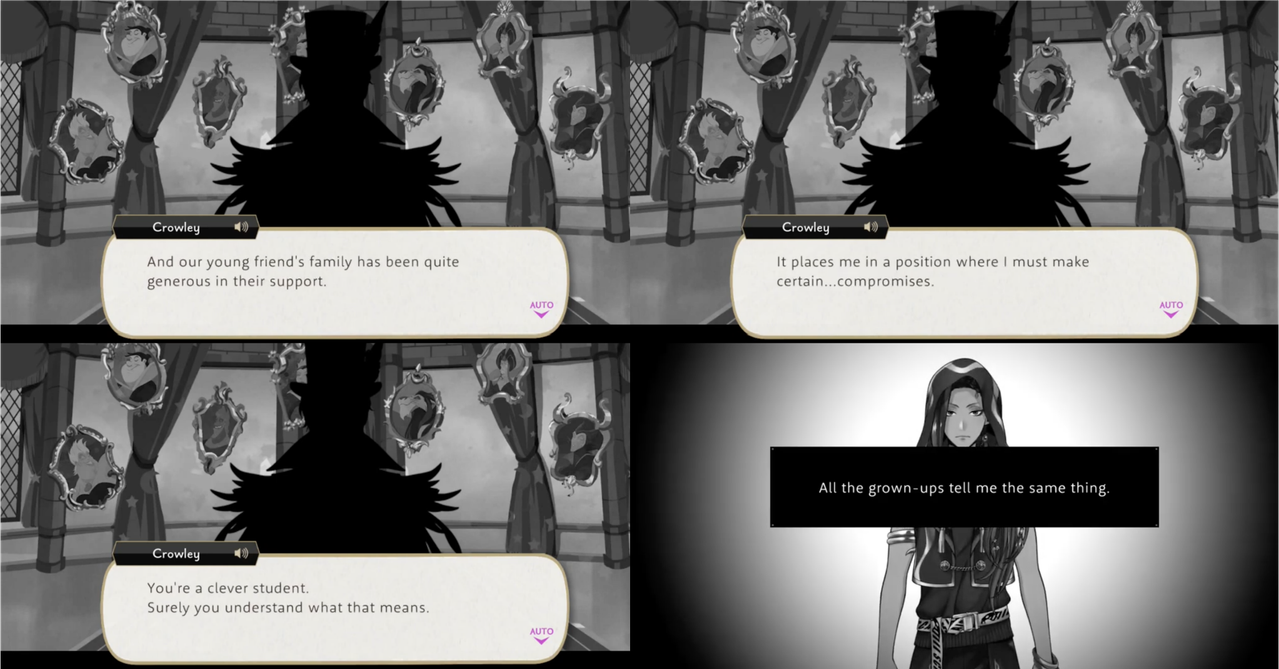

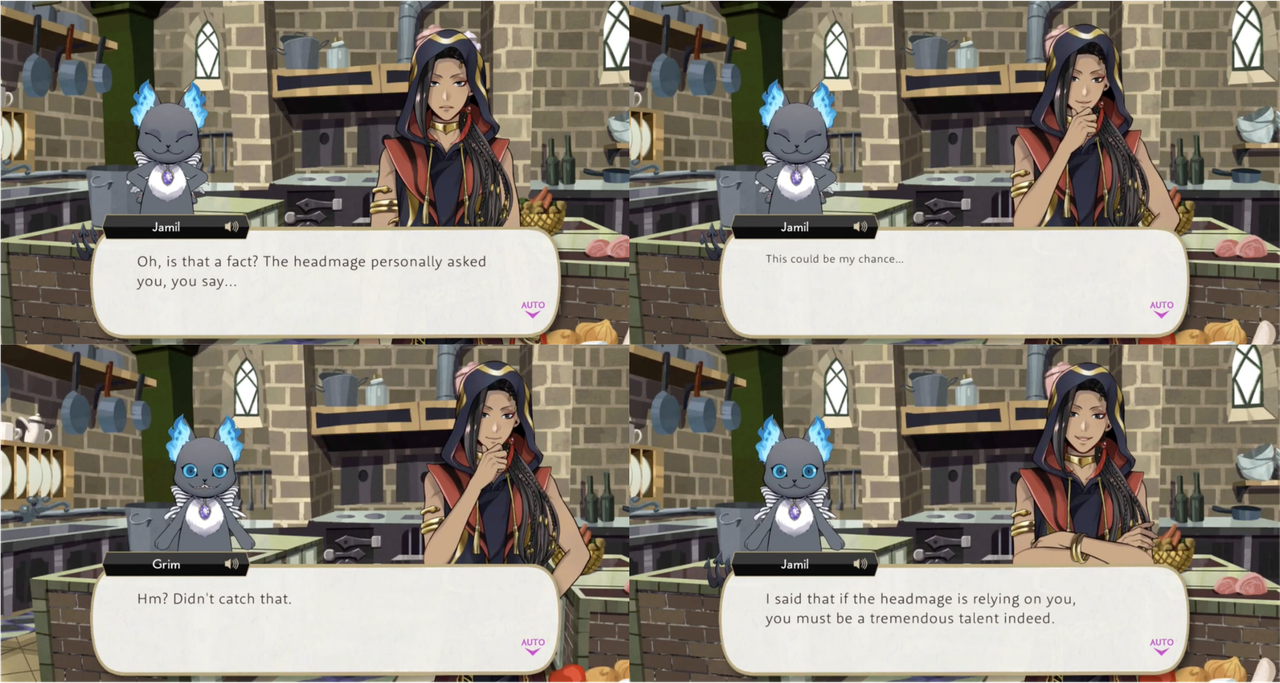
Jamil mumbles “This could be my chance” to himself upon realizing that Grim and the prefect will be staying at NRC for winter break, but when Grim asks what it is he said Jamil responds, “I said that if the headmage is relying on you, you must be a tremendous talent indeed.”
At the conclusion of Spectral Soiree Silver presents Jamil to Lilia as someone he had been able to rely on. Jamil responds, “You’re giving me a bit too much credit,” but Silver insists, “Don’t be modest. You amazed me so many times today.” (Jamil: “…Only because you never listen.”)
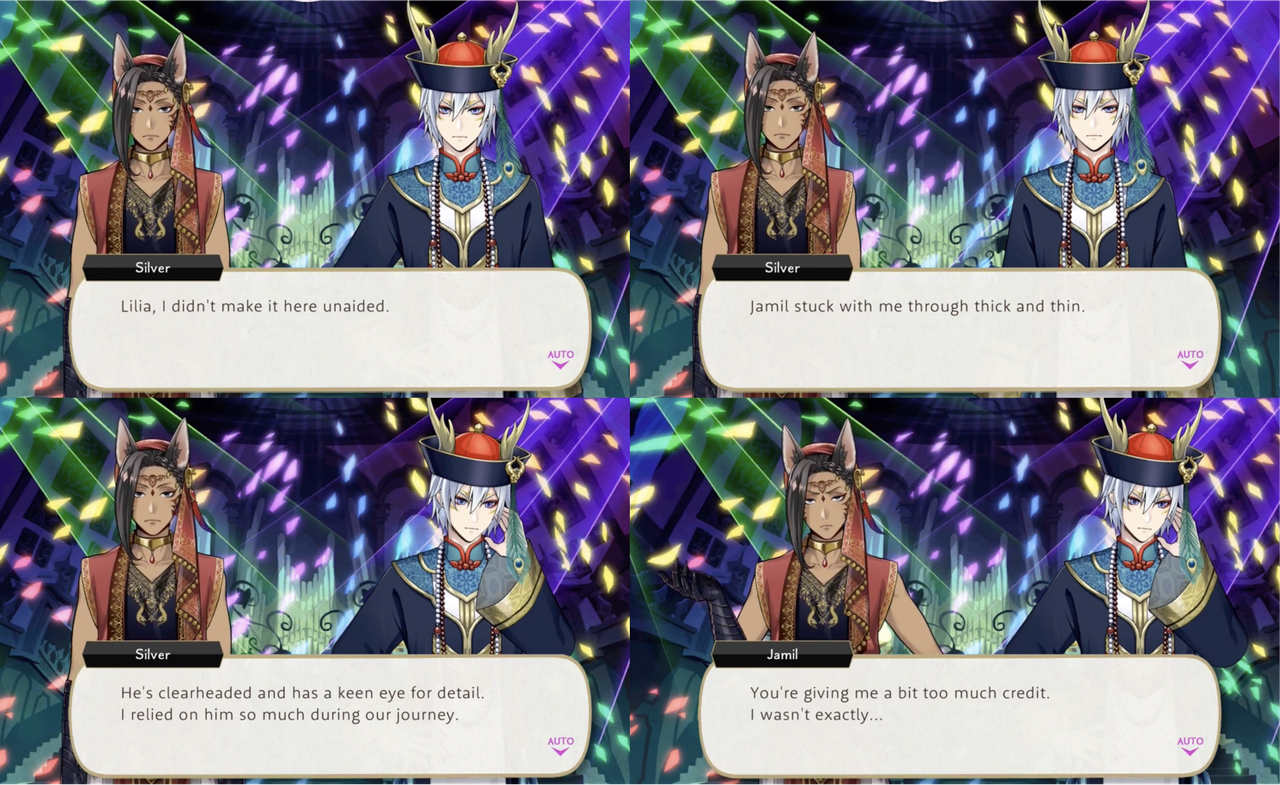
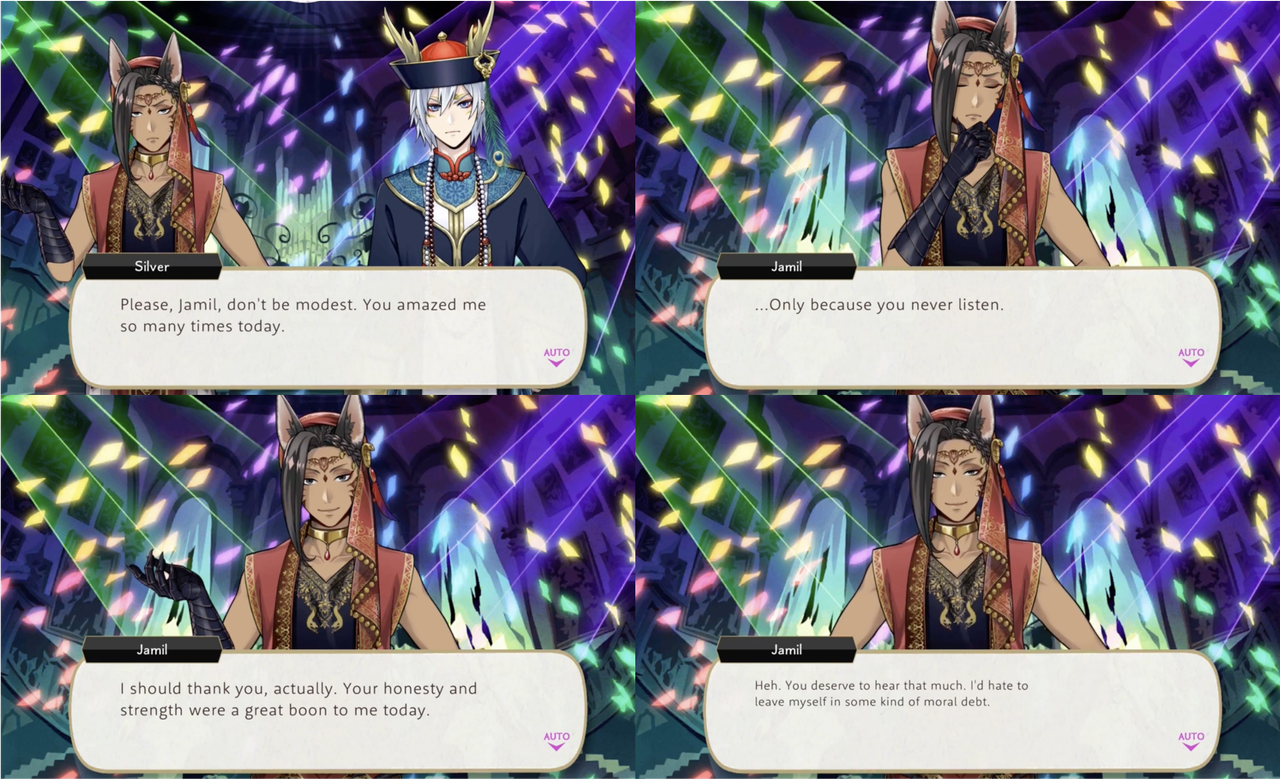

Jamil replies, “I should thank you, actually. Your honesty and strength were a great boon to me today,” and then quietly follows with, “You deserve to hear that much. I’d hate to leave myself in some kind of moral debt.”
When Vargas compliments Jamil’s flying abilities Jamil responds, “You flatter me, but it’s really all thanks to your splendid instruction,” but when Vargas then assigns him to tutoring Azul and leaves Jamil reacts with, “What a tyrant.”



There are apparently times when Jamil’s unpleasant inner thoughts are revealed on his face without him having to voice them aloud, with Jamil reflecting on Leona being “one of those indolent, haughty royals,” but when Leona calls him out on it he responds, “You just stand out so much that it’s hard not to look.” (Leona: “That’s not what that face is sayin’, though.” – Jamil: “My face always looks like this.”)
Jamil releases his true opinions about Kalim in Book 4, with Floyd saying that Jamil has likely “been mocking Sea Otter beneath his breath for pretty much their whole lives,” and Jamil declares, “There will be no more holding back for me,” possibly in relation to both the competitions that he no longer intends to sacrifice for Kalim’s benefit and to his personal opinions about Kalim. (Azul: “I like the authentic Jamil much more.”)
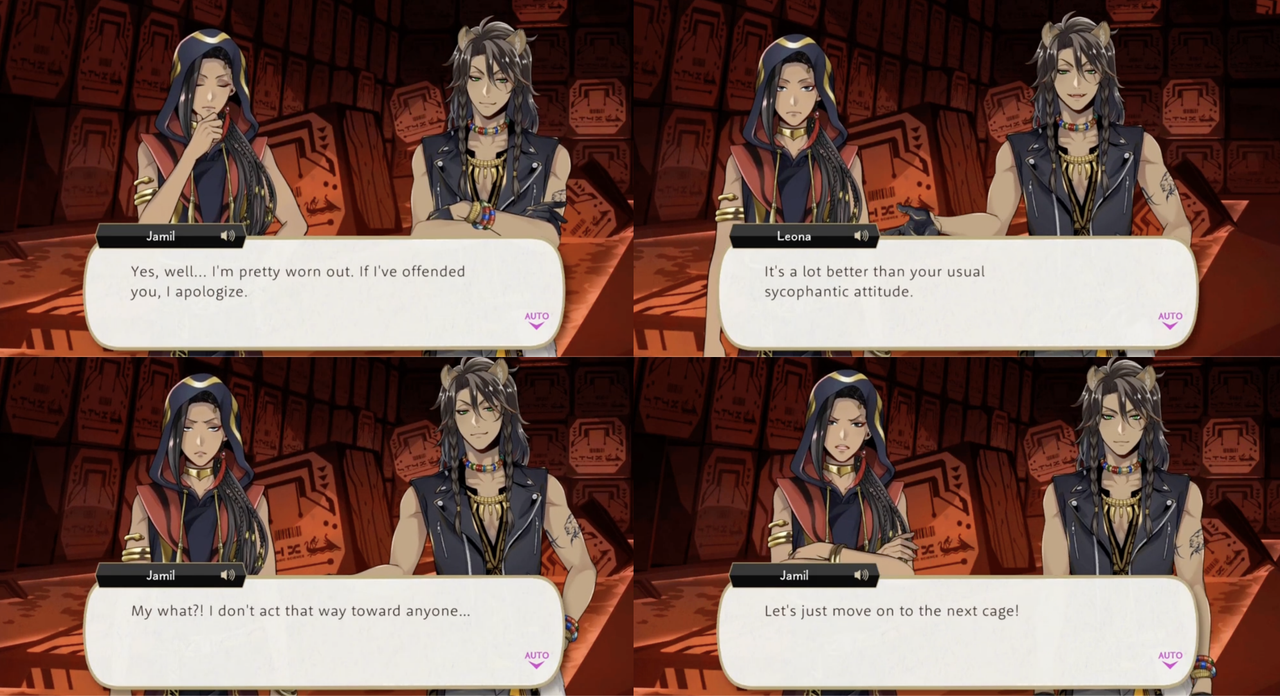


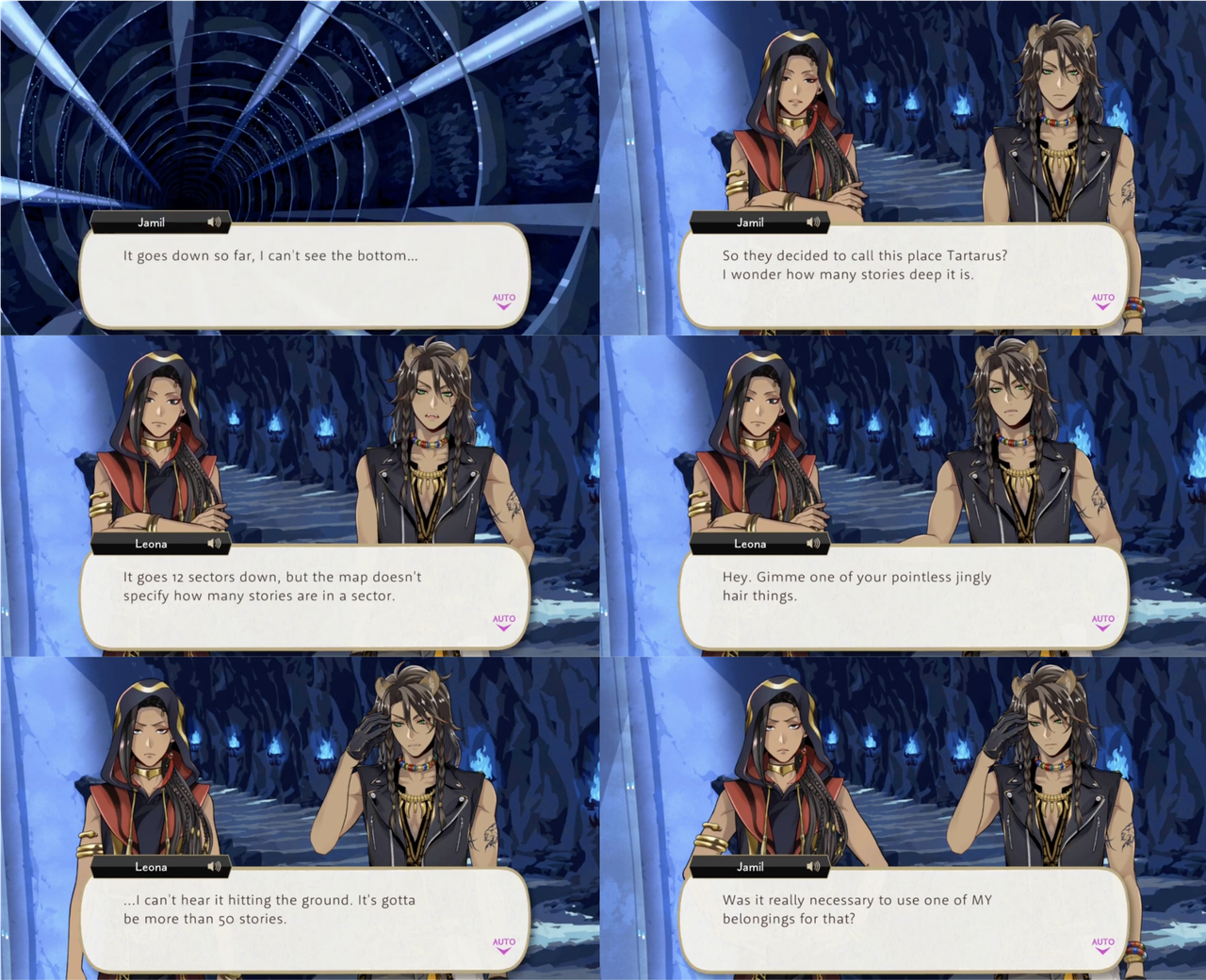
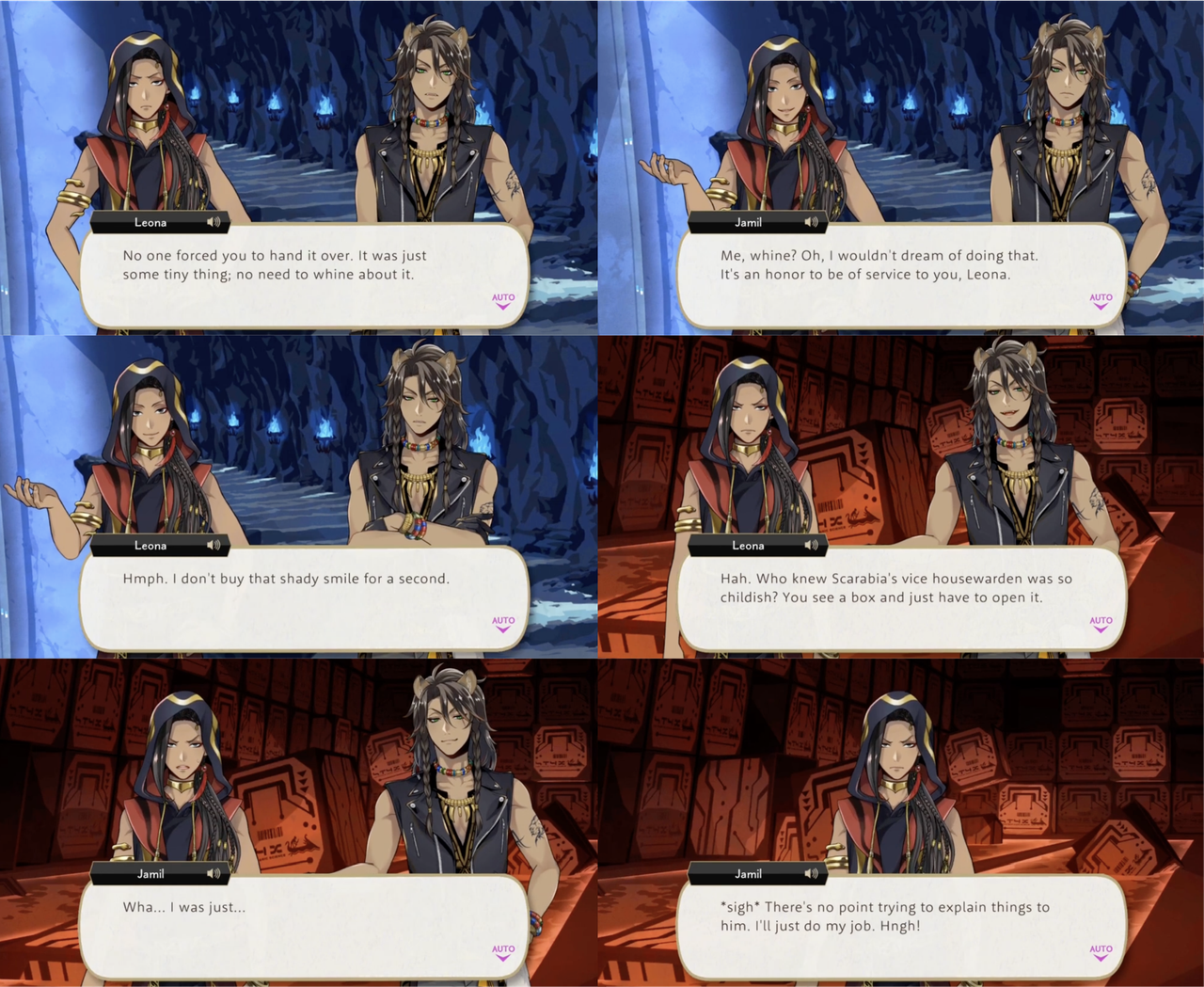
Jamil is not amused when Leona throws one of his hair accessories into Tartarus to gauge the depth, but when Leona says, “No need to whine about it,” Jamil responds, “Me, whine? Oh, I wouldn’t dream of doing that. It’s an honor to be of service to you.” Leona replies, “I don’t buy that shady smile for a second.”
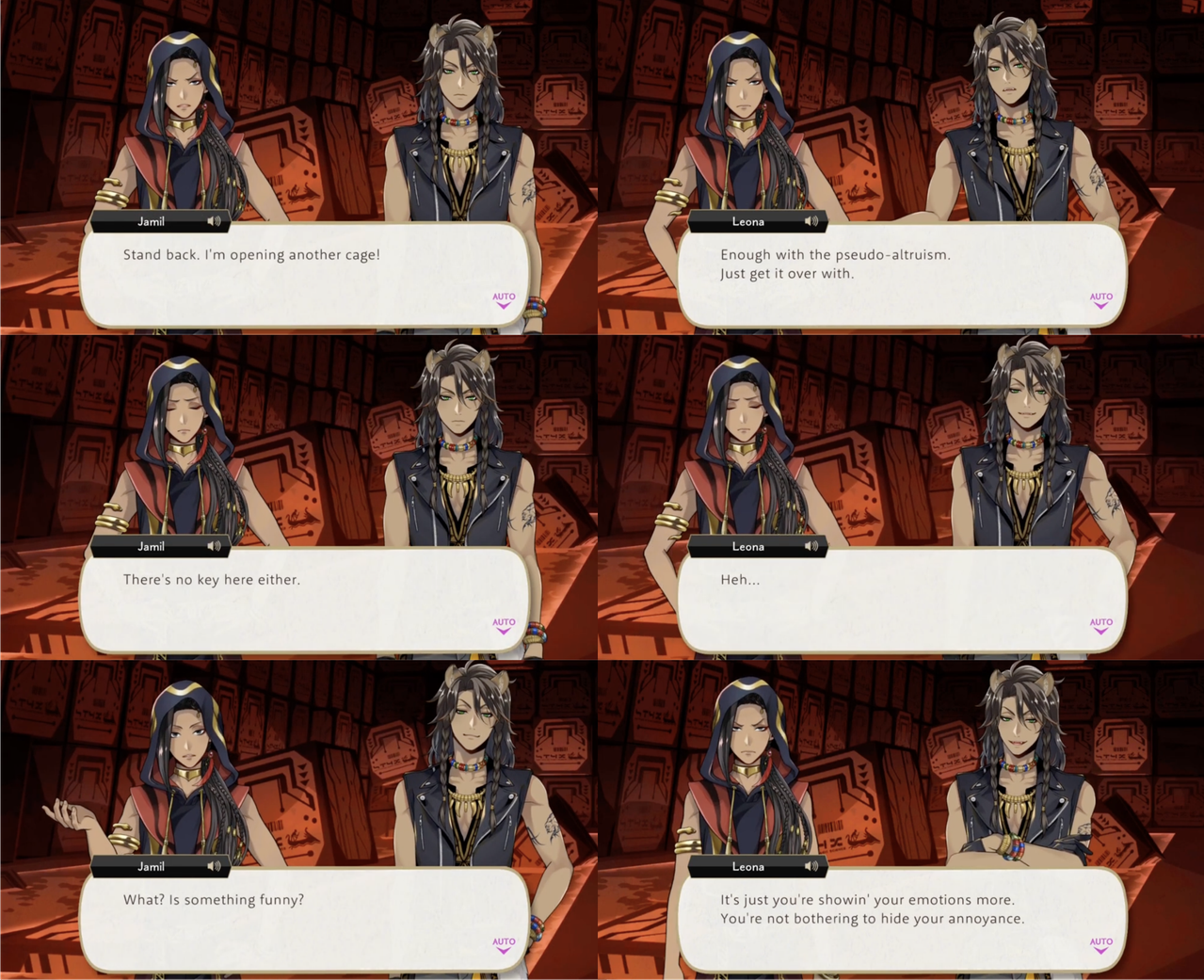
Later Leona tells him, “Enough with the pseudo-altruism,” and even later he comments that a tired Jamil has started “showing (his) emotions more and isn’t bothering to (his) annoyance.” Jamil apologizes for any offense he may have caused but Leona responds, “It’s a lot better than your usual sycophantic attitude.” (Jamil: “My what?! I don’t act that way toward anyone…”)
In a vignette where Lilia offers to help Jamil with cooking he responds aloud with, “I wouldn’t want to impose…” while silently reflecting, “You’re a walking culinary disaster! I’ve heard horror stories about the kitchen abominations you’re responsible for!” He then follows with, “No, really, I’ll be fine. But the sentiment is greatly appreciated.”
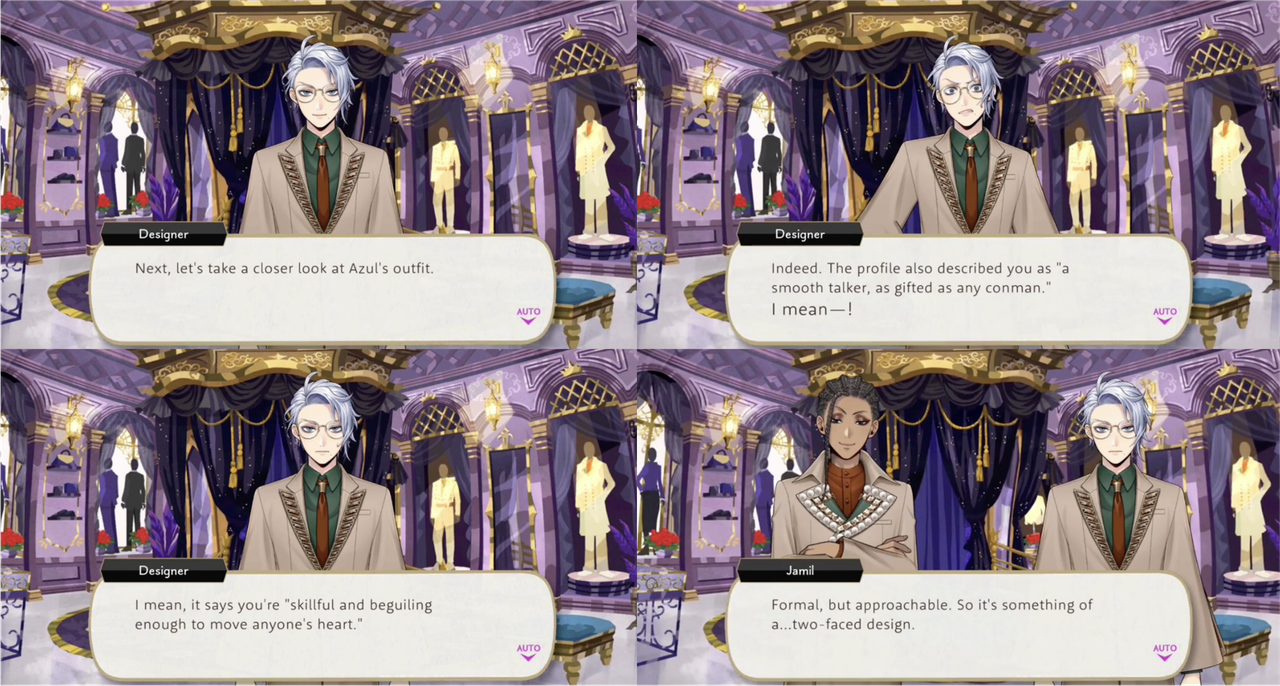
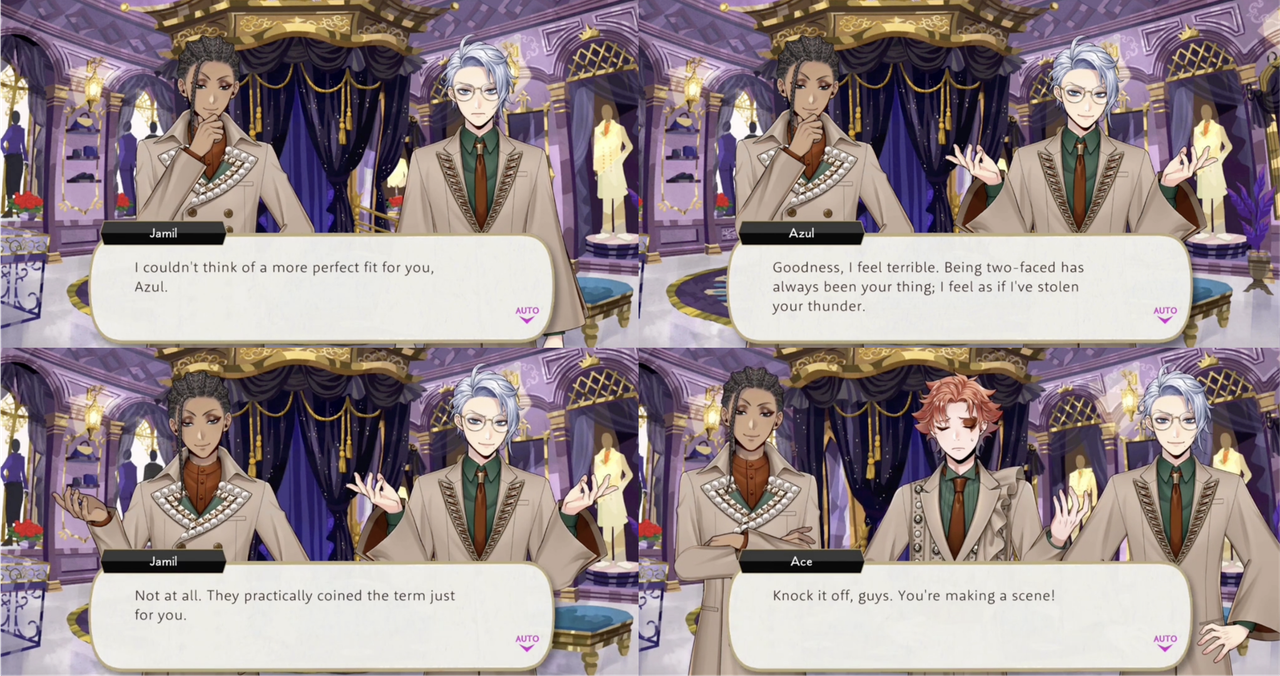
It is possible that the prefect has called Jamil two-faced (“Wow, you’ve gotten pretty cheeky”), and during Tapis Rouge Jamil says he “couldn’t think of a more perfect fit” for Azul than the “two-faced design” of his outfit. Azul responds, “Being two-faced has always been your thing; I feel as if l’ve stolen your thunder,” and Jamil replies, “Not at all. They practically coined the term just for you.” (Ace: “You’re making a scene!”)



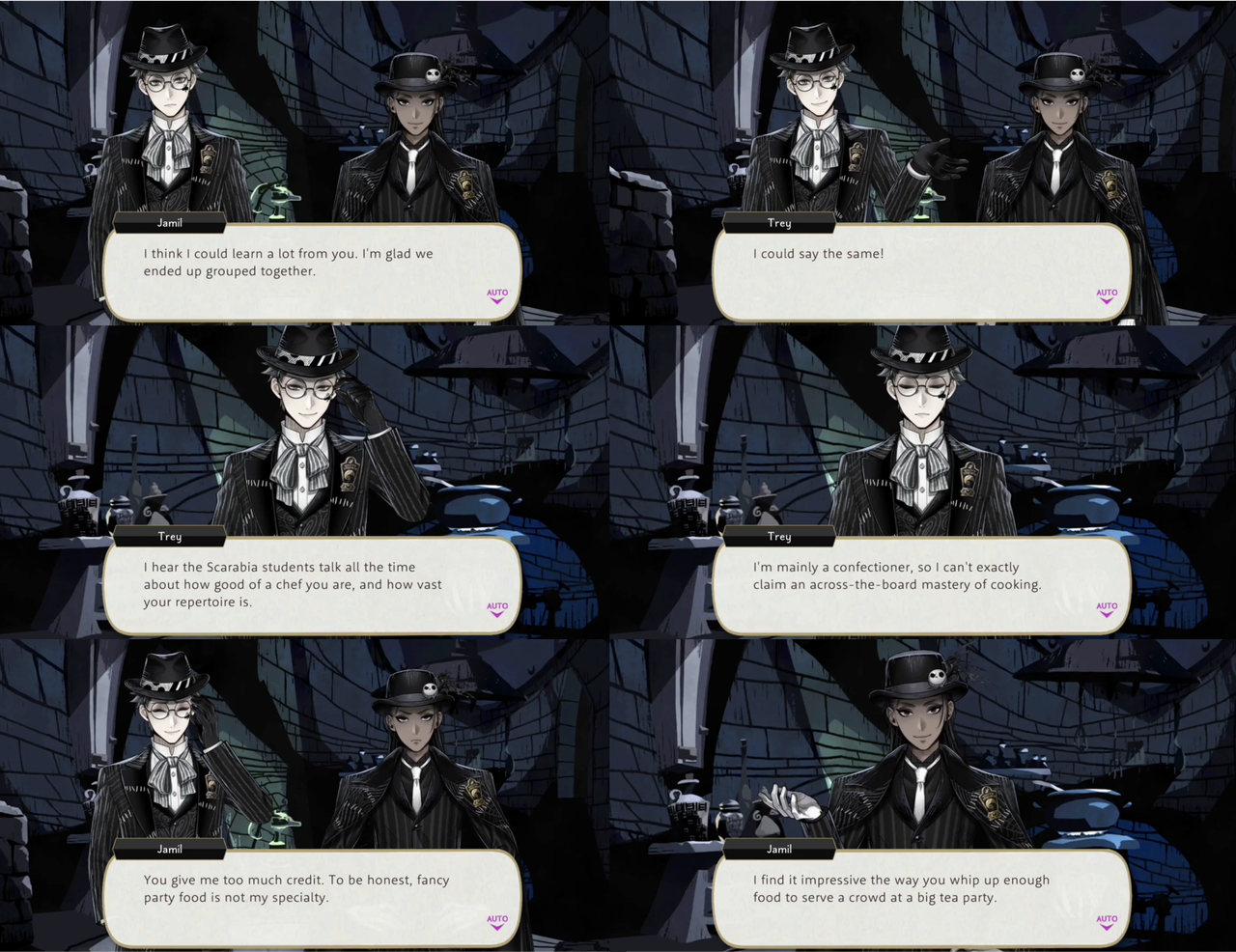
Idia watches a back-and-forth between Jamil and Trey where they both downplay their own cooking abilities while complimenting the other’s skills and says, “Trey and Jamil are basically the archetypes of functioning members of society at our school. And yet they still have that secret ulterior motive vibe that has ‘vice housewarden’ written all over it.”


Upon seeing Neige in person for the first time Jamil says, “The more innocuous someone looks, the worse they’re likely to act behind the scenes. That’s how entertainers are” (Grim: “Do you have any room to talk there?”), but later he seems to reconsider his initial impression, saying, “I’m starting to see why he’s such a beloved figure. He’s a leading global celebrity, but he still treats fans warmly and attentively. That’s definitely a strength.”

Firelit Sky gave us a fascinating look at Jamil’s constant code-switching between the different versions of himself demanded by his social roles, and at his lifelong conflict between being a “servant” and being an individual in his own right (credit to かわの on Note for this discovery).
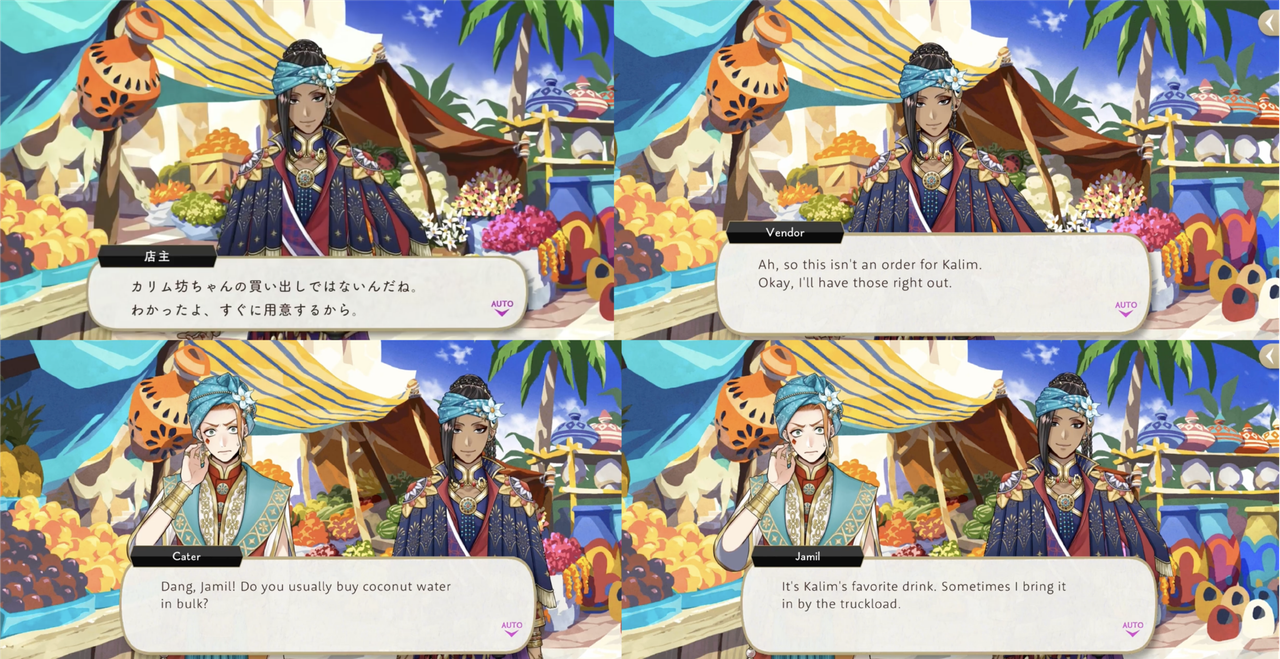
The Coconut Vendor seems to interact with Jamil primarily through his role as an Asim servant, referring to Kalim as “Kalim-bocchan” (“Young Master Kalim”). His speech is gentle but relatively businesslike, and Jamil mirrors that distance by responding politely and formally. This contrasts with several of Jamil’s other interactions during the festival, where vendors appear to know him more personally.
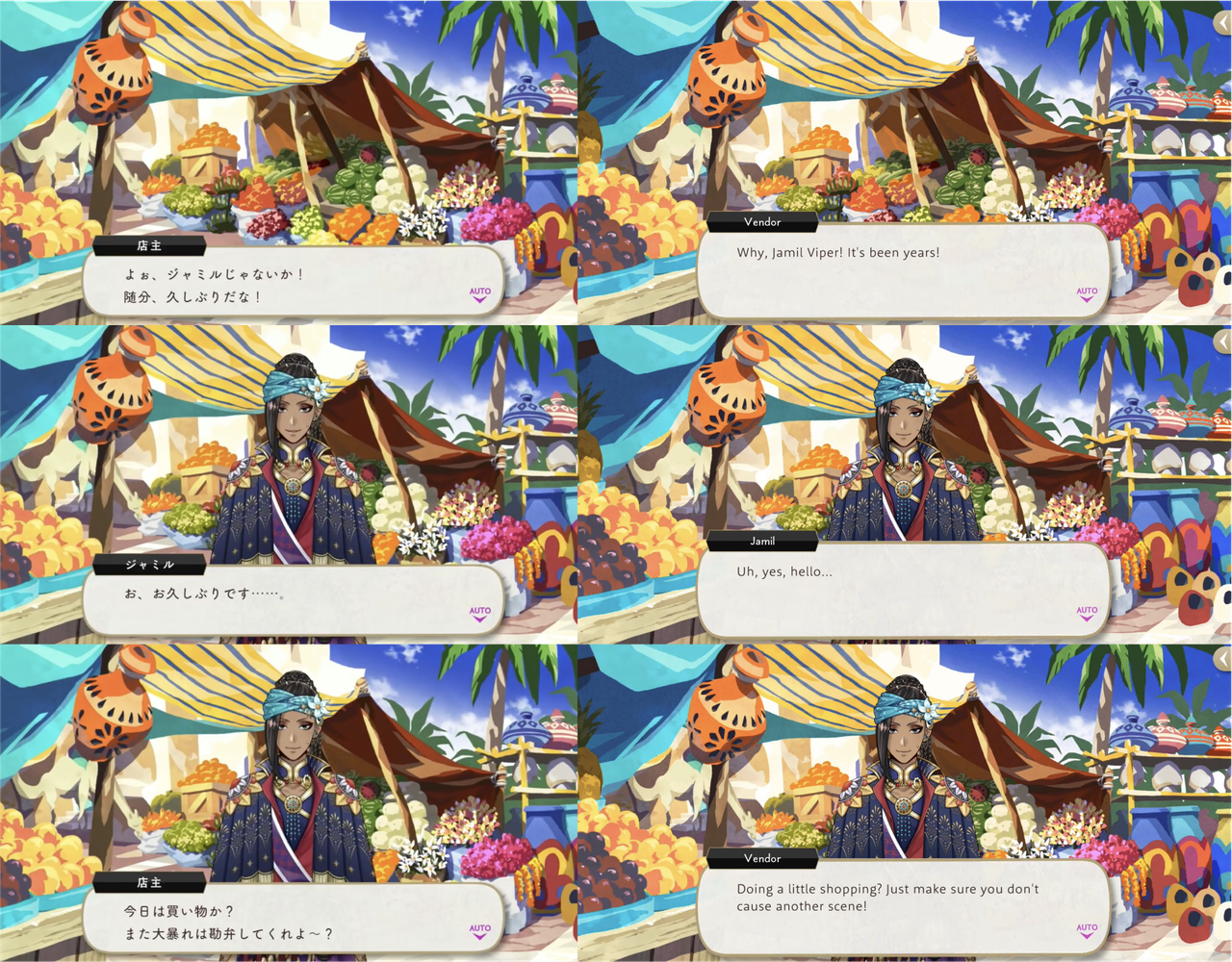
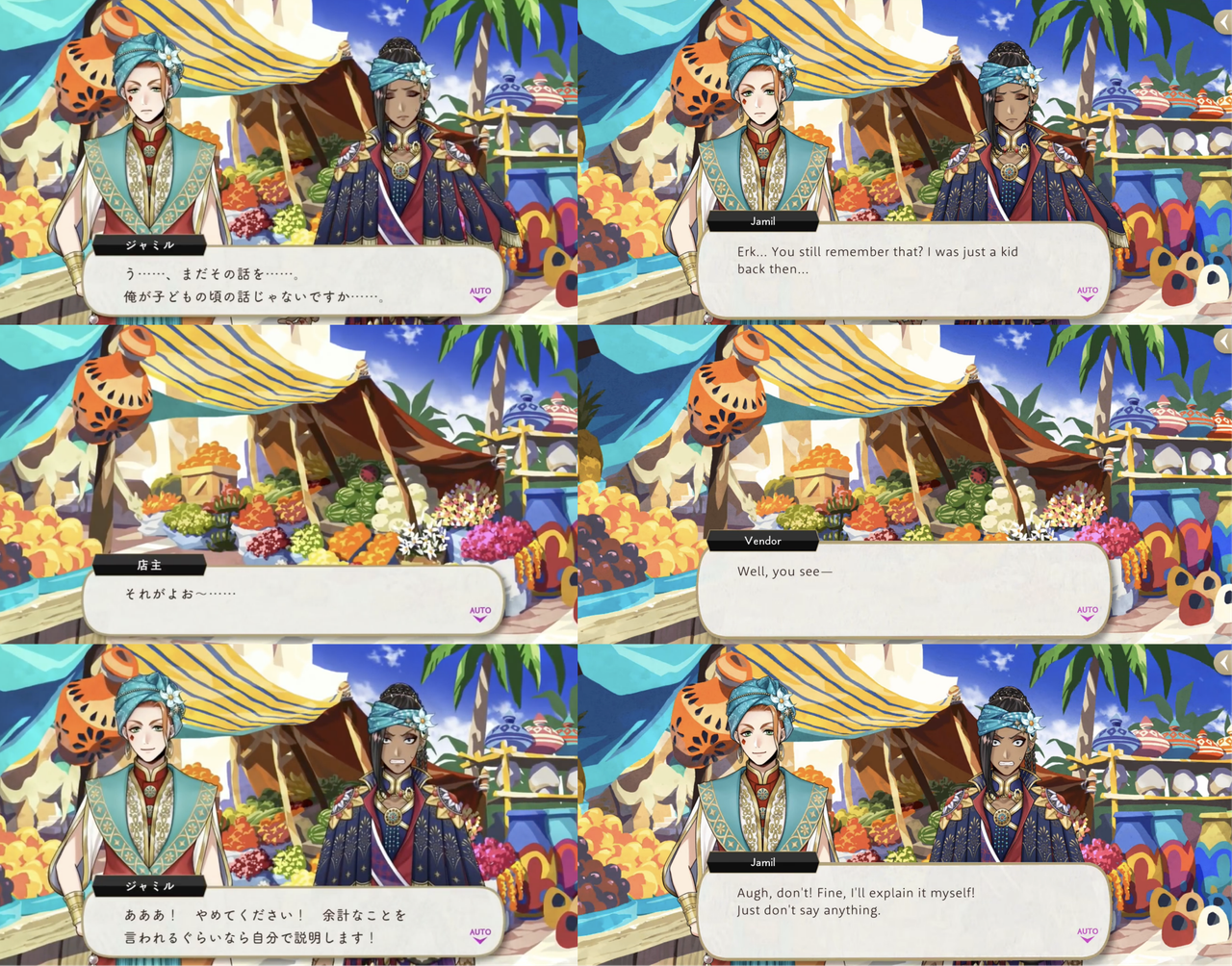
The Dried Fruit Vendor speaks to Jamil very casually and familiarly, even bringing up an incident where child-Jamil scorched his awning with fire magic and cried afterwards. Jamil remains polite, despite his embarrassment.
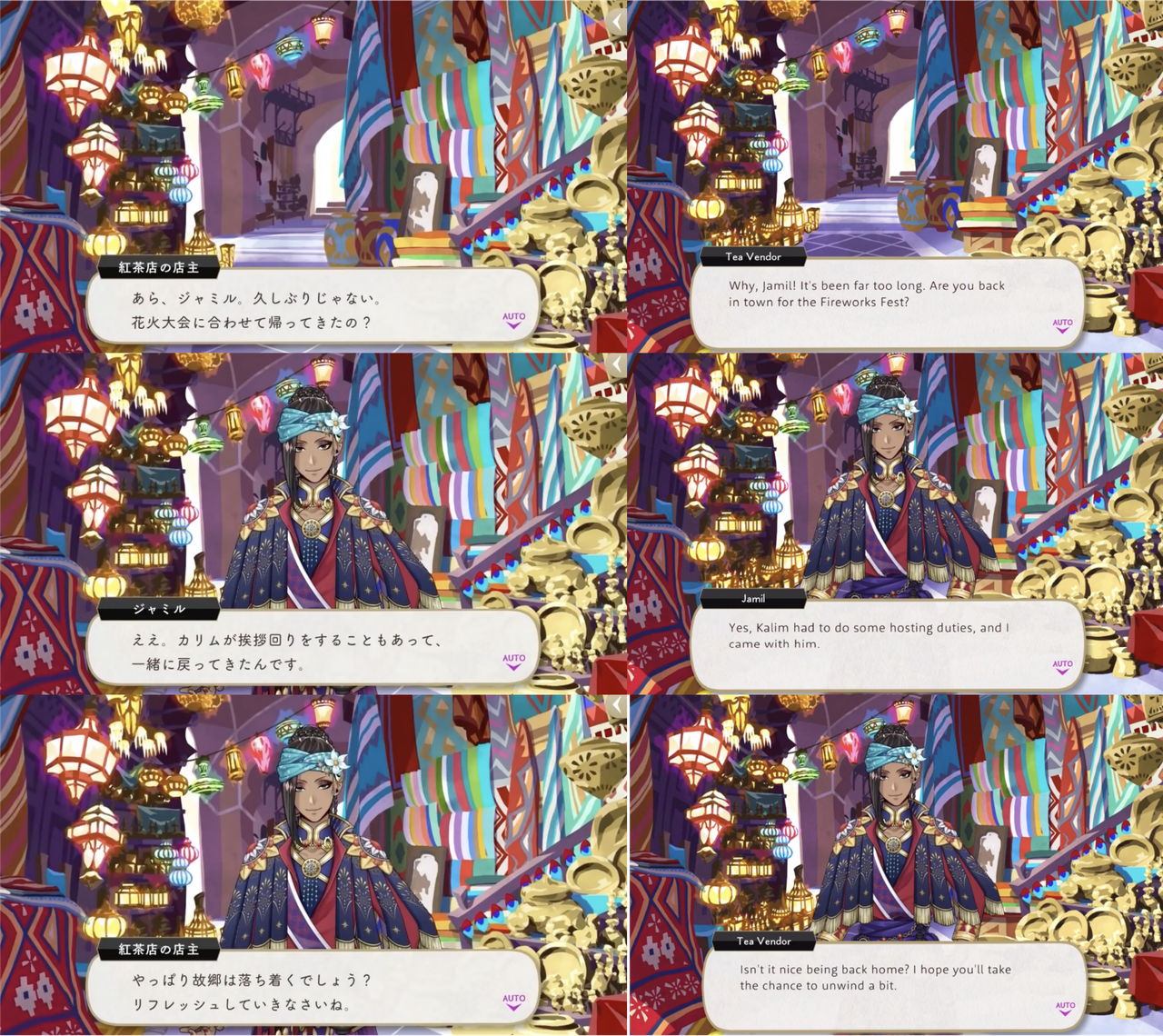
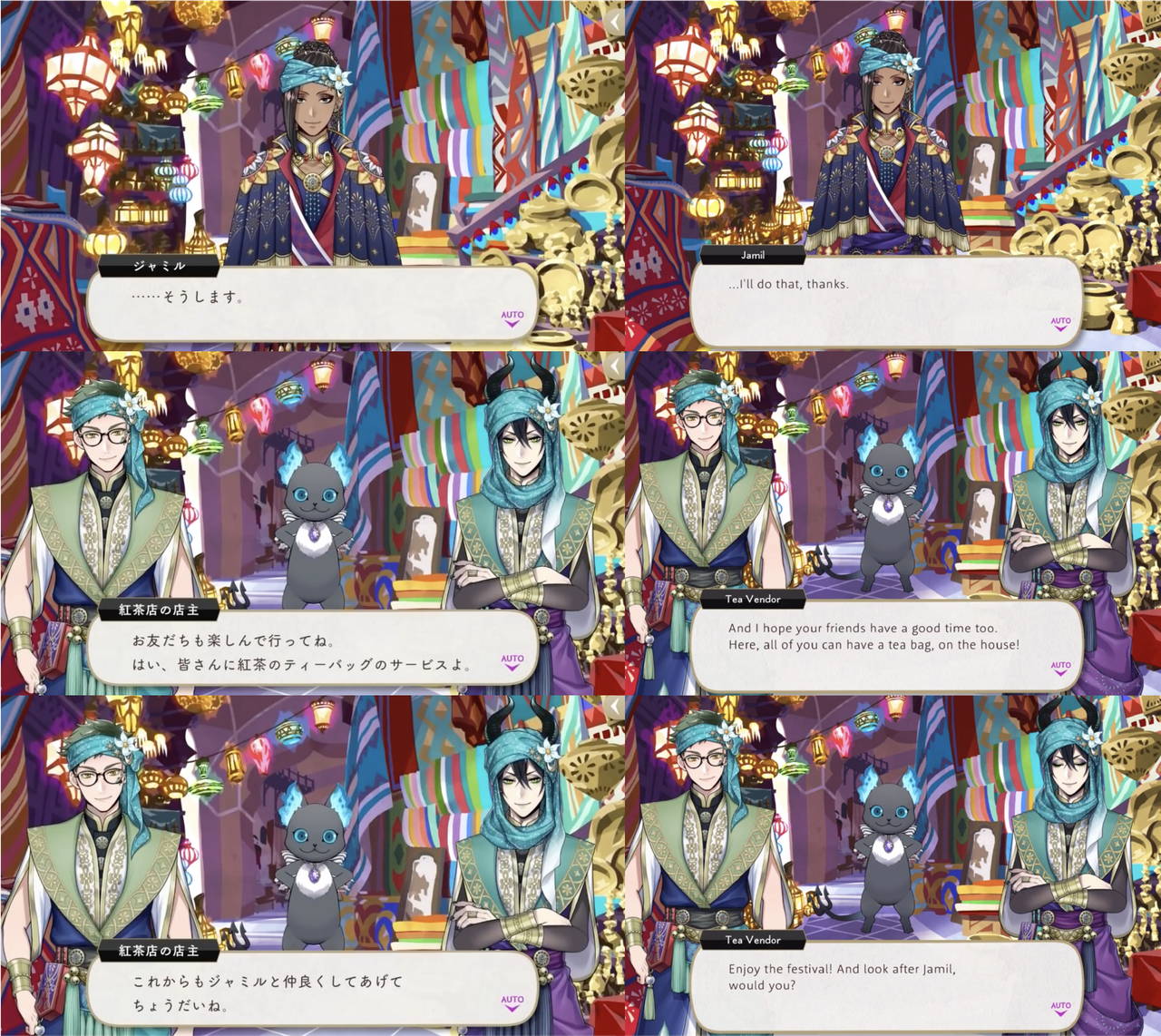
The Tea Vendor similarly speaks with a familiarity that suggests she may know Jamil as a local child rather than primarily as a member of the Asim household, while Jamil again maintains polite speech.
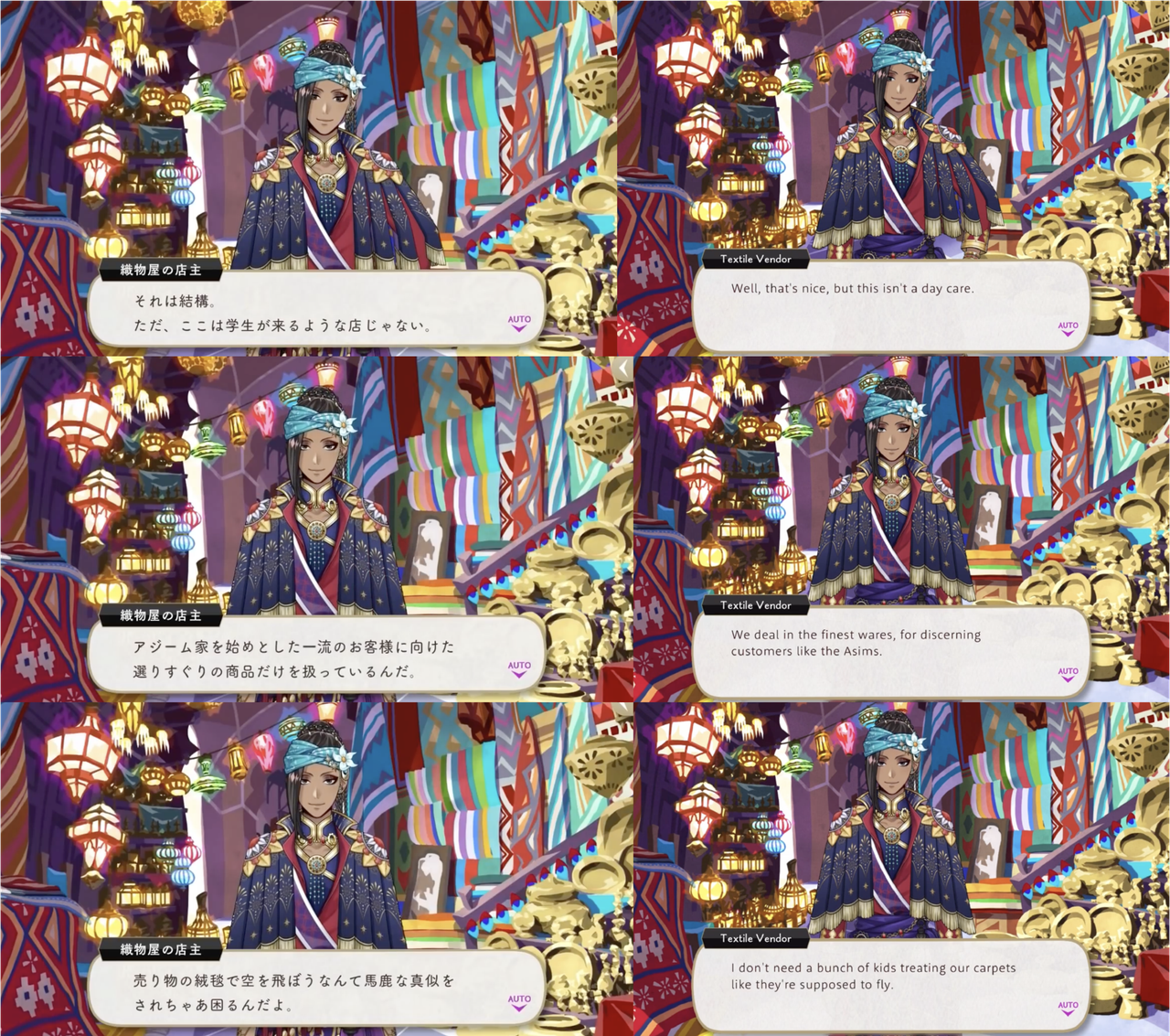

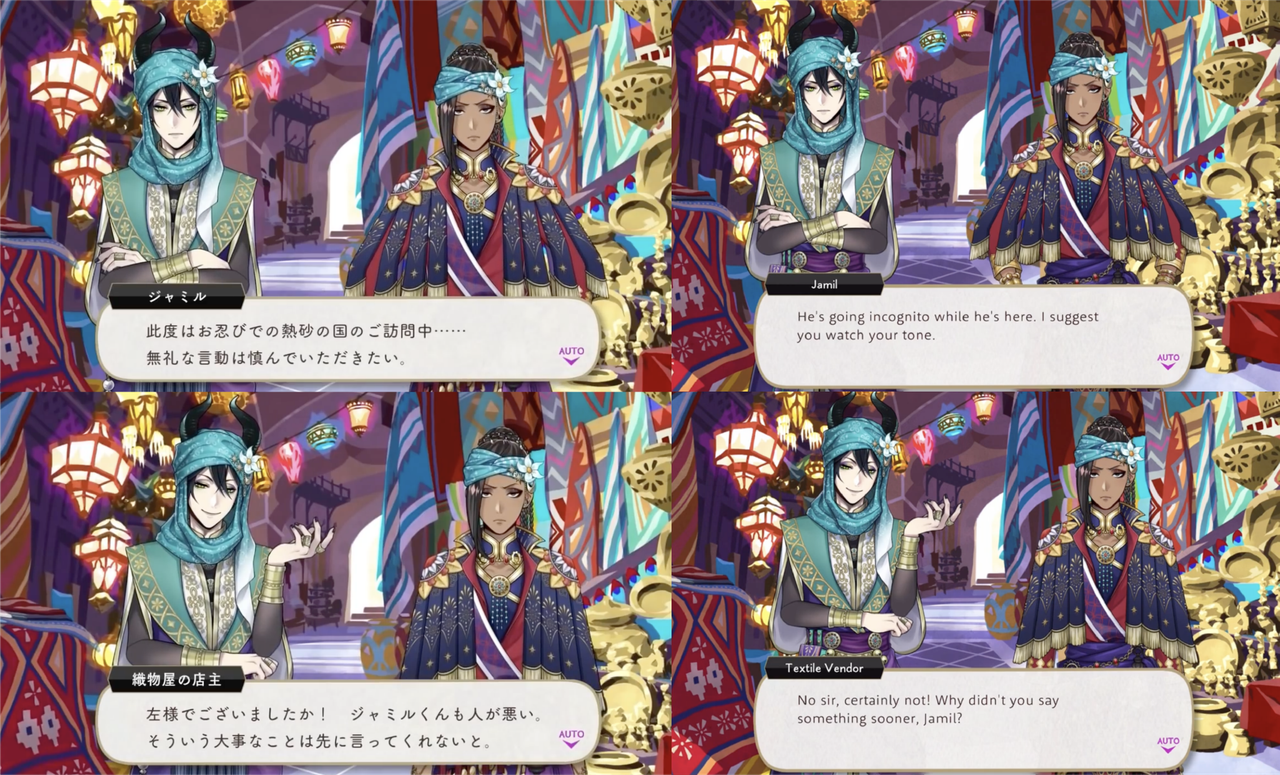
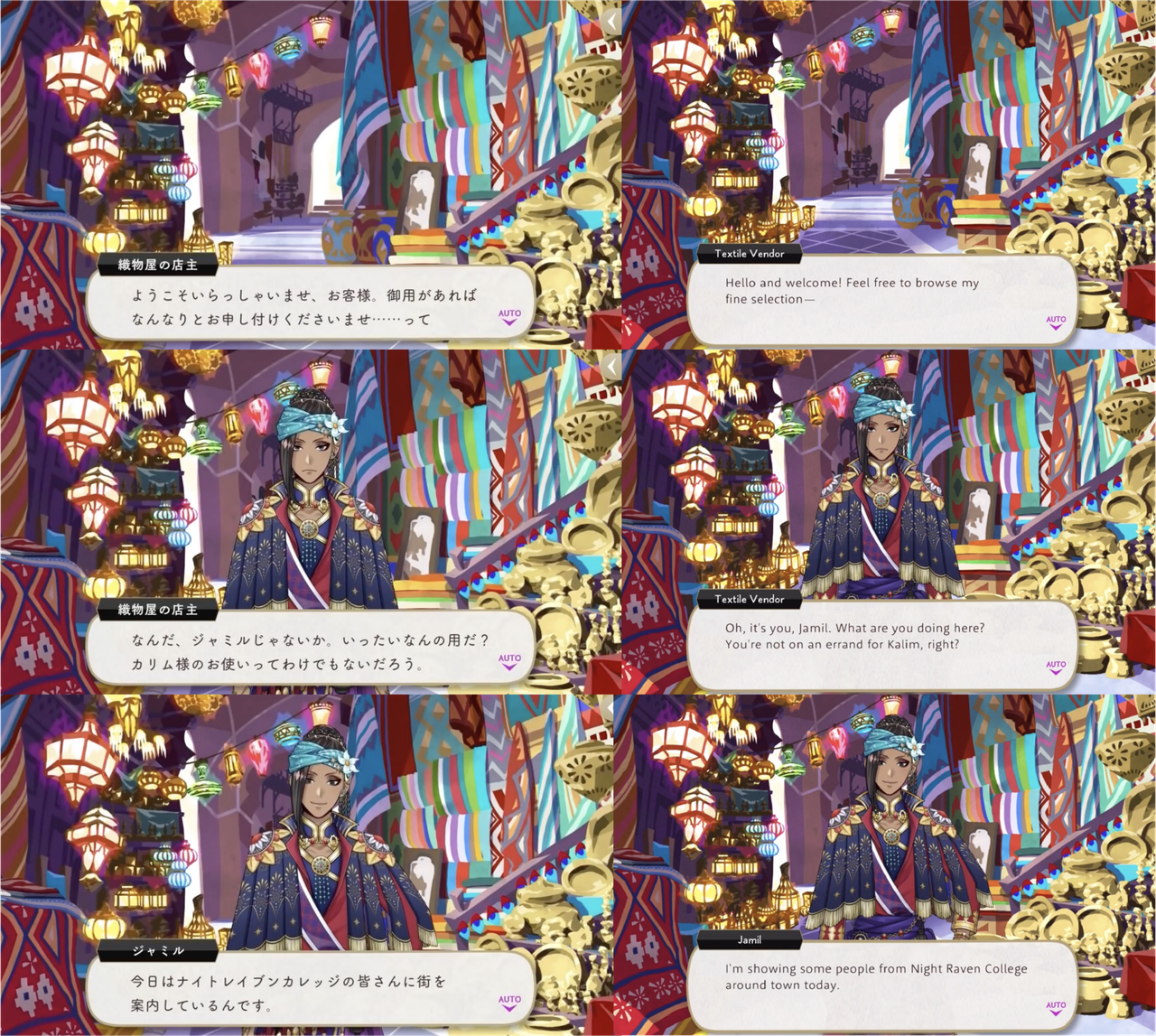
The Textile Vendor initially uses formal customer-service language, but immediately switches to rough, casual speech upon recognizing Jamil, complaining about something Kalim did as a child, resulting in Jamil apologizing for Kalim. When they learn Malleus’ status, however, they immediately return to polite, subservient speech and even scold Jamil for not warning them.
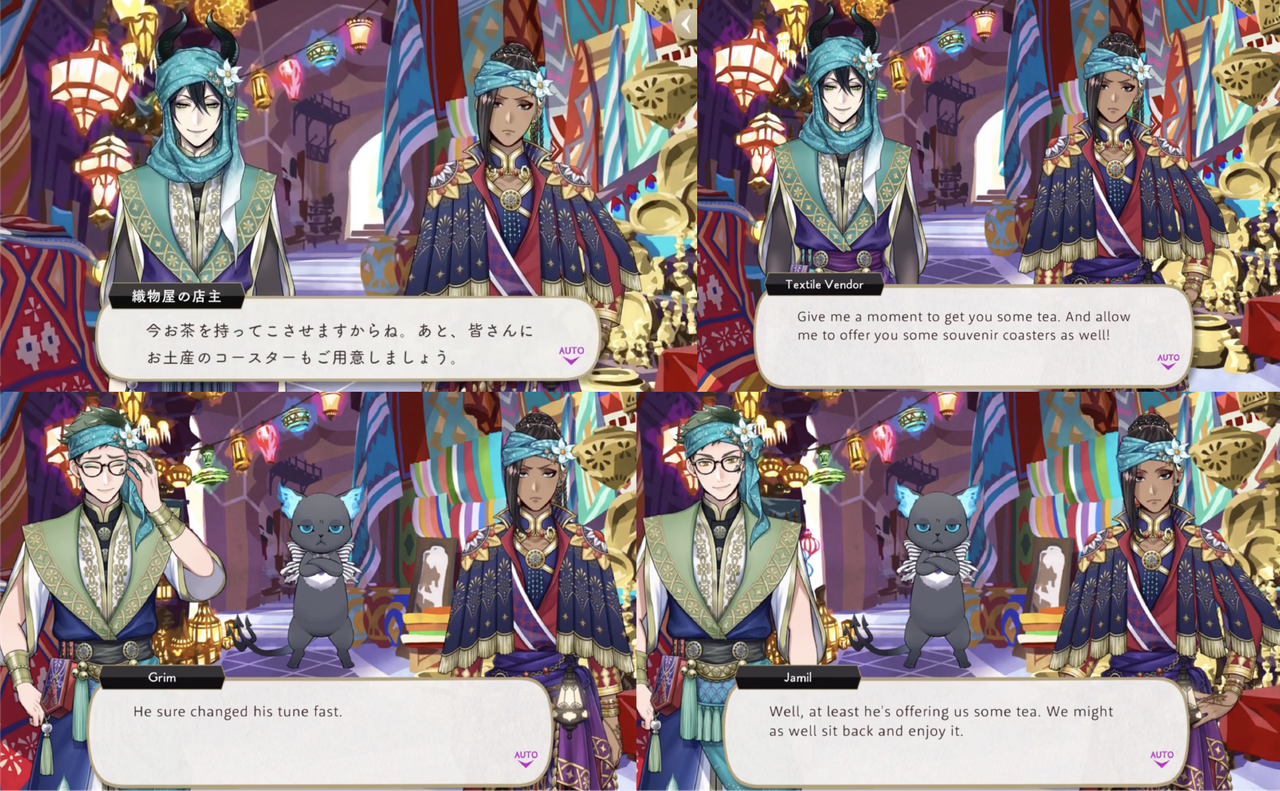
Jamil’s use of “Kalim-sama” in this interaction possibly reflects the highly status-conscious nature of their relationship, suggesting that this vendor may associate him with being as an Asim servant rather than being an individual.
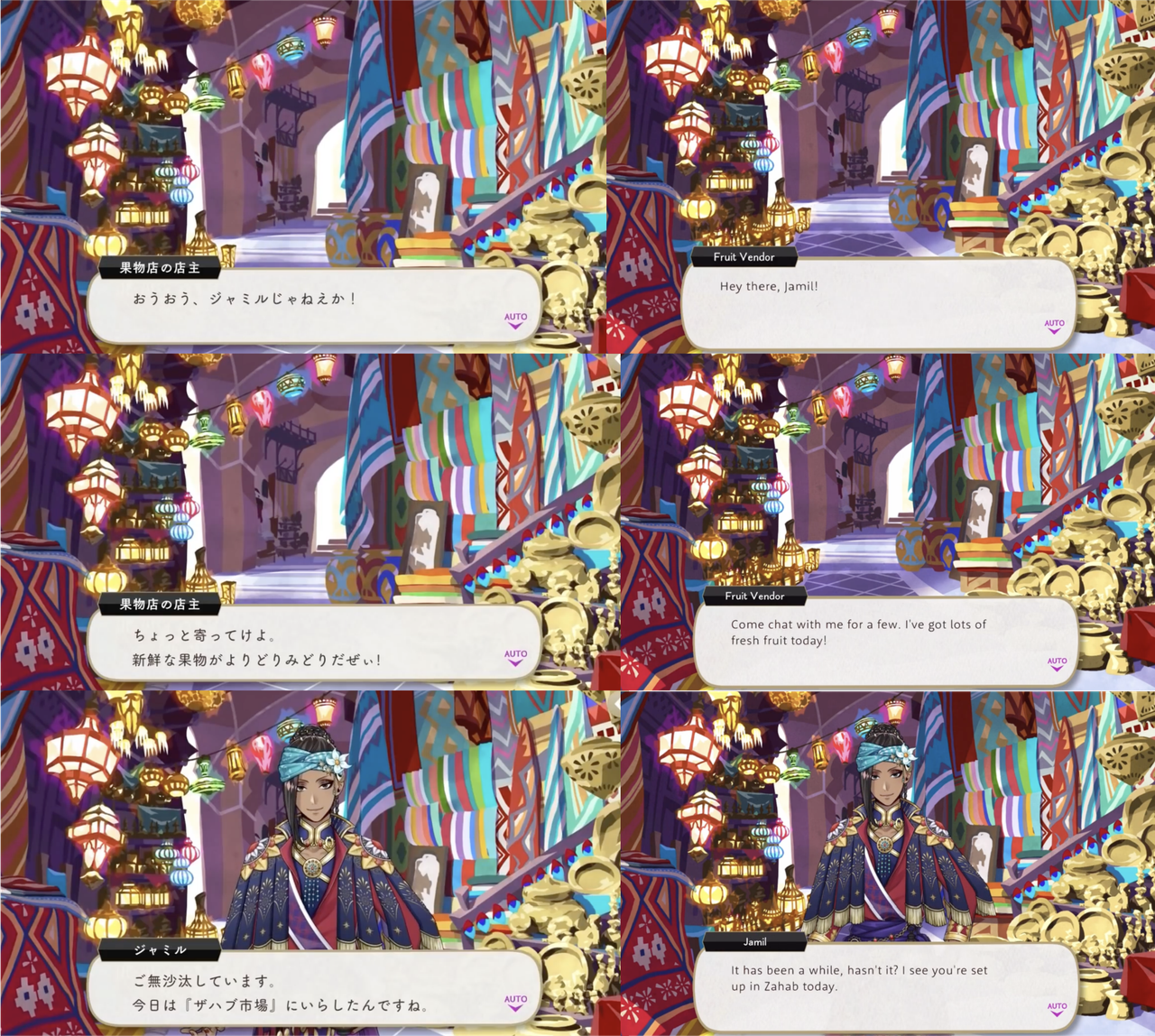
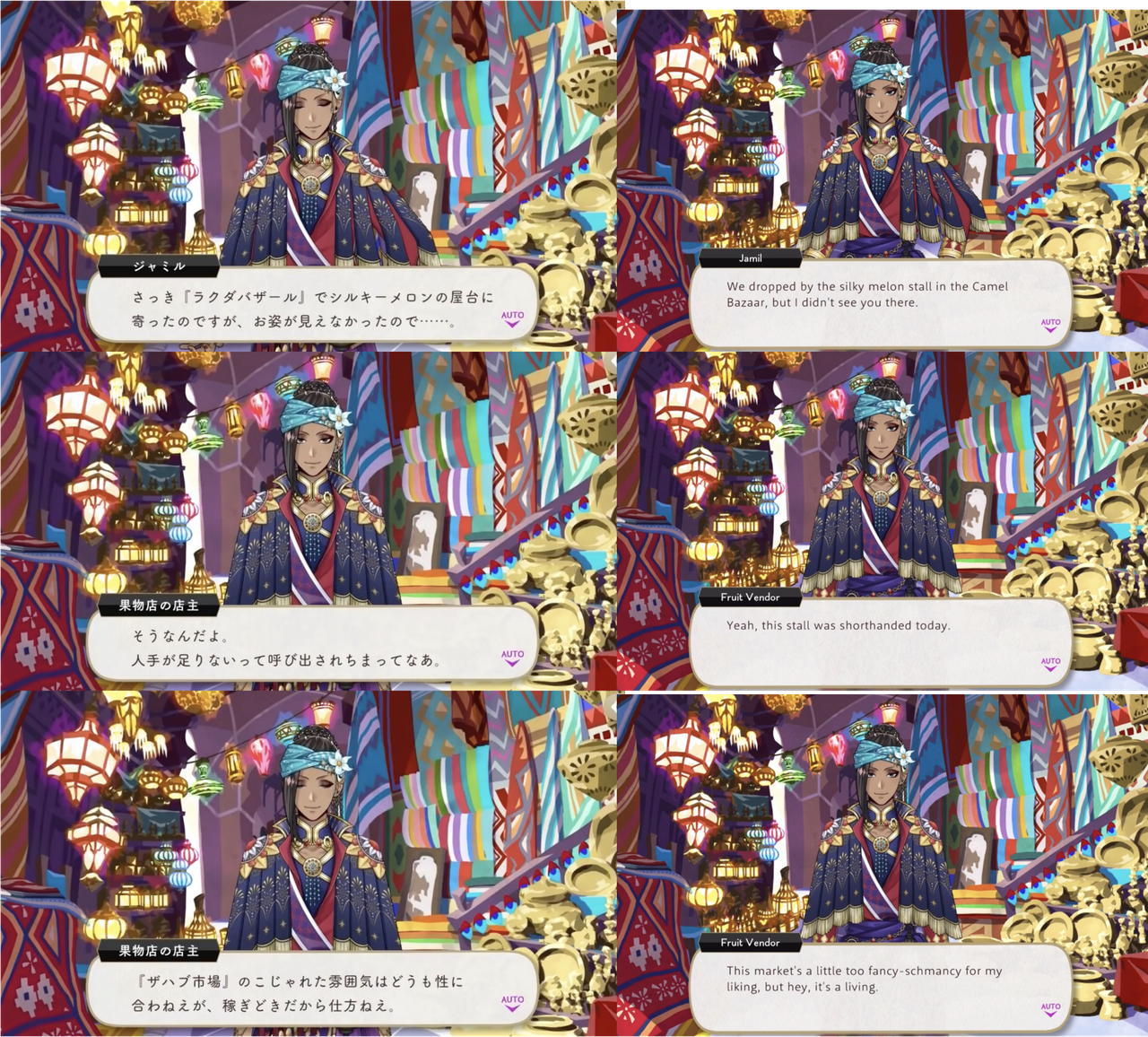
The Fruit Vendor calls Jamil over himself, and Jamil addresses him as おやっさん (oyassan), a familiar/respectful term for an older male (depending on context), different from the おじさん (Oji-san) used by Najma for the Dried Fruit vendor. The Fruit Vendor speaks to Jamil in a rough but friendly manner, treating him more like the mischievous local child he watched grow up than as a servant of the Asim family. The vendor does not acknowledge Jamil’s reference to his “master” or mention the Asims at all.
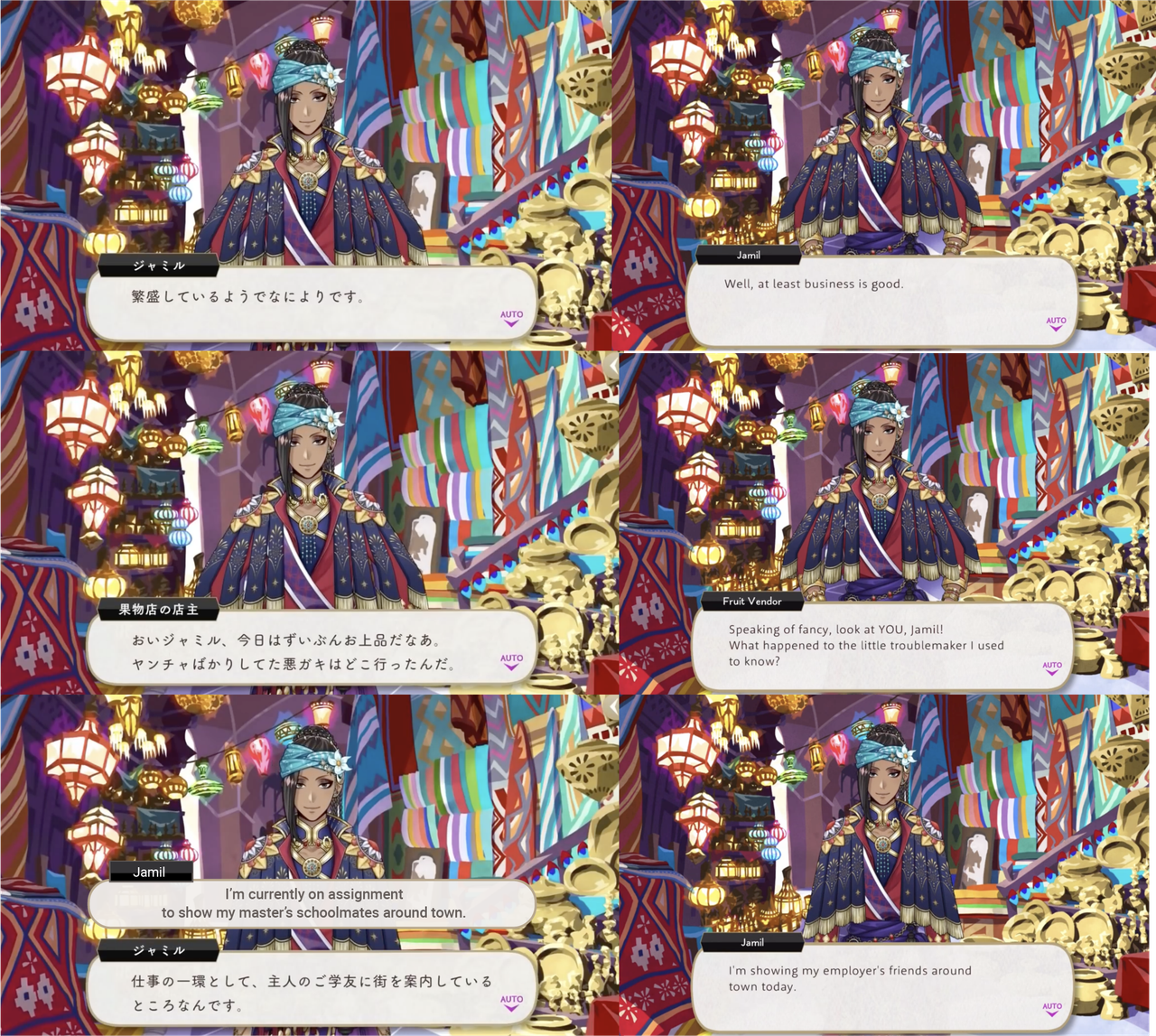
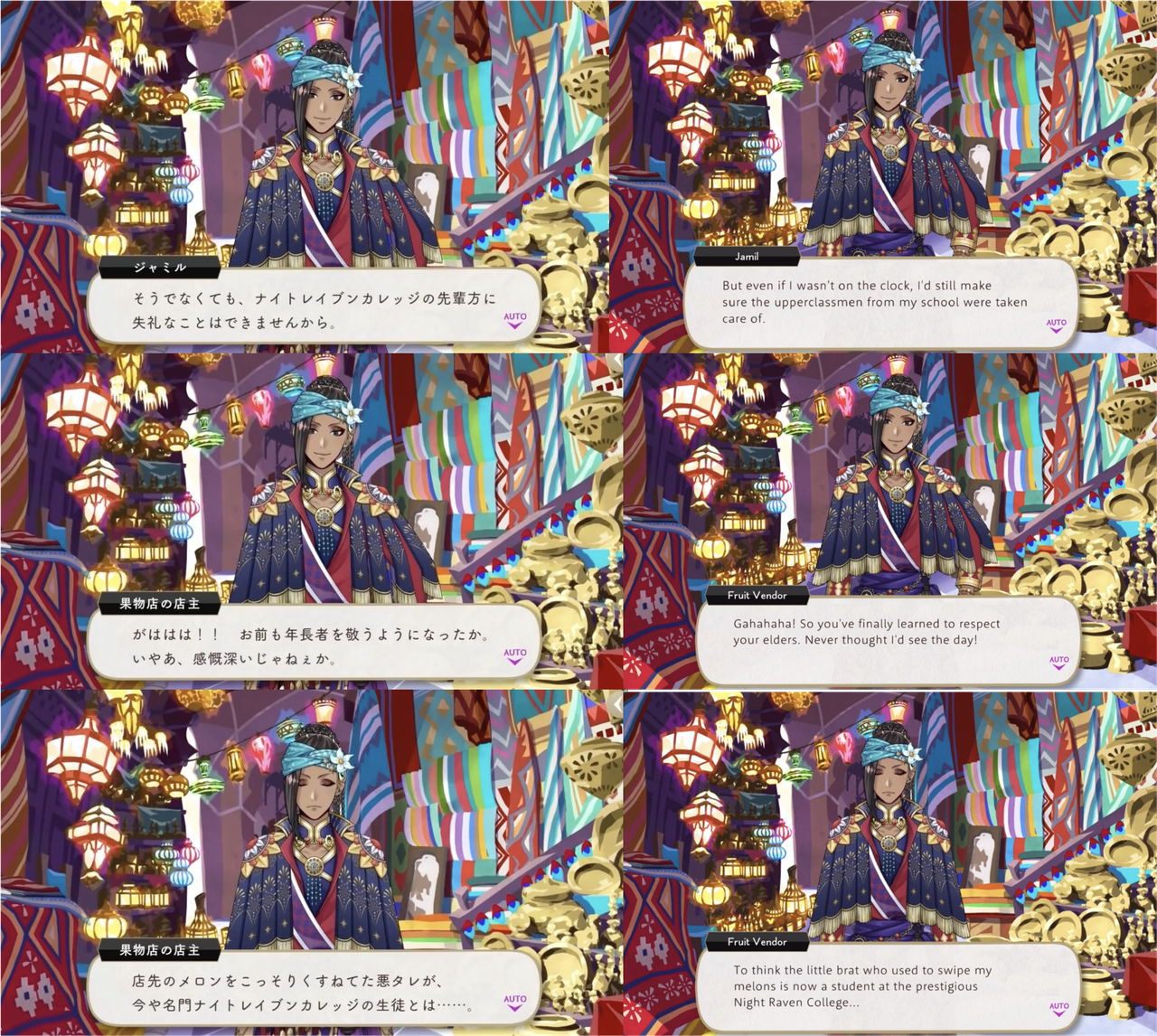
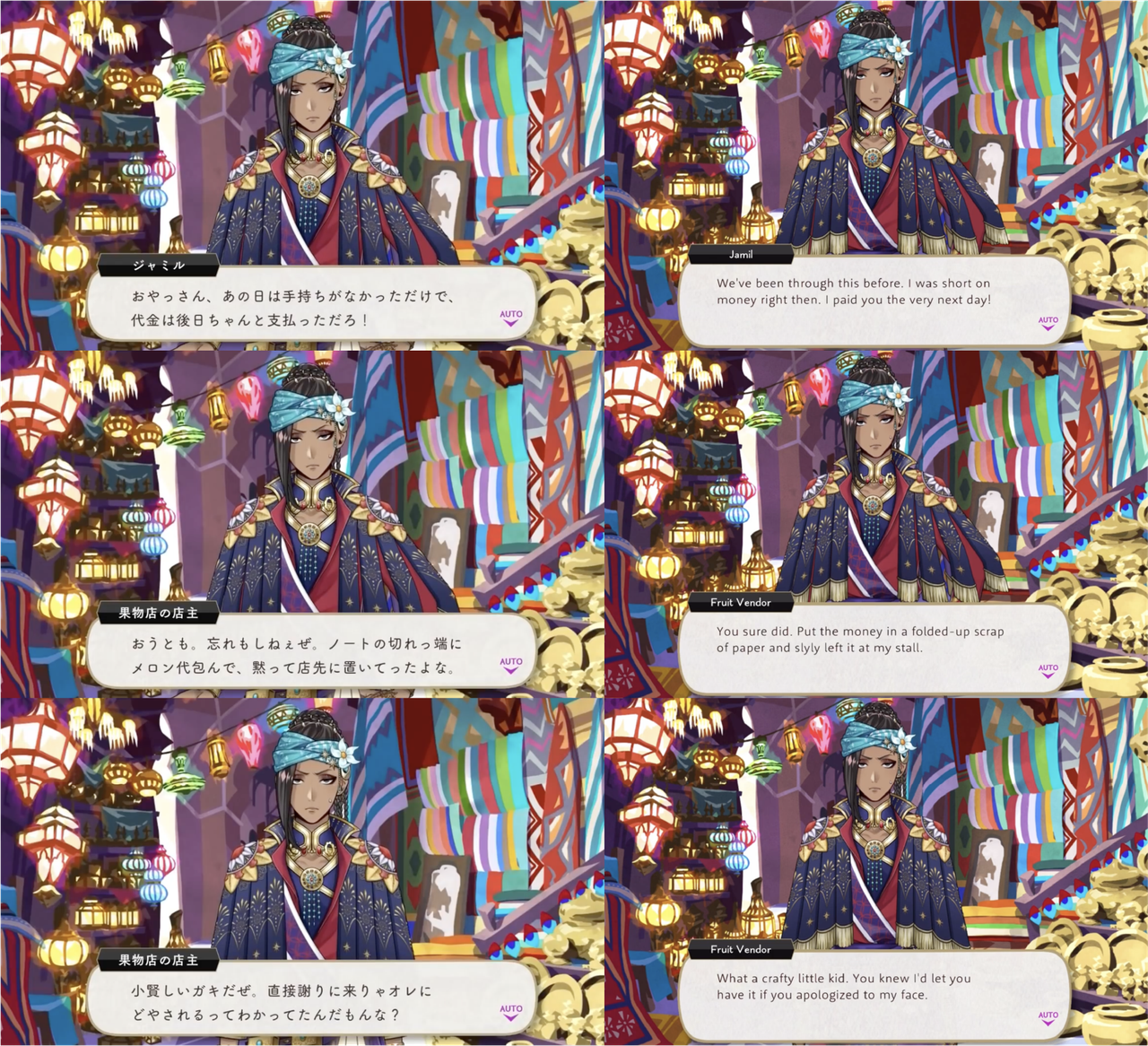
Jamil initially speaks politely to the Fruit Vendor as he does with the other vendors, but eventually joins the Fruit Vendor in using casual speech. He also praises the vendor’s skill to the others. This may be an example of Jamil allowing a more familiar side of himself to emerge when interacting with someone who knows him primarily as Jamil, rather than as Kalim’s servant.
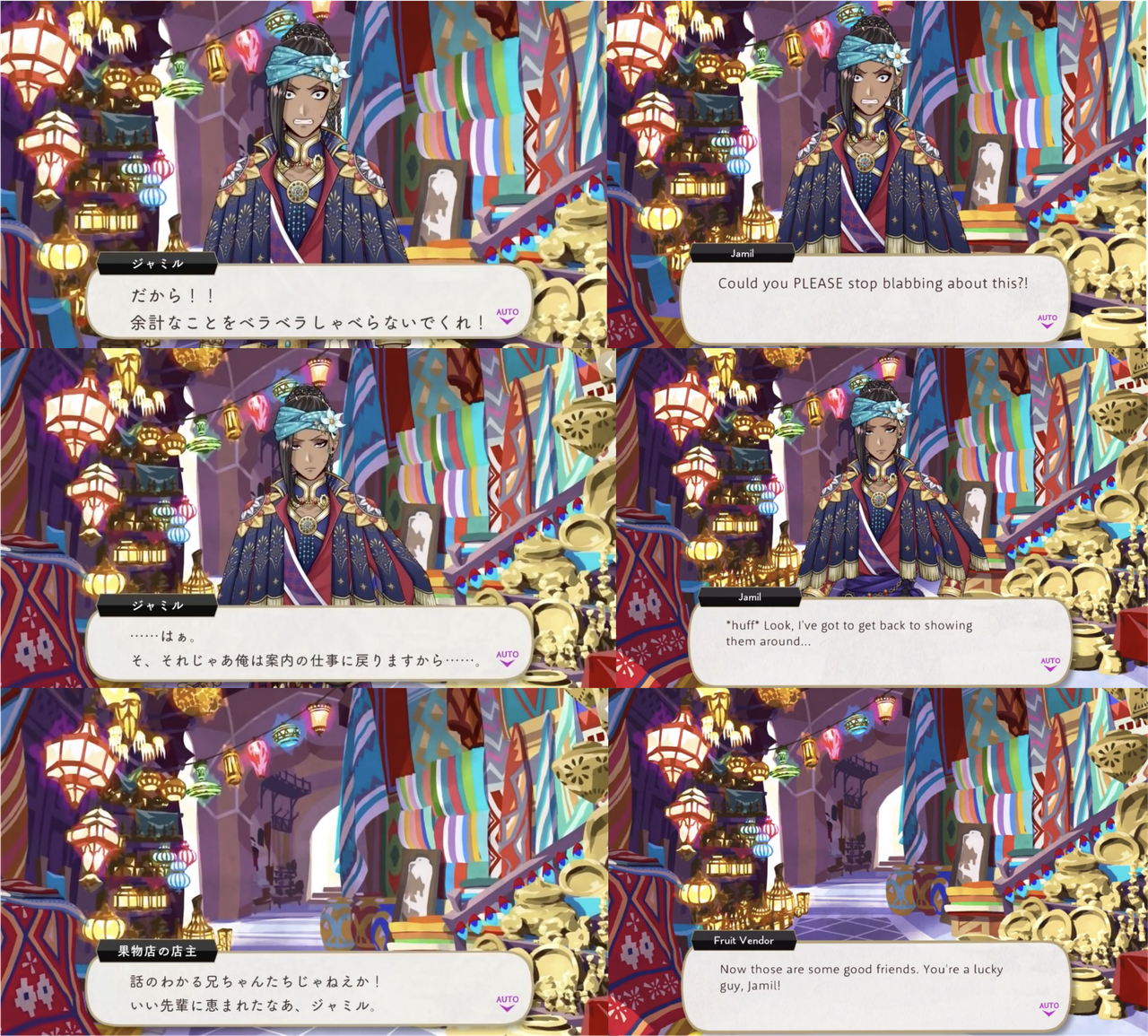
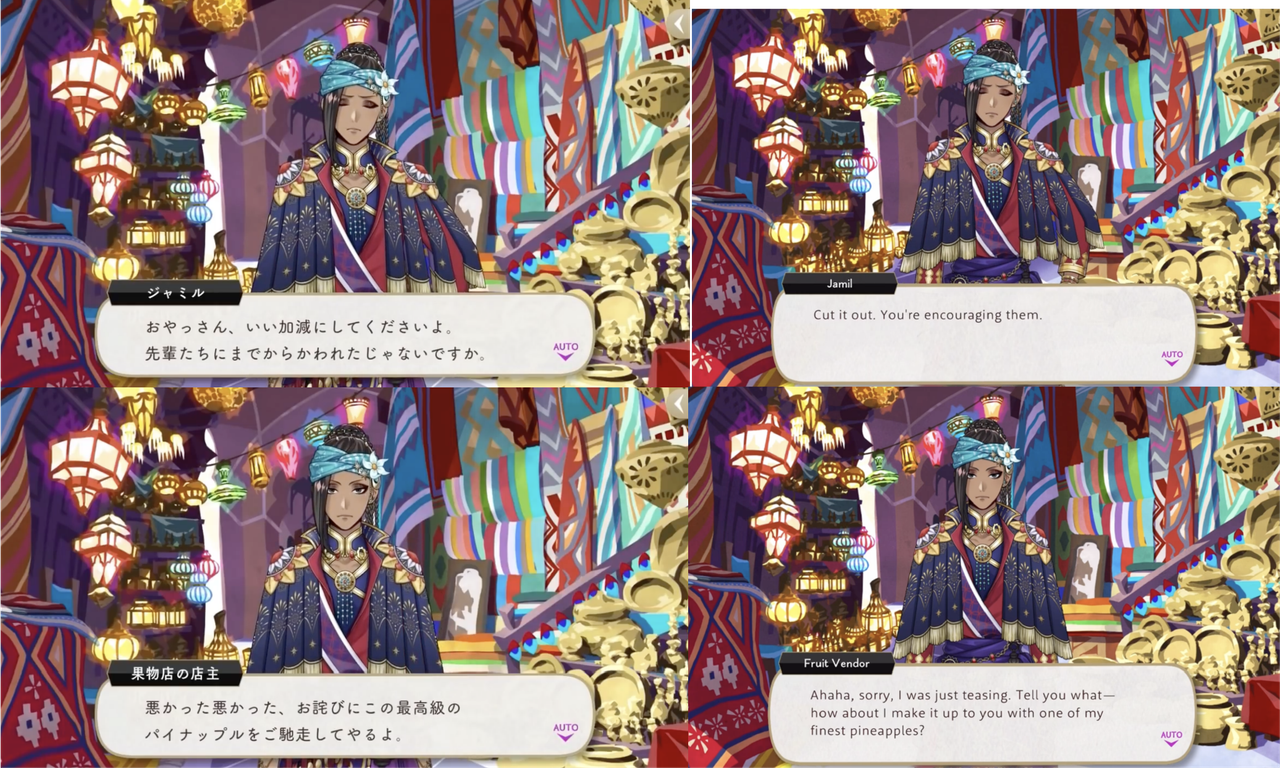
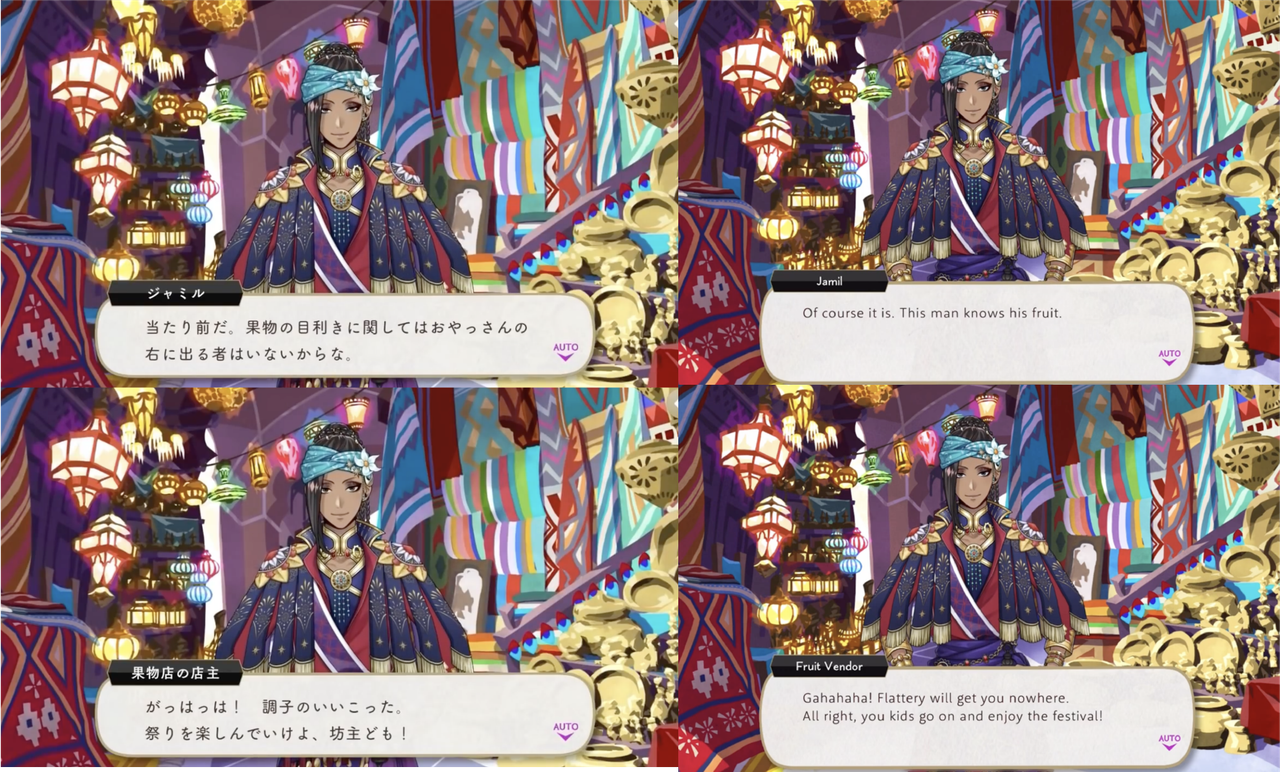
The various vendor interactions might be less so a matter of “fake Jamil” versus “authentic Jamil” and more so about which version of Jamil a particular relationship allows to emerge. The Coconut and Textile Vendors interact with Jamil-as-Asim-servant, while the Dried Fruit and Tea Vendors seem to know Jamil-as-local-child, and the Fruit Vendor seems to know Jamil-as-local-child-who-has-grown-up.
The differences in both how the vendors address him and how Jamil responds to them make Firelit Sky a great example of how his social role shapes the version of himself he presents.

