

Upon visiting Jamil’s hometown for the first time Malleus says that it is very different from what he had been taught, which was the area being mostly desert with little rainfall meant that the people “struggled to get enough water to survive.”
Jamil responds, “There was a time when that was true, but the Scalding Sands has advanced a lot over the years,” and Malleus says, “My grandmother told me tales of the Scalding Sands, but we haven’t heard much about the country since things became peaceful here,” possibly insinuating that there was a time in the (perhaps distant) past when things in the country were not peaceful.



When Malleus observes that a market called “the Camel Bazaar” does not have any camels Jamil explains:
“Camels were used to transport goods and luggage before we developed the canals and roads. There used to be an oasis here where merchants would bring their camels to rest. They started selling their wares right at the oasis, and eventually it became a market. Now we use trucks and boats for commerce and shipping, but the name stuck around.”



Jamil further explains, “People used to travel on camels, since they can go long distances in extreme heat. But now they mainly ferry tourists around to famous spots. We’ve got elephants and giraffes that do the same thing, too.
Kalim explains that while the country is hot and dry and “Most of the country is desert,” there are canals lining the streets of his and Jamil’s hometown, Silk City, “so it’s quite cool.”



Kalim says, “in the distant past it was hard to find drinking water, but there’s nothing to worry about now,” and Leona replies, “Sounds like your government was proactive about adopting advanced tech in order to improve the lives of its citizens.”
Jamil says that there a lot of water tower back in his hometown, “though infrastructure developments have rendered some of them obsolete” and “The temperature’s hot, but you really need to watch out for the sun. Its rays are quite strong. The Scalding Sands is home to a vast desert and has a torrid climate. Most of the land sits on a peninsula facing the sea. You can find many affluent neighborhoods and resorts along the coast.”



Jamil says that Kalim’s family developed “the rivers running through the country into a network of man-made canals. The canals then made it easier to set up land routes, which expanded our commerce.”
Jamil explains that these canals “operate the same as roadways. They’re a key part of our commerce, so they always have a steady flow of boat traffic. Naturally, swimming in them is prohibited on account of how dangerous they are.”


Malleus comments on the triangular roof of a boat he sees and Jamil says, “That’s a traditional Scalding Sands ferry. People travel up and down the canals on them. Locals use them, of course, but they’re also popular for sightseeing. The water vapor from these canals helps to keep things from getting too dry.”
Trey says, “I was expecting the weather here in Silk City to be scorching hot like out in the desert, but it’s relatively pleasant,” And Cater follows with, “All thanks to the canals!”

Jamil says that “Desert regions like this with no rivers get extremely hot during the day, while at night temperatures can drop to 0 degrees Celsius,” and this is referenced during Glorious Masquerade when he compares the effects of Malleus’ magic on the firelotuses to what he has seen happen to plants in his hometown: “The temperature’s drastically different during the day than it is at night. When someone sets out plants during the day and forgets to bring them in at night, a frost forms on them and they wilt like this.”
On the subject of local buildings Jamil says, “Large amounts of wood were hard to come by in the olden days, so they made buildings using stone mined from quarries. Nowadays we have much better access to construction materials, but stone helps insulate against the heat, so the tradition remains,” and, “Economic growth has led to high-rises being built all over the Scalding Sands. But Silk City still has a number of traditional buildings, like the Asim estate. And when new buildings go up, people generally prefer them to be in a traditional style as well. The city’s a tourist destination after all. It’s important we preserve our historic architecture.”
Jamil says that Kalim’s house, which he refers to as “The Asim estate,” is “a well-known fixture in Silk City,” “If you told a taxi driver to take you there, they’d know exactly where to go,” and, “Locals like to refer to it as Asim Palace.”
Kalim says that he and Jamil were born and raised in Silk City, which is “the center of the Scalding Sands. It’s quite popular with tourists, both domestically and internationally.”
Kalim says, “The seaside cities ship fresh seafood here every day through the canals. There’s something for everyone, even the die-hard foodies! We’ve got tons of award-winning restaurants!,” and Jamil explains, “A number of merchant families, including the Asims, went to great lengths to establish Silk City as a center of commerce. They adopted cutting-edge technologies to ensure everyone had access to water. With better access to water, the population grew. And so commerce expanded, wealth increased, the city became prosperous, and our tourism industry developed from there.”
Cater agrees, saying, “Now it’s THE resort spot! People come here from all over the world!,” and Jamil continues with, “the majority of the country remains an inhospitable desert. We all need water to live, of course. So wealthy families and commoners alike came to the city by the canals, and eventually it grew into this large metropolis. Its name, Silk City, comes from the fact that silk was an essential item in trade back then.”
Kalim says, “It’s definitely one of the biggest cities in the Scalding Sands!,” and Jamil follows with, “That’s right. It’s not the capital, but it’s a major political and economic hub.”

On the subject of life in the city Jamil says, “There are a lot of crowds right now because locals tend to go out in the early morning or evening hours, when the sun’s less harsh. The temperature’s only going to go up from here. That said, it’s easier to get around the city when it’s hotter, since fewer people are out. There are plenty of misters all over the city, so it’s relatively cool compared to other places in the Scalding Sands. And the bazaars and shops provide shade, of course.”
He has a voice line about how he likes seeing fallen leaves on the streets of Sage’s Island, as it is something his hometown doesn’t have.

Trey comments, “The main roads have four lanes on either side. I guess a lot of people drive here, huh?,” and Jamil explains, “Most households have their own car. We locals may be used to the heat, but it still limits what we can do when traveling by foot. That’s also why many stores have drive-through windows, so people don’t even have to get out of their cars.”
Grim describes “all the cars and bicycles” as being in “such flashy colors!,” and Jamil says, “People like to customize their vehicles. It gives them an original flair and sets them apart,” and Cater comments on seeing a rainbow sports car and a gold luxury sedan.

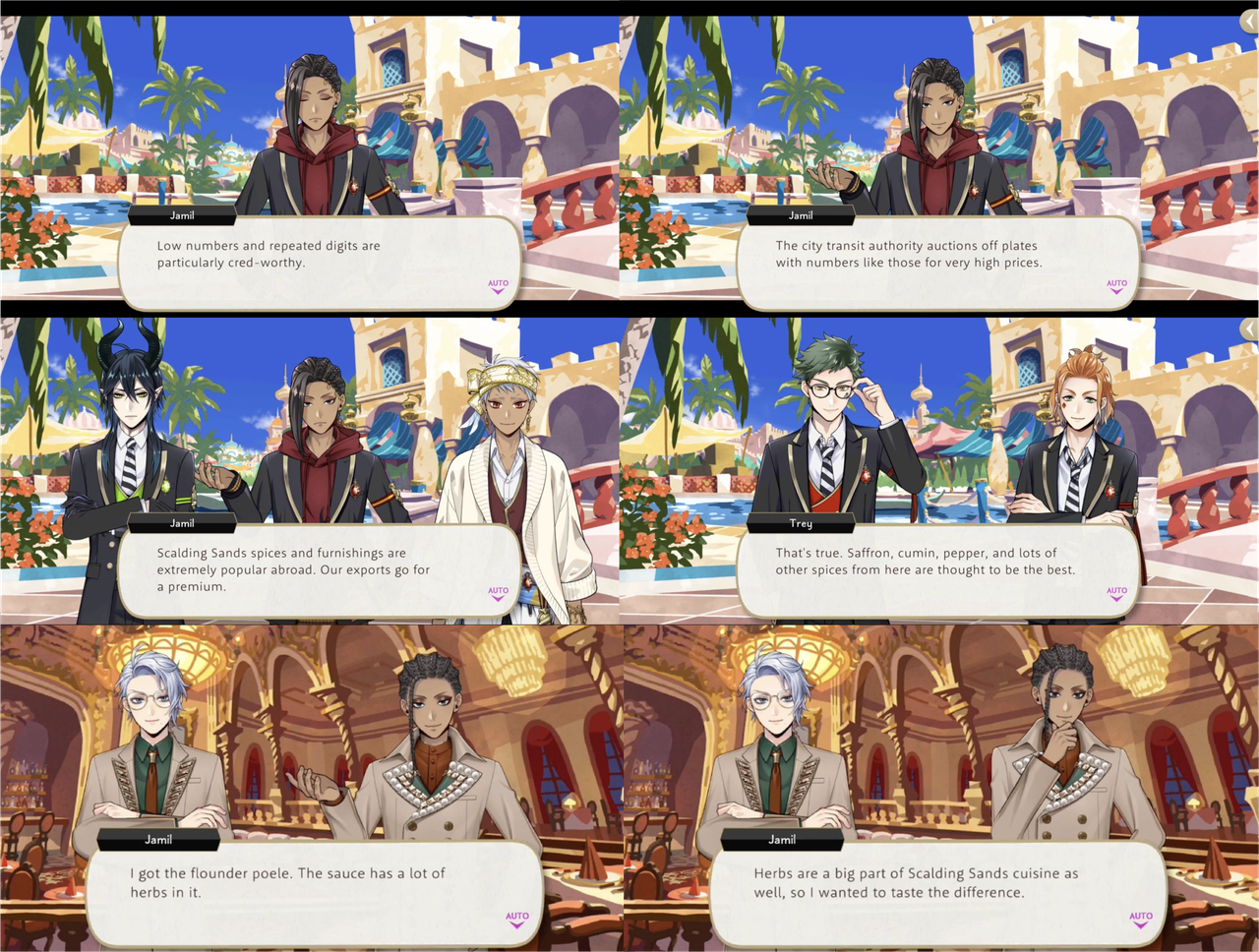
Jamil says, “License plate numbers are also a kind of status symbol for some people. Low numbers and repeated digits are particularly cred-worthy. The city transit authority auctions off plates with numbers like those for very high prices.”
On the subject of local exports Jamil says, “Scalding Sands spices and furnishings are extremely popular abroad. Our exports go for a premium,” which Trey confirms, saying, “Saffron, cumin, pepper, and lots of other spices from here are thought to be the best.”
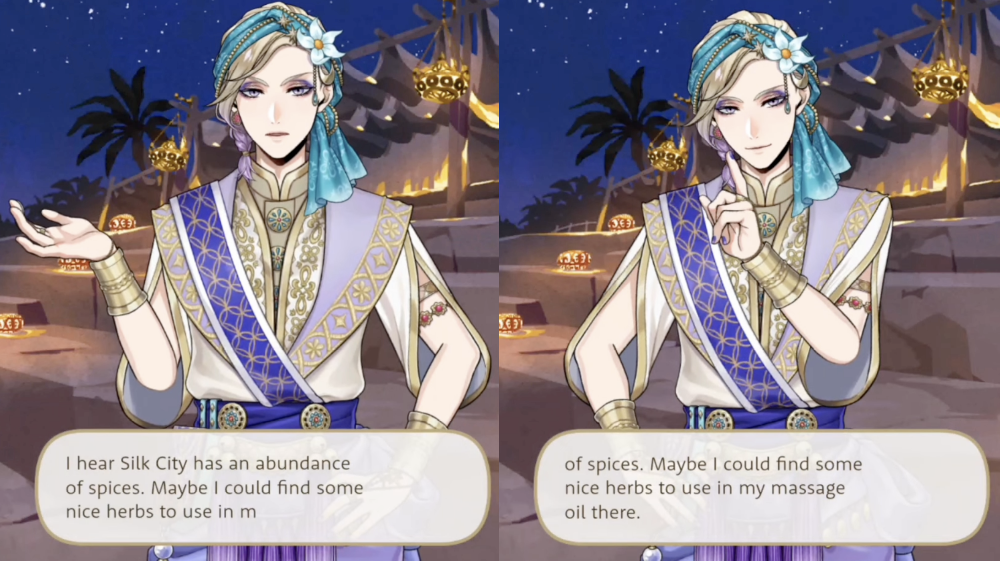
Jamil says, “Herbs are a big part of Scalding Sands cuisine,” and Vil has a voice line of, “I hear Silk City has an abundance of spices. Maybe I could find some nice herbs to use in my massage oil there.”



Cater says, “The colorful folk art from here is pretty famous too. I’ve seen a lot of those pieces in museums.”
Jamil explains, “House Asim is said to be the first family in the Scalding Sands to trade overseas. They did so by ship,” and the clothes they wear during the event are made from Yasamina silk the are’s “most iconic textile.” Jamil tells Trey, “What you’re wearing right now is a top-quality material that artisans spent hours weaving and sewing together.”
Jamil says he has been around a lot of luxury goods and “Fabrics and textiles are major industries in Scalding Sands, so I’m pretty familiar.”


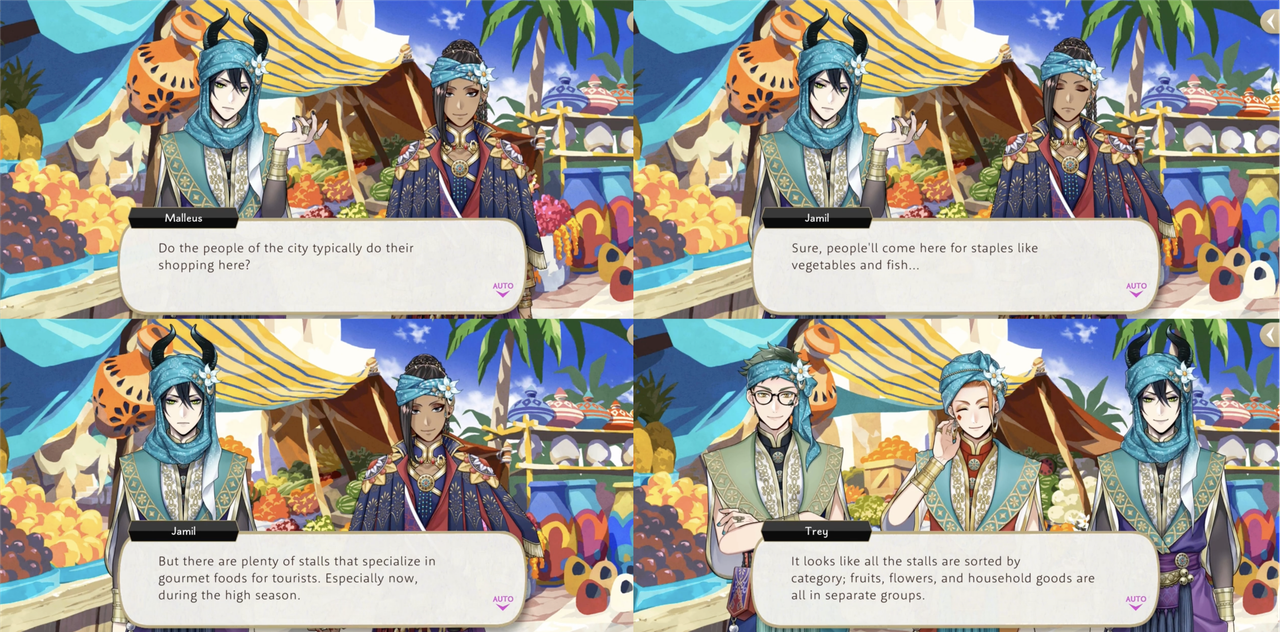
In a local market Malleus asks, “Do the people of the city typically do their shopping here?,” and Jamil responds, “Sure, people’ll come here for staples like vegetables and fish, but there are plenty of stalls that specialize in gourmet foods for tourists. Especially now, during the high season.”
Trey says “all the stalls are sorted by category; fruits, flowers, and household goods are all in separate groups.”
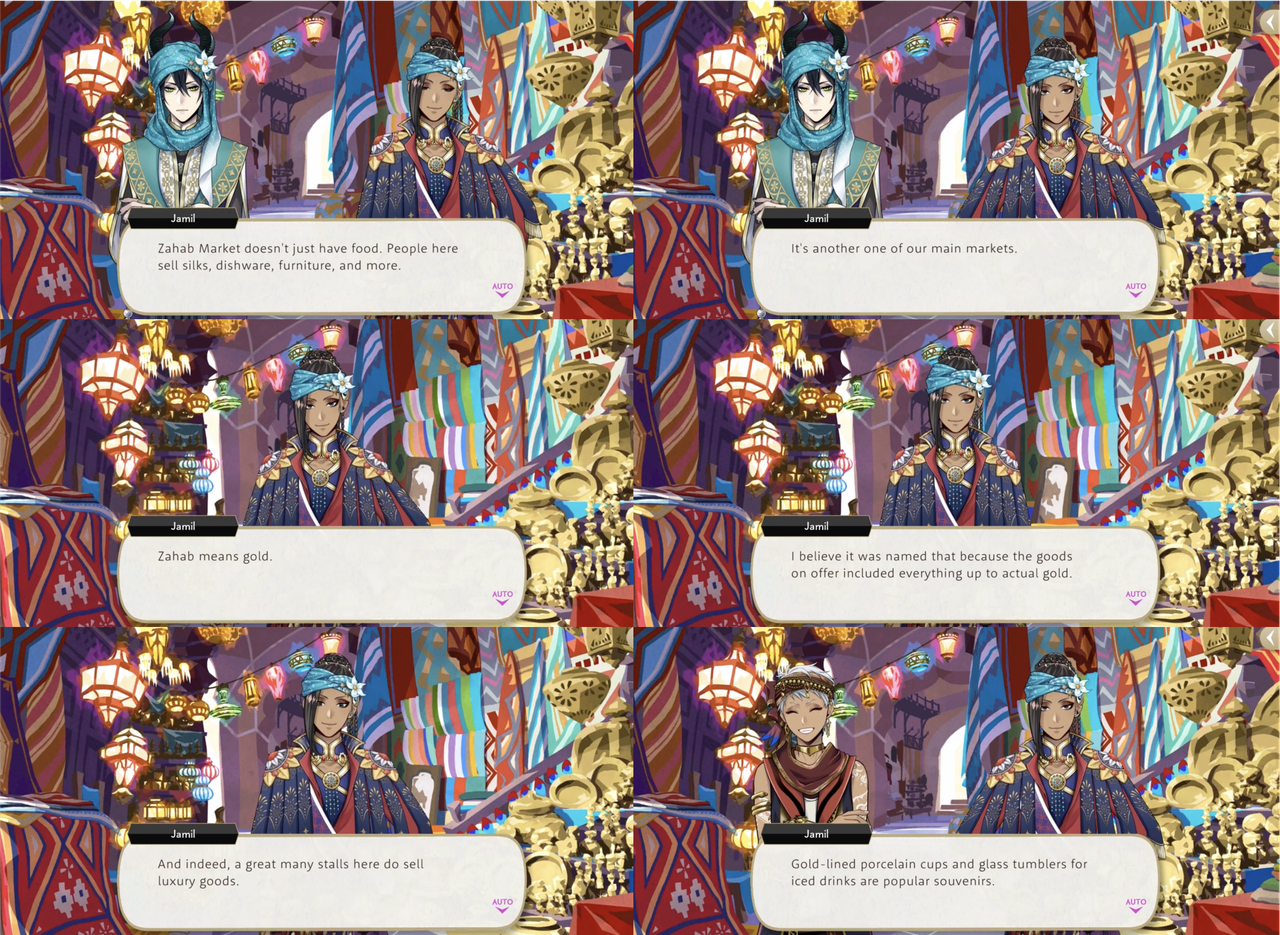
Later they move to Zahab Market, which Jamil explains, “doesn’t just have food. People here sell silks, dishware, furniture, and more. It’s another one of our main markets. Zahab means gold. I believe it was named that because the goods on offer included everything up to actual gold. And indeed, a great many stalls here do sell luxury goods. Gold-lined porcelain cups and glass tumblers for iced drinks are popular souvenirs.”


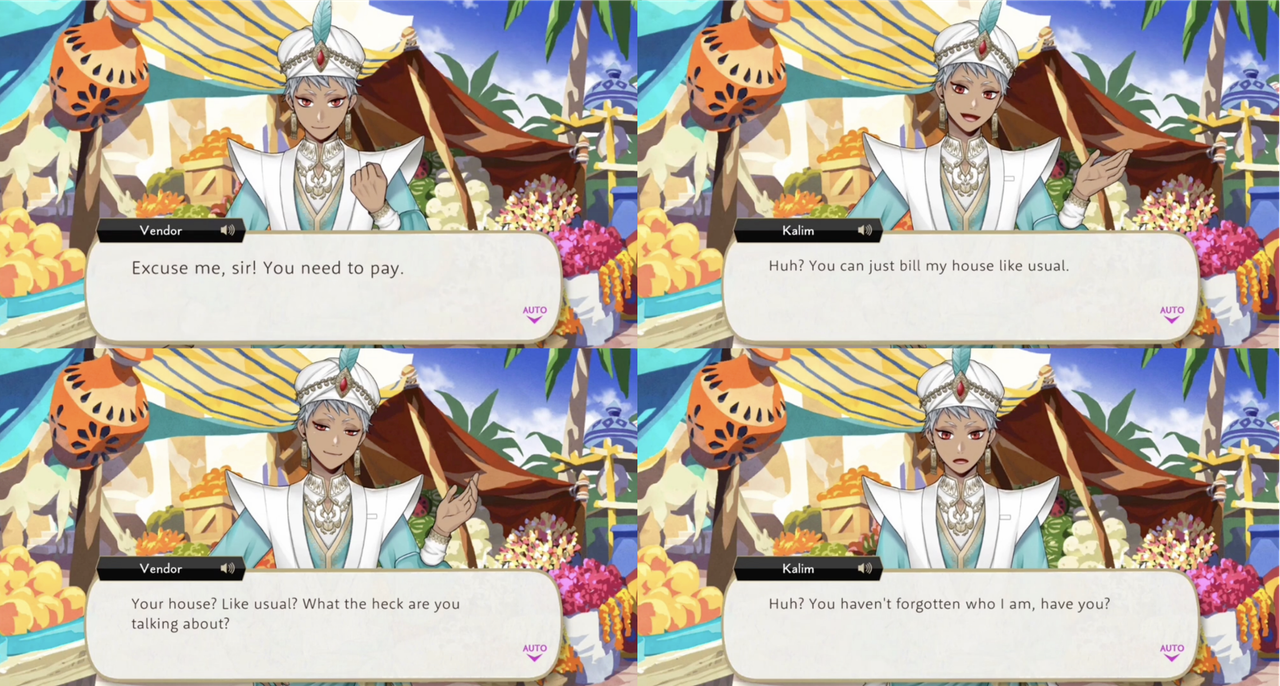
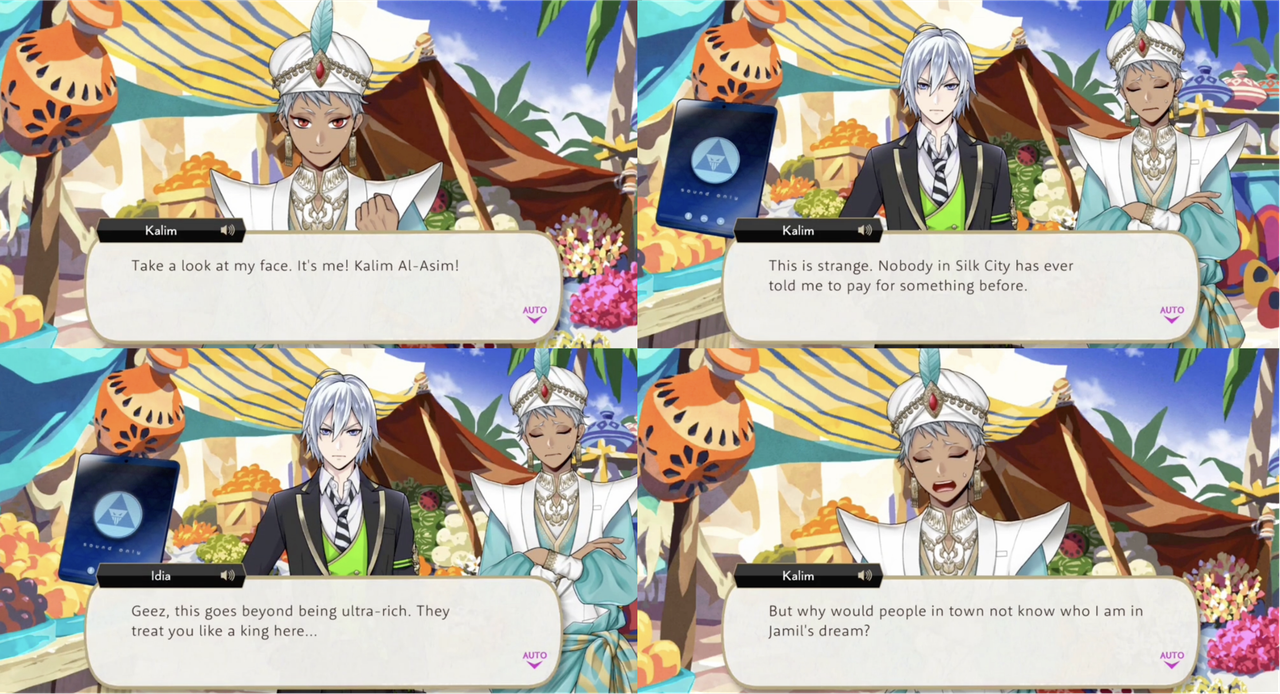
It seems that Kalim is recognized in the markets of their hometown to the point that in Jamil’s dream of Book 7 Kalim is surprised when a vendor seeing his face is not enough for them to “just bill (his) house like usual.” Kalim says, “You haven’t forgotten who I am, have you?,” and, “This is strange. Nobody in Silk City has ever told me to pay for something before.” (Idia: “This goes beyond being ultra-rich. They treat you like a king here…”)
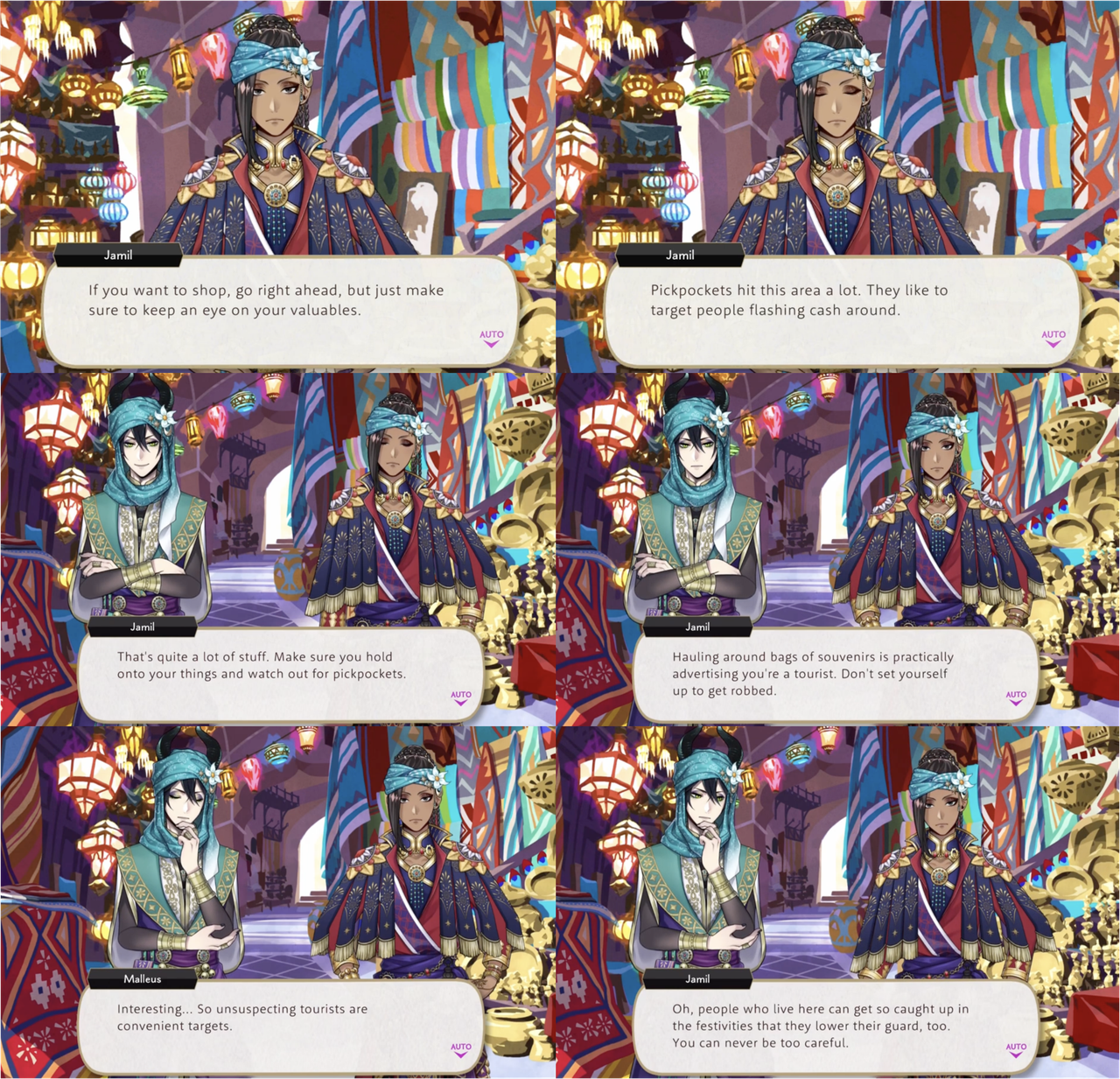
Jamil tells the visiting group, “If you want to shop, go right ahead, but just make sure to keep an eye on your valuables. Pickpockets hit this area a lot. They like to target people flashing cash around…Hauling around bags of souvenirs is practically advertising you’re a tourist. Don’t set yourself up to get robbed.”
Malleus comments on unsuspecting tourists being “convenient targets” and Jamil responds, “People who live here can get so caught up in the festivities that they lower their guard, too. You can never be too careful.”

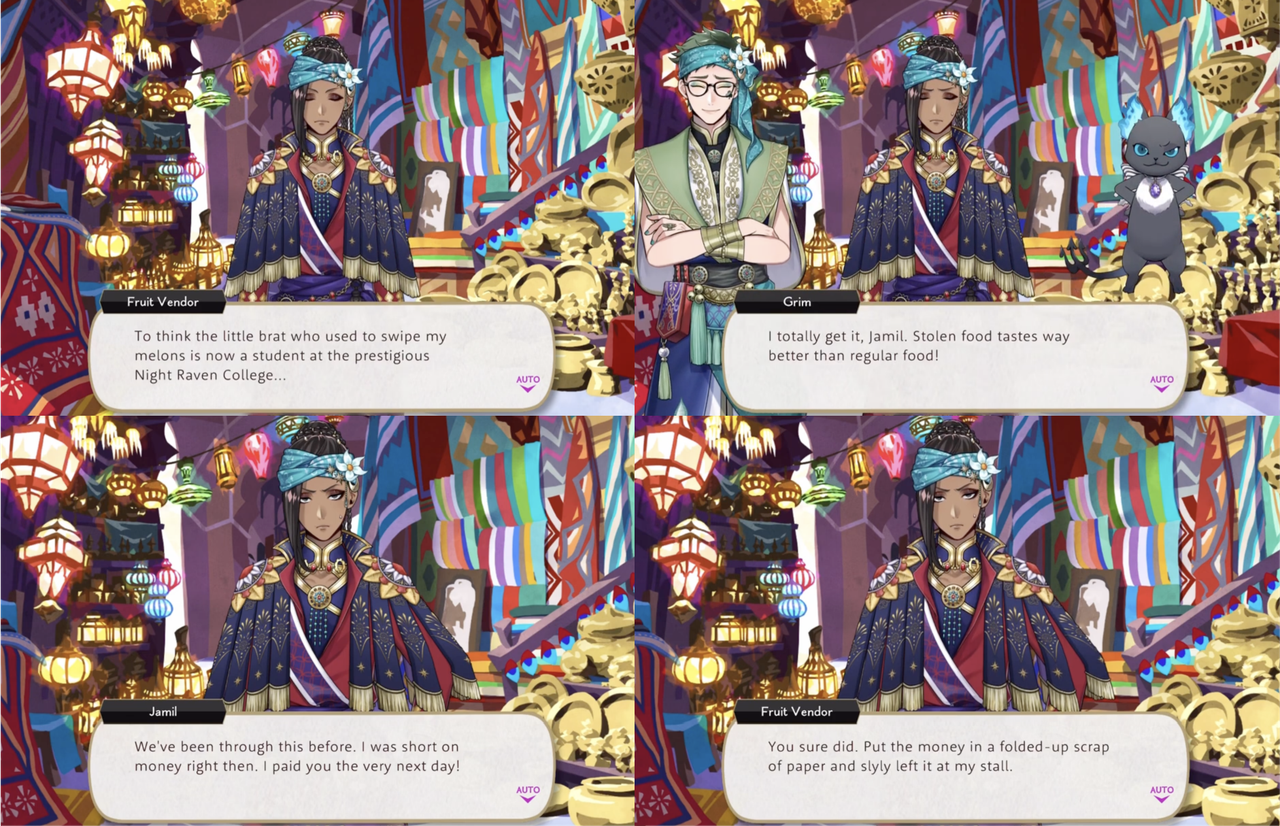
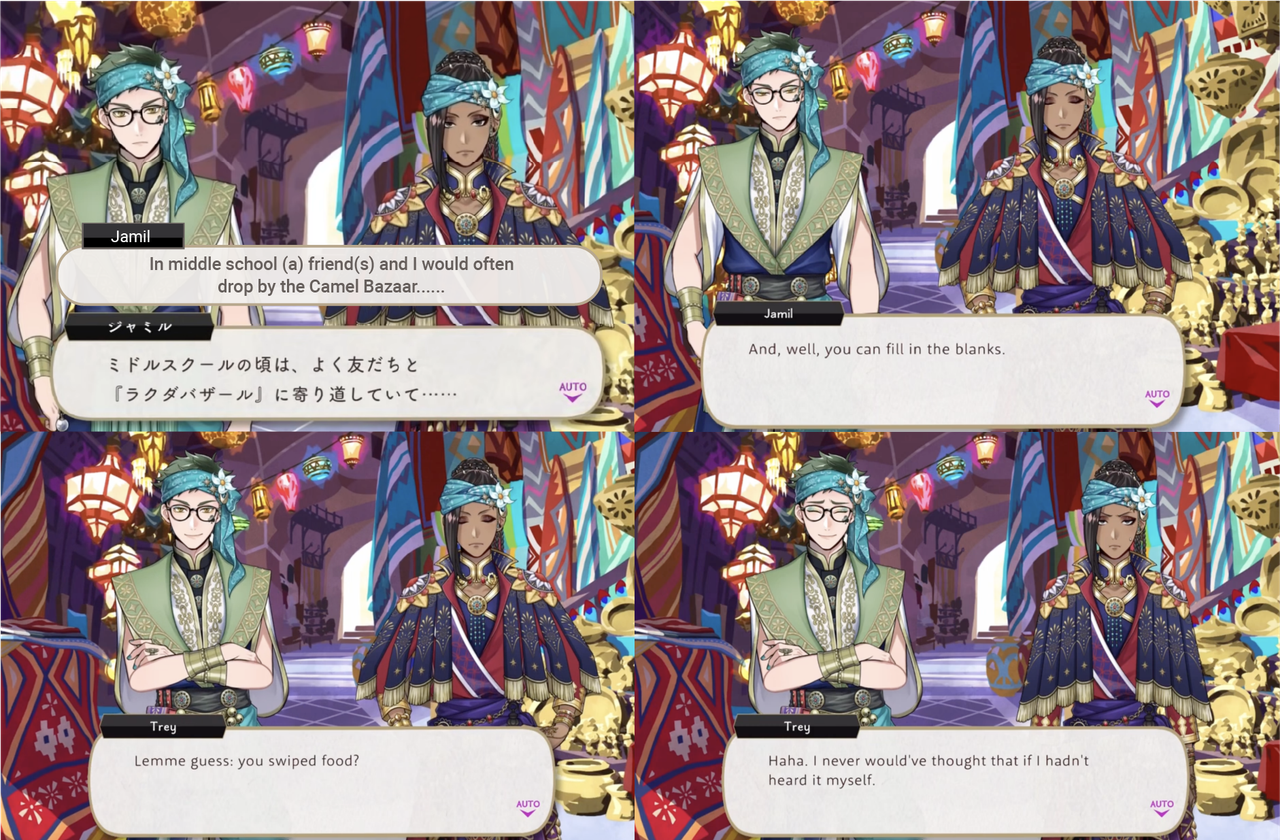
They meet with a fruit vendor who comments on how Jamil “used to swipe (his) melons,” and while Jamil says, “I was short on money right then. I paid you the very next day!,” he later tells Trey that when he was in middle school he would “drop by the Camel Bazaar a lot…and, well, you can fill in the blanks.”
Trey responds, “Lemme guess: you swiped food?,” and it is a little unclear if Jamil stole only from the fruit vendor or other vendors, and if he always paid them back the following day, and if vendors were his only targets or if he also has experience as a pickpocket (unconfirmed).
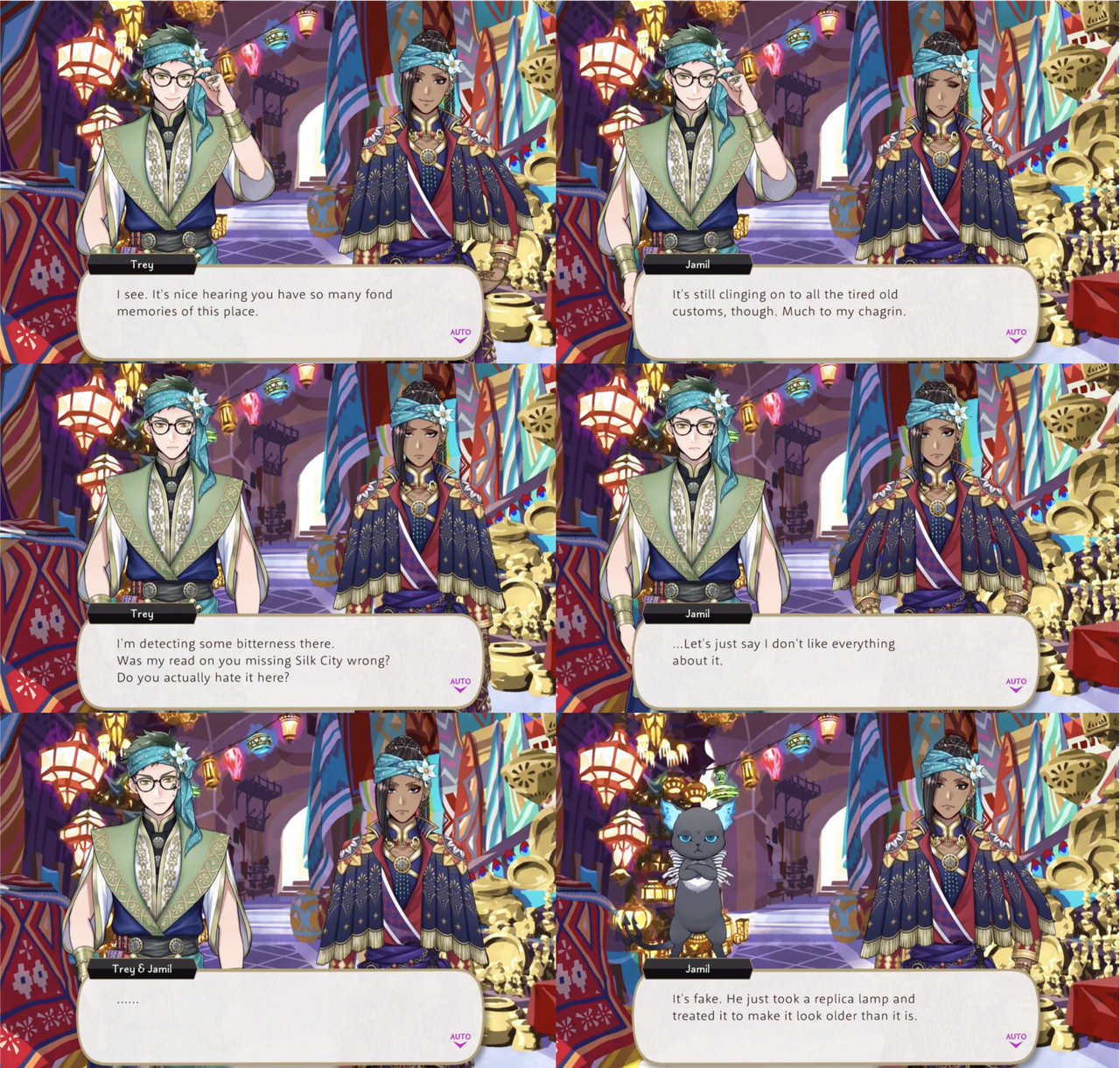
When Trey comments on Jamil having “fond memories” of his hometown Jamil responds, “It’s still clinging on to all the tired old customs, though. Much to my chagrin.”
Trey responds, “I’m detecting some bitterness there. Was my read on you missing Silk City wrong? Do you actually hate it here?,” and Jamil says, “…let’s just say I don’t like everything about it.”

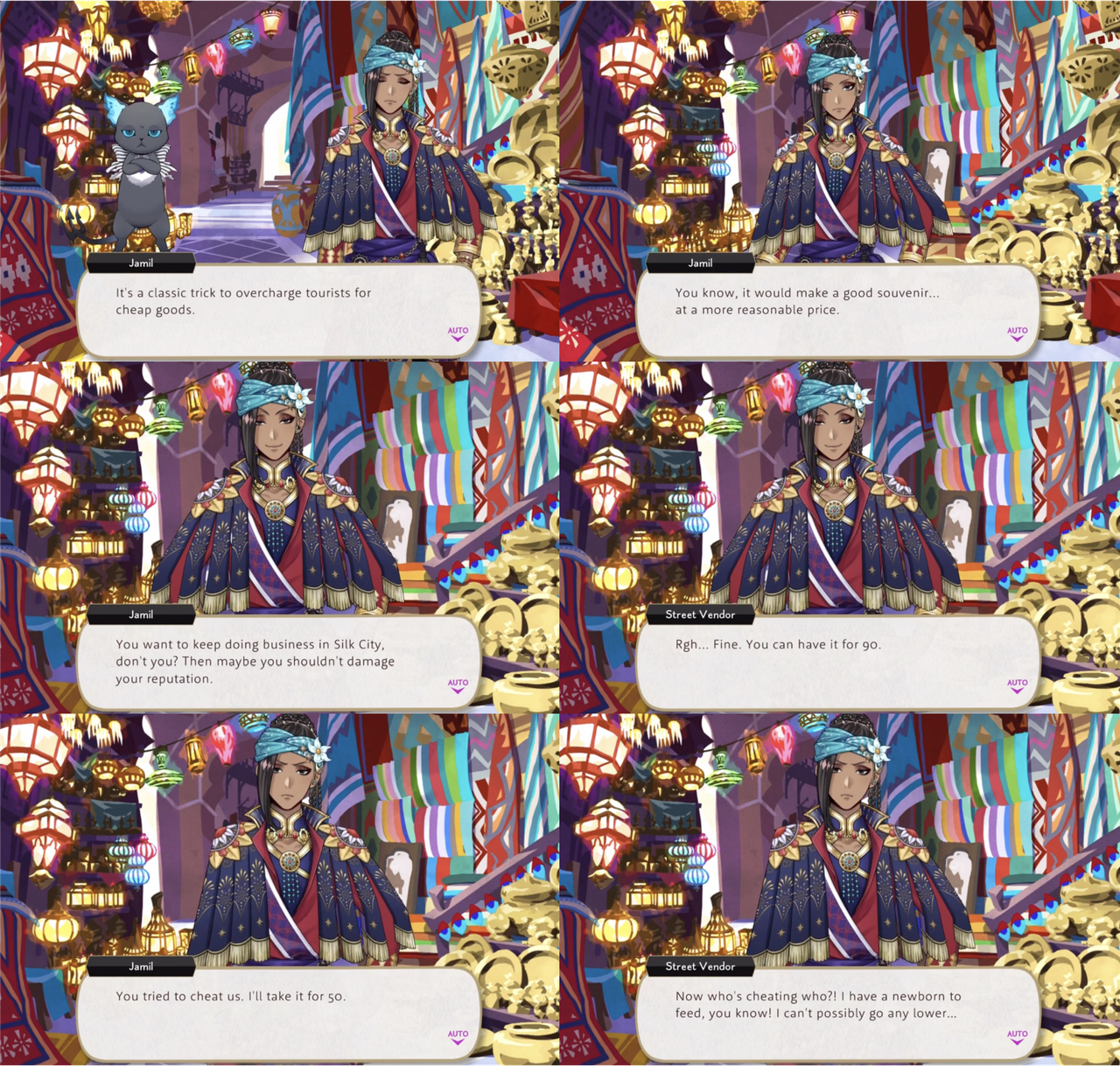
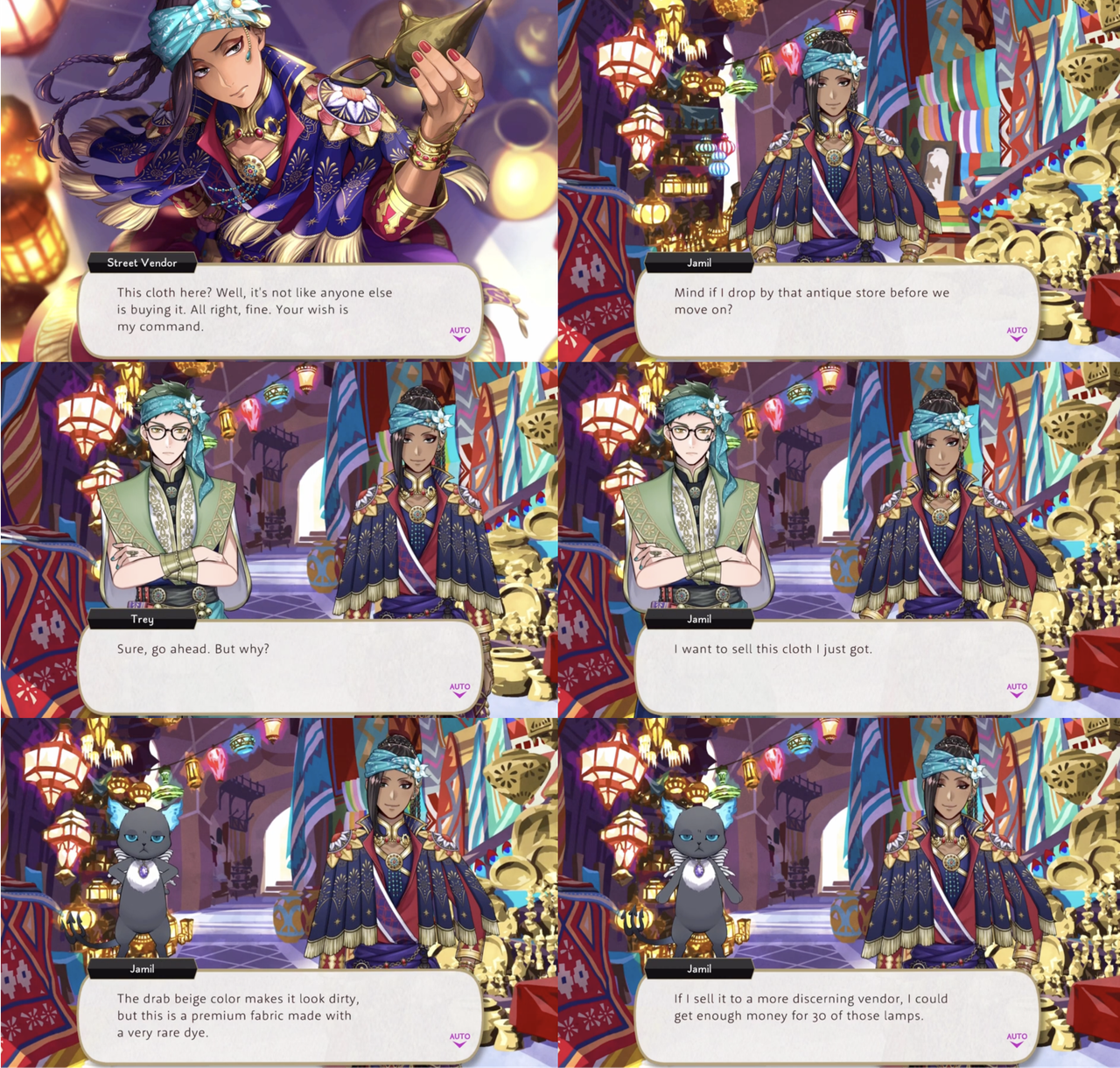
Later Jamil haggles with a street vendor who had tried to trick Grim into buying a lamp falsely advertised as capable of granting wishes, with Jamil threatening to expose his scam to blackmail him into a lower price.
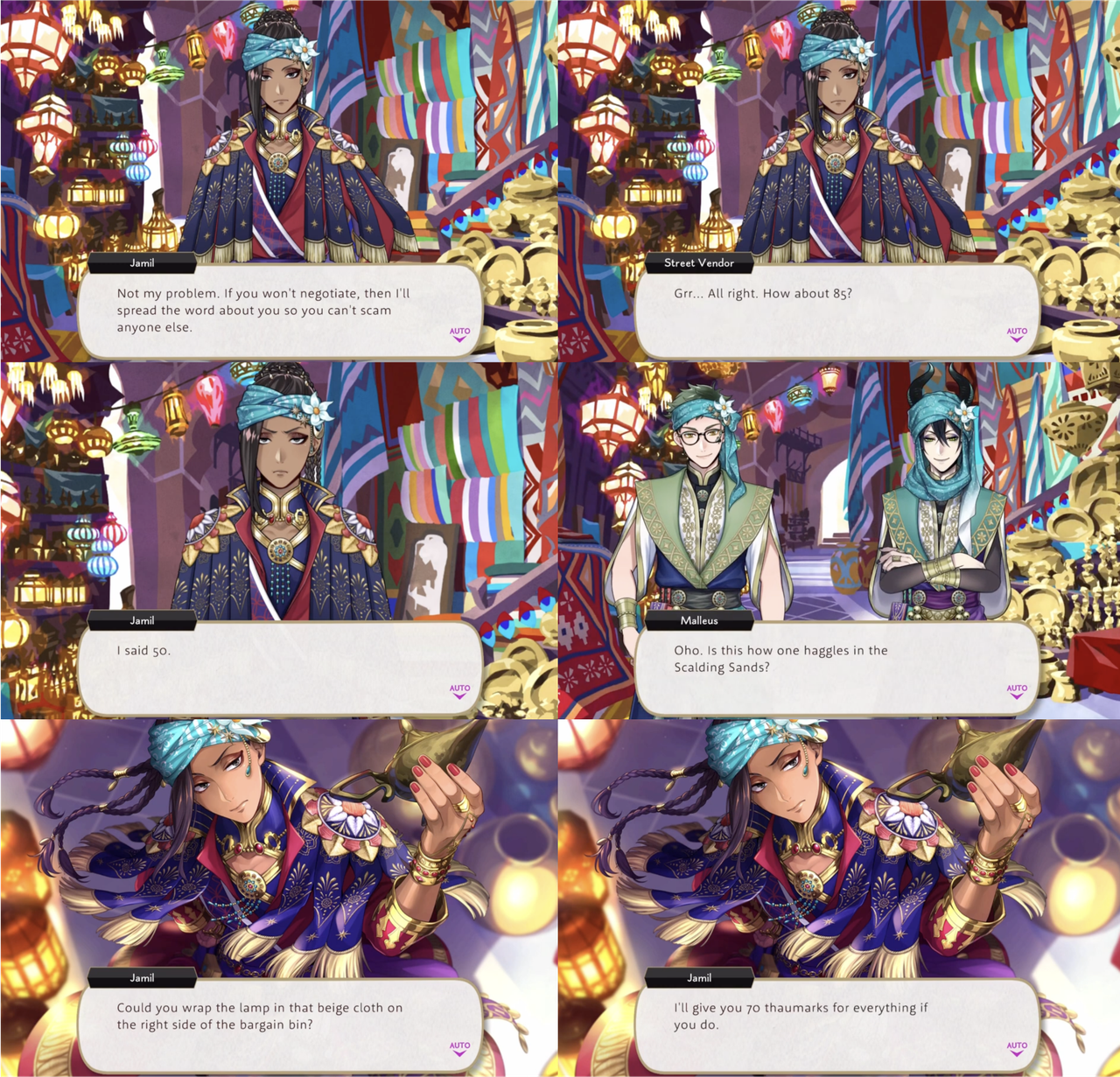
The vendor says, “I have a newborn to feed, you know! I can’t possibly go any lower…” to which Jamil responds, “Not my problem. If you won’t negotiate, then I’ll spread the word about you so you can’t scam anyone else.”
Jamil purchases the lamp for a slightly higher price than he’d been demanding but also asks for a beige cloth to wrap it in for free, later revealing, “The drab beige color makes it look dirty, but this is a premium fabric made with a very rare dye. If I sell it to a more discerning vendor, I could get enough money for 30 of those lamps.”
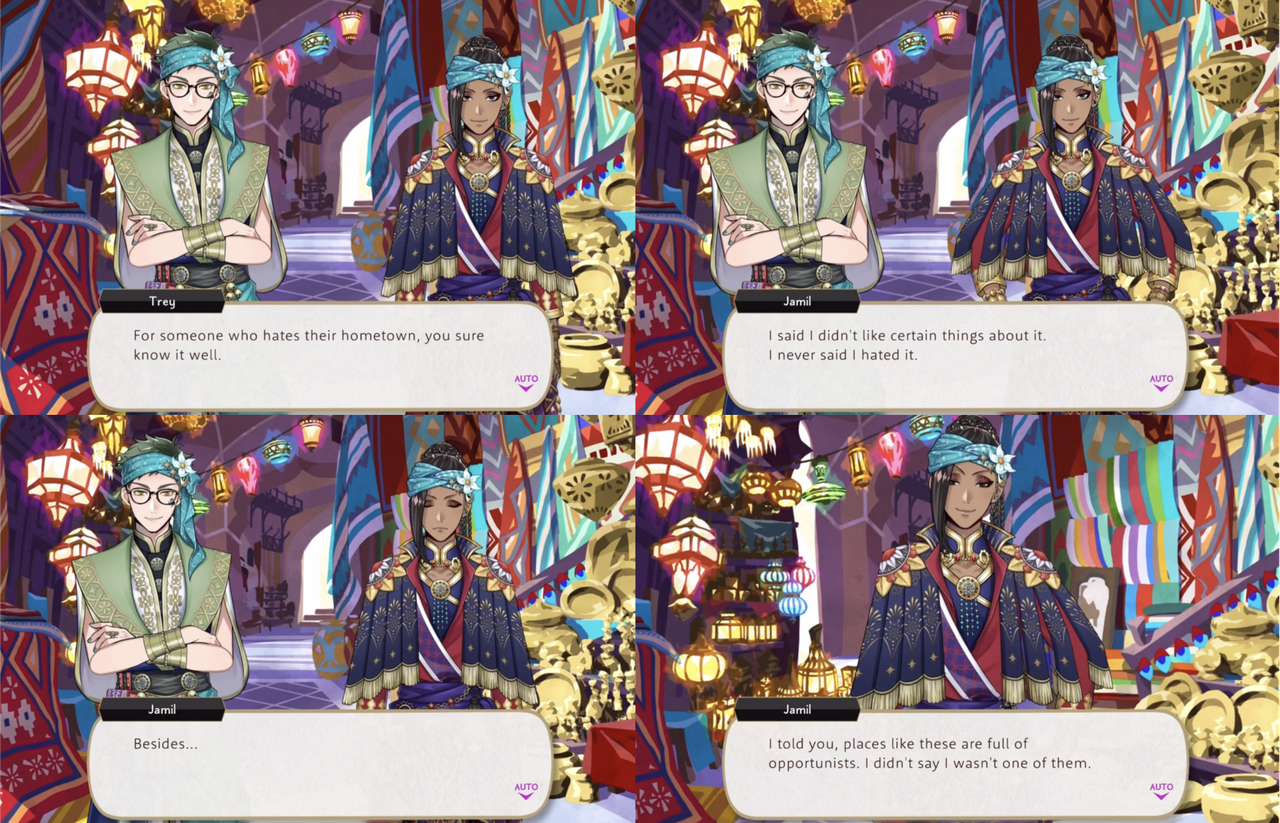
Trey says, “For someone who hates their hometown, you sure know it well,” and Jamil responds, “I said I didn’t like certain things about it. I never said I hated it. Besides, I told you, places like these are full of opportunists. I didn’t say I wasn’t one of them.”

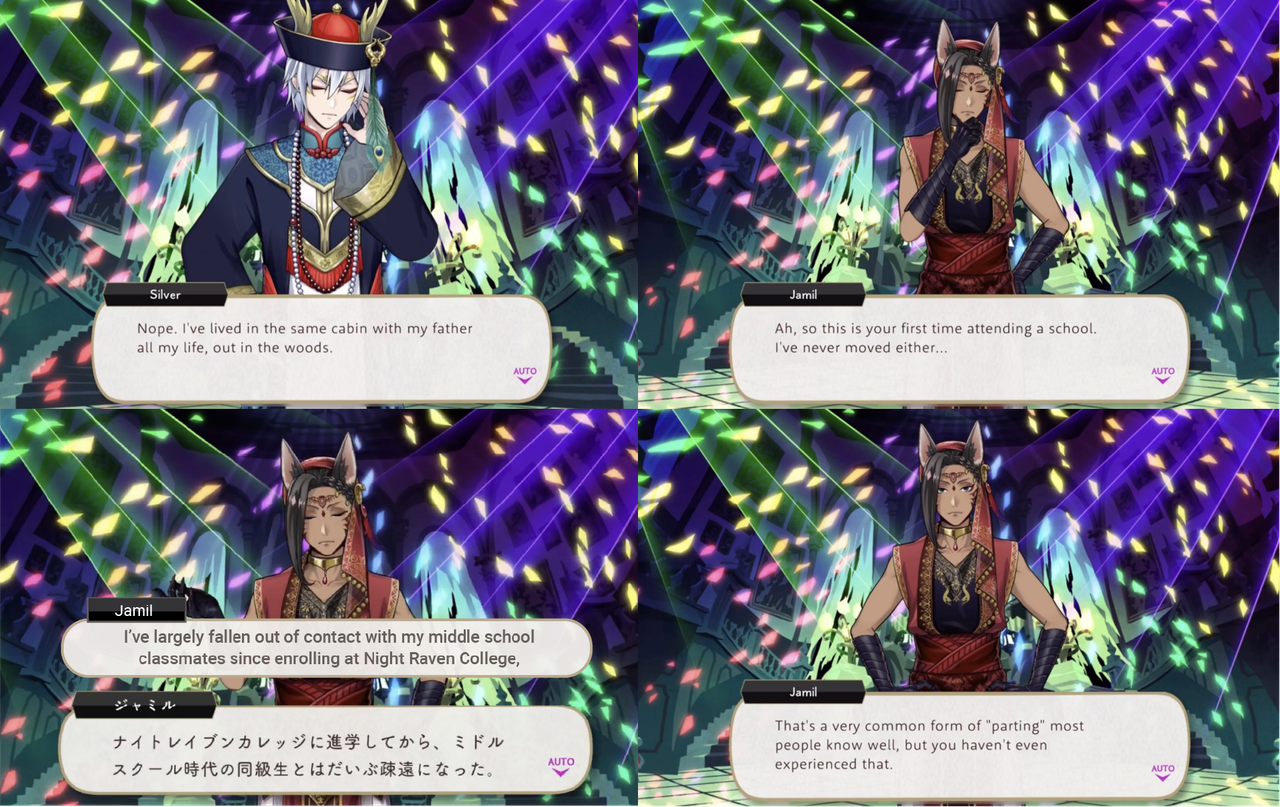
Jamil has a voice line of, “Noble Bell College has such a historic, refined air. I doubt I’d ever feel at home here,” and says that he has “largely fallen out of contact” with his classmates from middle school.
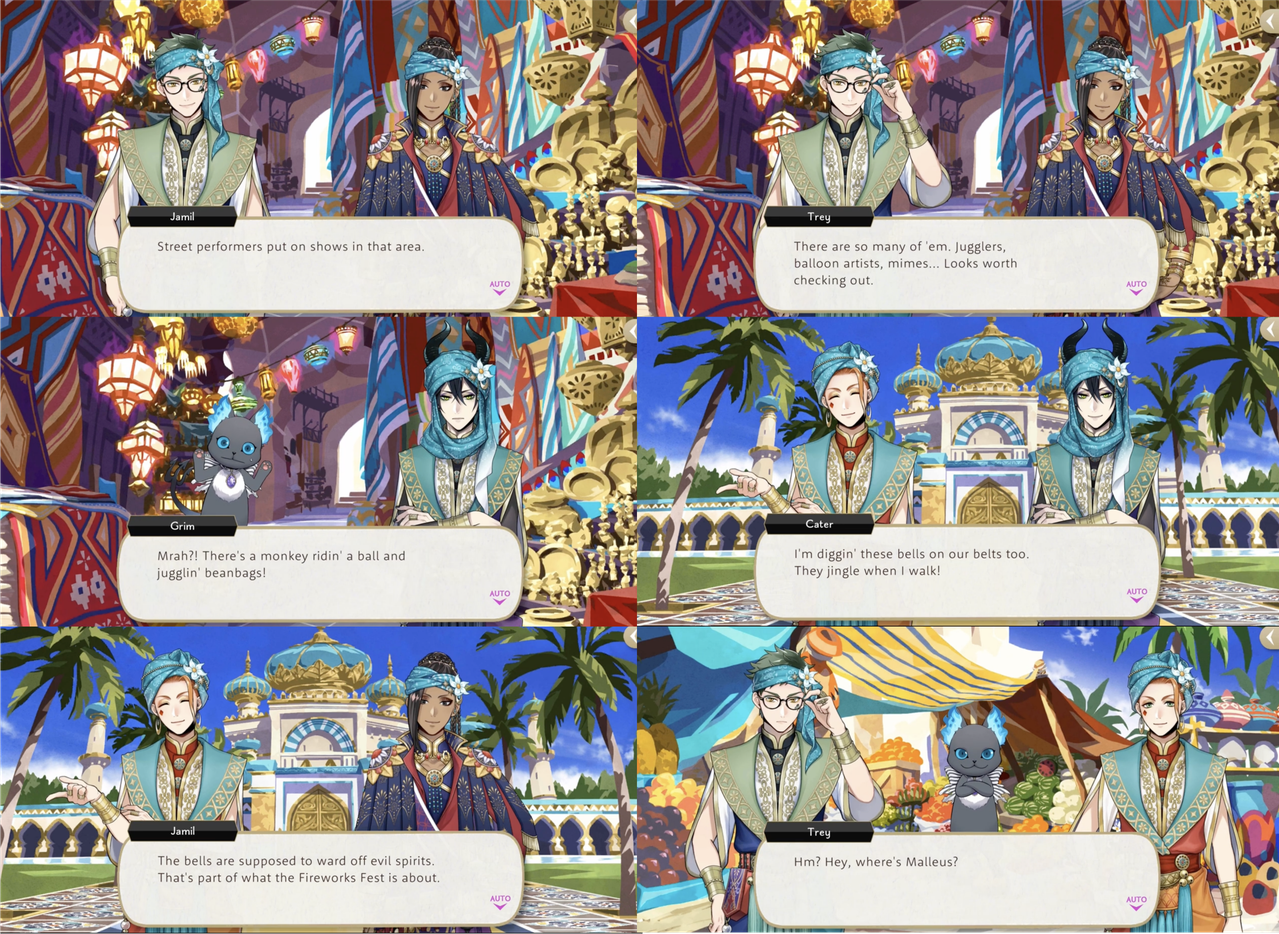
While in a market Jamil explains an area where street performers put on shows, with Trey commenting, “There are so many of ’em. Jugglers, balloon artists, mimes…” and Grim sees “a monkey ridin’ a ball and jugglin’ beanbags!”
The Firelit Sky group seems to all have bells attached to their outfits, which Jamil says “are supposed to ward off evil spirits. That’s part of what the Fireworks Fest is about,” but those particular bells are later revealed to “contain GPS devices.”
Jamil tells Trey that his hometown “has a lot of food carts that specialize in different regional cuisines and desserts,” offering to show Trey some of his favorite restaurants.



Trey asks about different-sized urns in a market and asks what they’re for, to which Jamil responds, “Tons of things. You can store things like grains and coffee in them, use them as flower vases, you name it.”
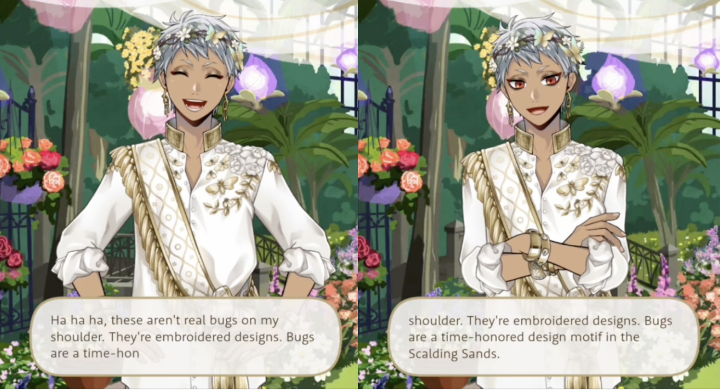
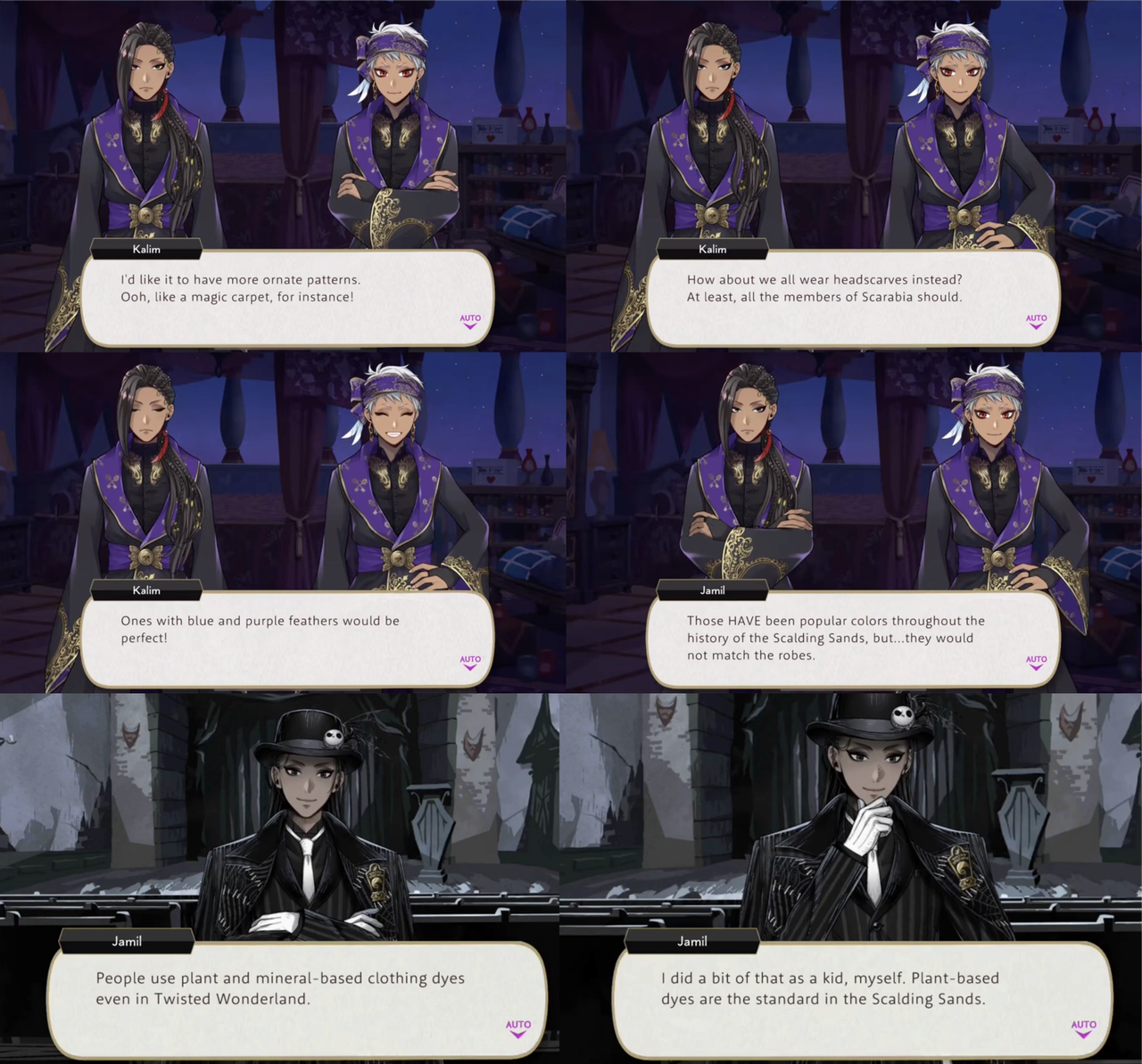
Kalim says that “Bugs are a time-honored design motif in the Scalding Sands,” and Jamil says that blue and purple “have been popular colors throughout the history” of the country. Jamil also says “Plant-based dyes are the standard in the Scalding Sands,” and that he “did a bit” of clothes-dyeing as a child.
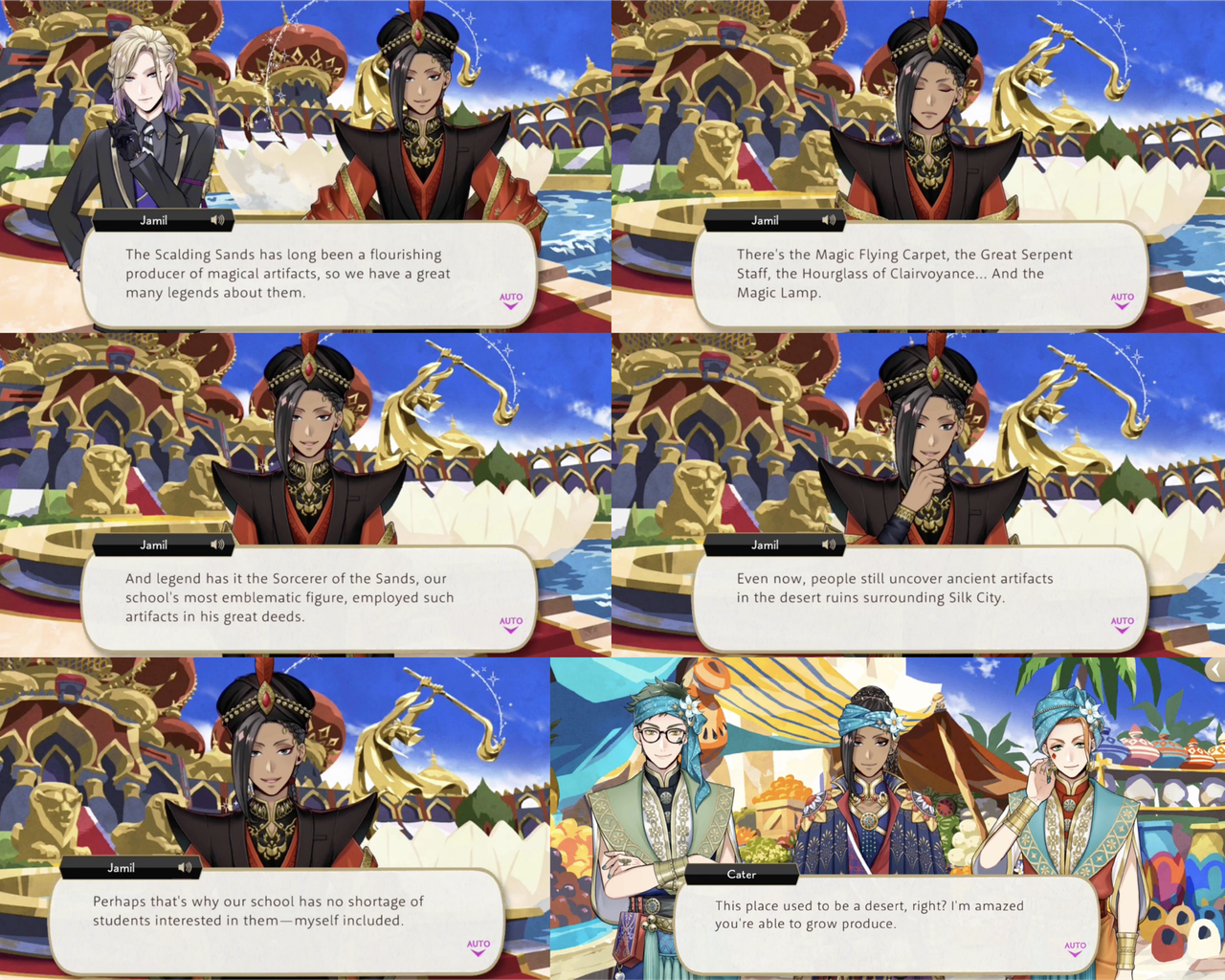
In Jamil’s dream of Book 7 he says, “The Scalding Sands has long been a flourishing producer of magical artifacts, so (there are) a great many legends about them.”
Jamil explains, “There’s the Magic Flying Carpet, the Great Serpent Staff, the Hourglass of Clairvoyance…and the Magic Lamp. And legend has it the Sorcerer of the Sands…employed such artifacts in his great deeds. Even now, people still uncover ancient artifacts in the desert ruins surrounding Silk City,” but it is maybe unclear if that is also true of the real-world country or if there were embellishments made as a part of Jamil’s dream.

When Cater says he is surprised that Jamil’s hometown is able to grow produce despite how it used to be a desert Jamil responds:
“From what I understand, the arid climate helps cultivate high-quality crops. Growing food with less water concentrates the flavor and produces a higher sugar content…Back in the old days, water was an extremely valuable resource here. Because of that, people could only use a limited amount of water for irrigation. Some tried to produce crops for years, but they never succeeded and eventually gave up. But our forebears insisted it was possible. They worked hard to cultivate the land and make it more fertile. Their efforts eventually bore fruit, as it were, and now we can grow our own crops in Silk City. Those crops were a hit once they came on the market, because of their freshness and rich flavors. Nowadays, Silk City’s produce is prized by top chefs all over the world.”
Jamil says that locally produced vegetables “are another local specialty,” and “Tropical fruits like dragon fruit are also popular in the Scalding Sands.”
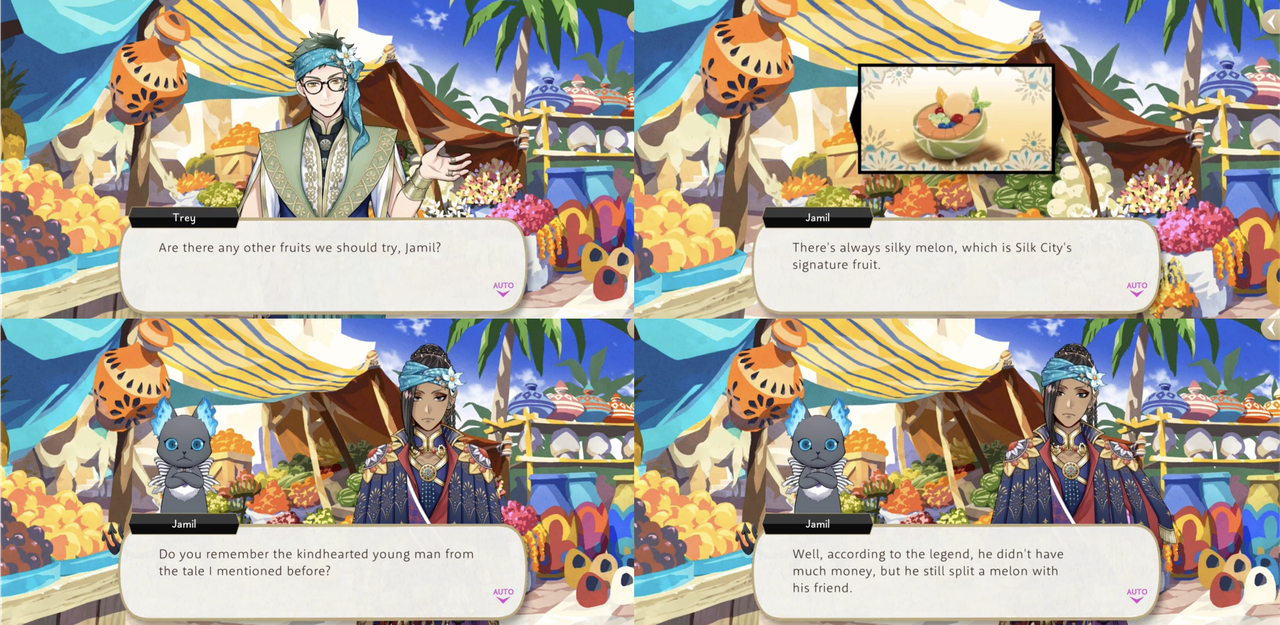
When asked about other fruits they should try Jamil says, “There’s always silky melon, which is Silk City’s signature fruit. It has a sophisticated sweetness and silky texture. You won’t find it in many other countries. They cut the melons in half, then serve them with a scoop of their homemade melon ice cream.”


Najma says that bread is a local staple food, and Jamil explains, “Even smaller roadside bakeries have wood-fired ovens so they can serve it fresh. Bread’s best that way.”
Cater comments on seeing “loaves in all shapes and sizes! Round, square, narrow, puffy, hard and crunchy,” while Malleus comments on a stall “selling baguettes that are taller than many of the children here.”
Najma explains, “They’re called tower baguettes. They’re a famous Fireworks Fest treat. It’s not meant for one person. You’re supposed to tear off bits and share it with a group.”
Jamil says, “Our local fruits are made into all sorts of things. Our apricot jam is especially famous,” and points out “baba ghanoush. It’s a roasted eggplant dip.”
Najma says that nuts and dried fruit “are all staple snack foods here. Everyone likes them,” and Trey describes seeing “chickpeas, pistachios, sunflower seeds…lots of nutritious stuff.” Najma says she likes dates, which are typically eaten dried, and “there are also date jams and jellies… oh, and syrup!”

While shopping Jamil says, “You can certainly find a lot of tea ware here, given our strong tea and coffee culture. Coffee and tea are really popular here, and there are tons of cafes in town. Scalding Sands spiced coffee is known for its distinctive flavor profile. Some of the cafes even do coffee divination. It’s a fortune-telling method that was invented here. Najma’s really into it.”
Jamil explains coffee divination, saying, “Our spiced coffee is brewed without using a filter.So the cup still has the grounds in it, and people tell fortunes based on its shapes and patterns, and the amount of water droplets.”
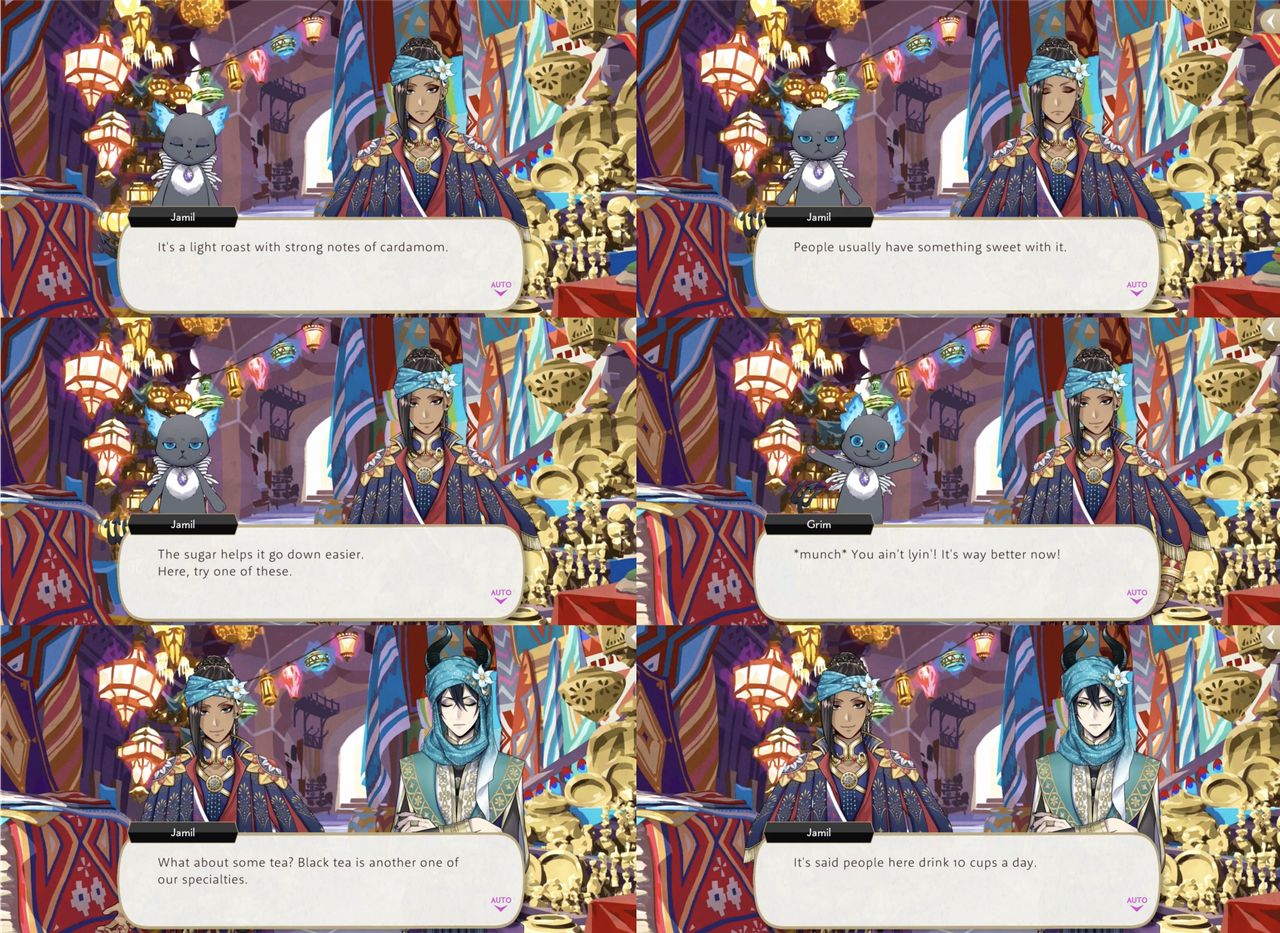
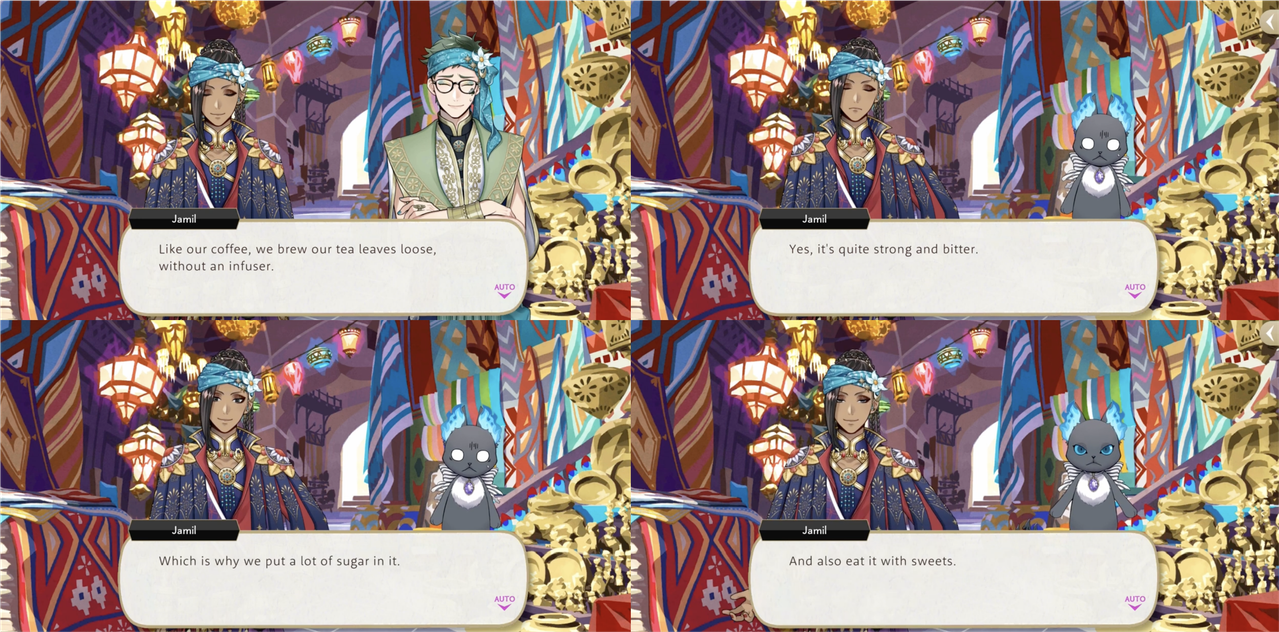
Grim comments on the coffee he drinks being bitter and Jamil explains, “It’s a light roast with strong notes of cardamom. People usually have something sweet with it. The sugar helps it go down easier,” and on the subject of local tea he says, “Black tea is another one of our specialties. It’s said people here drink 10 cups a day. Like our coffee, we brew our tea leaves loose, without an infuser…it’s quite strong and bitter. Which is why we put a lot of sugar in it. And also eat it with sweets.”
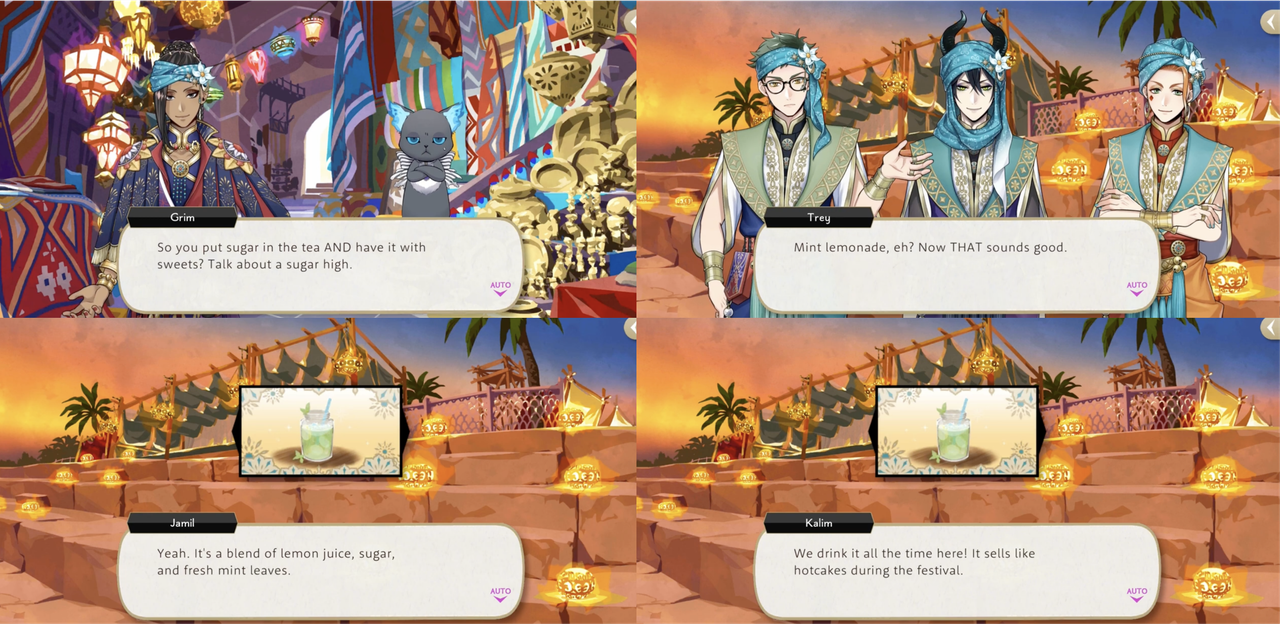
Later the group tries mint lemonade, which Jamil describes as “a blend of lemon juice, sugar, and fresh mint leaves.” Kalim says, “We drink it all the time here! It sells like hotcakes during the festival.”
Kalim says that Halloween in his and Jamil’s hometown “is all about feasting!…Everyone loves gathering around a table of food and talking. So when Halloween rolls around, we stack our plates high with cuisine of all sorts.”
Jamil explains, “We make it so abundant that the ghosts who return on that night may also have their fill. We have every kind of dish imaginable, from sweet to spicy, finger foods to giant platters. When Halloween draws near, our kitchens are in a constant flurry of activity as the chefs begin the necessary preparations.”
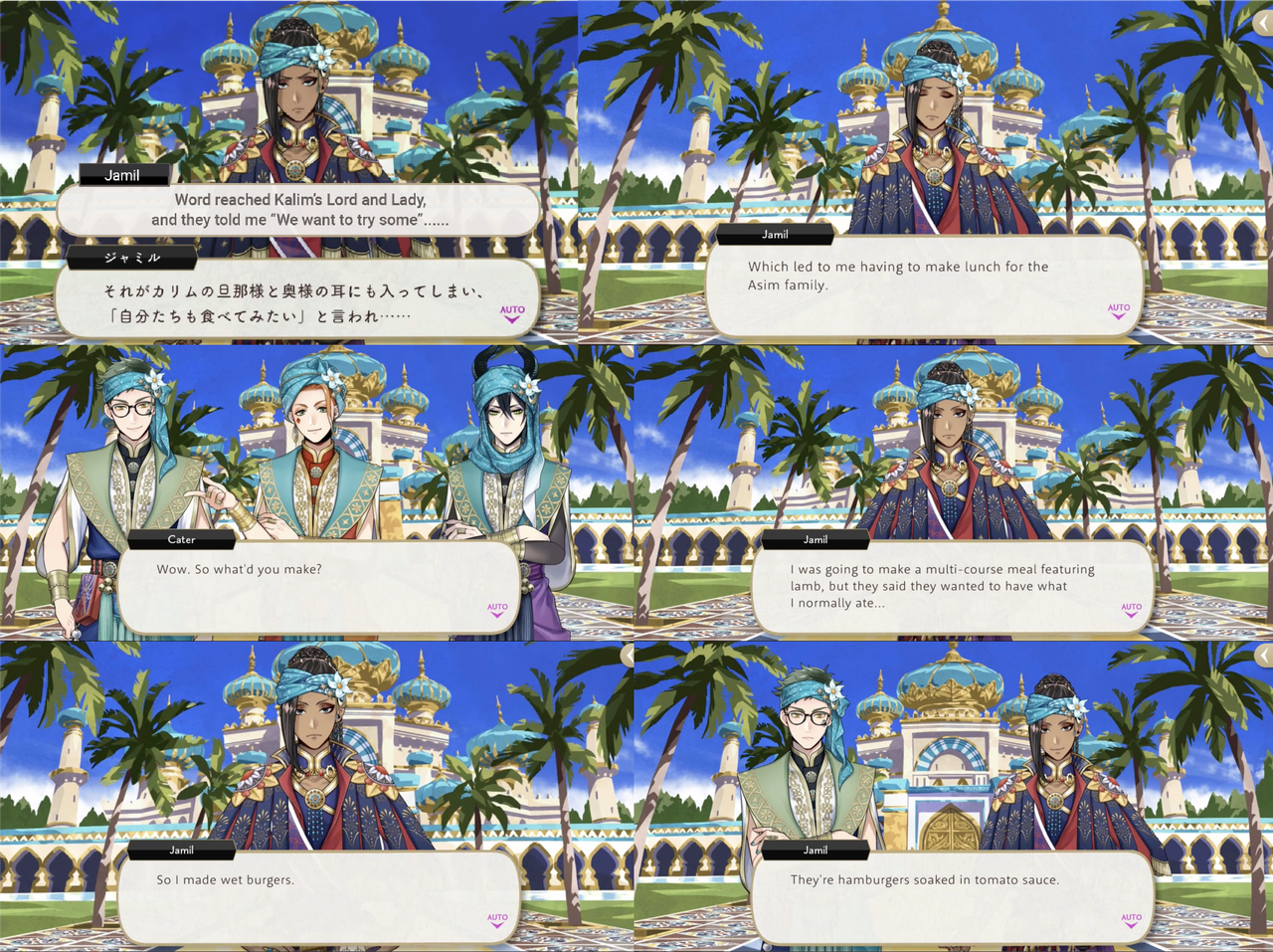
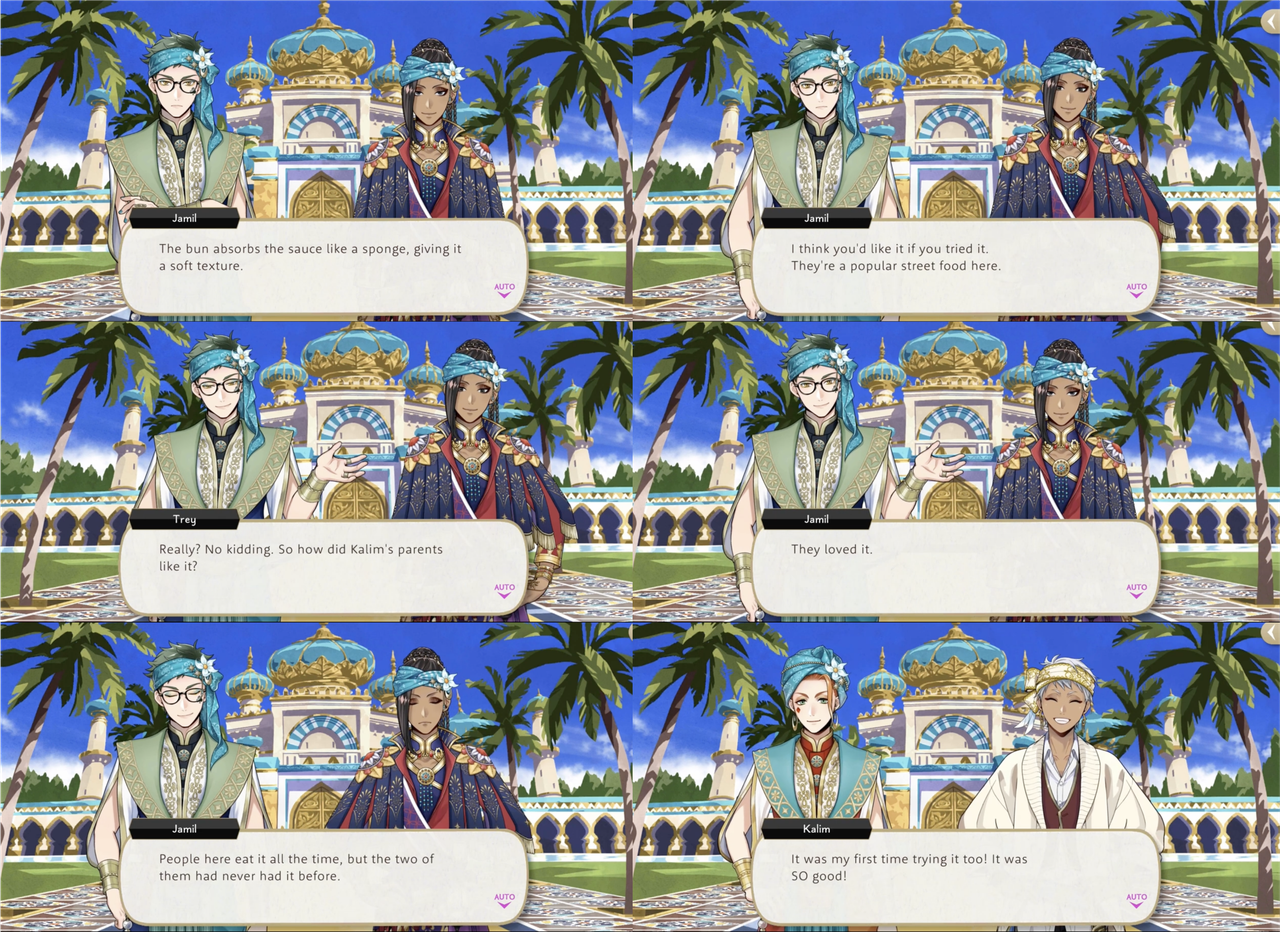
Jamil explains a time he was asked to make lunch for the Asim family and, while he “was going to make a multi-course meal featuring lamb, but they said they wanted to have what I normally ate, so I made wet burgers,” which he describes as “hamburgers soaked in tomato sauce. The bun absorbs the sauce like a sponge, giving it a soft texture.” Jamil says that they are a popular local street food and “People here eat it all the time,” but Kalim’s parents (and Kalim himself) had never had it before.

Jamil says, “We hold our legends and customs in high regard,” and explains how the fireworks festival “came about because of one particular legend”:
“The legend is about a beautiful princess who cared for her people, and a poor yet kindhearted young man. The two of them crossed social divides to join in eternal love. And to celebrate their love, the Genie of the Lamp fired countless rings of light into the night sky. The spectacle left such a deep impression on the onlookers that the tale was passed down for generations. Eventually, the people of the Scalding Sands started celebrating the young man and princess’s union with fireworks. That’s how the Fireworks Fest became a traditional holiday here.”
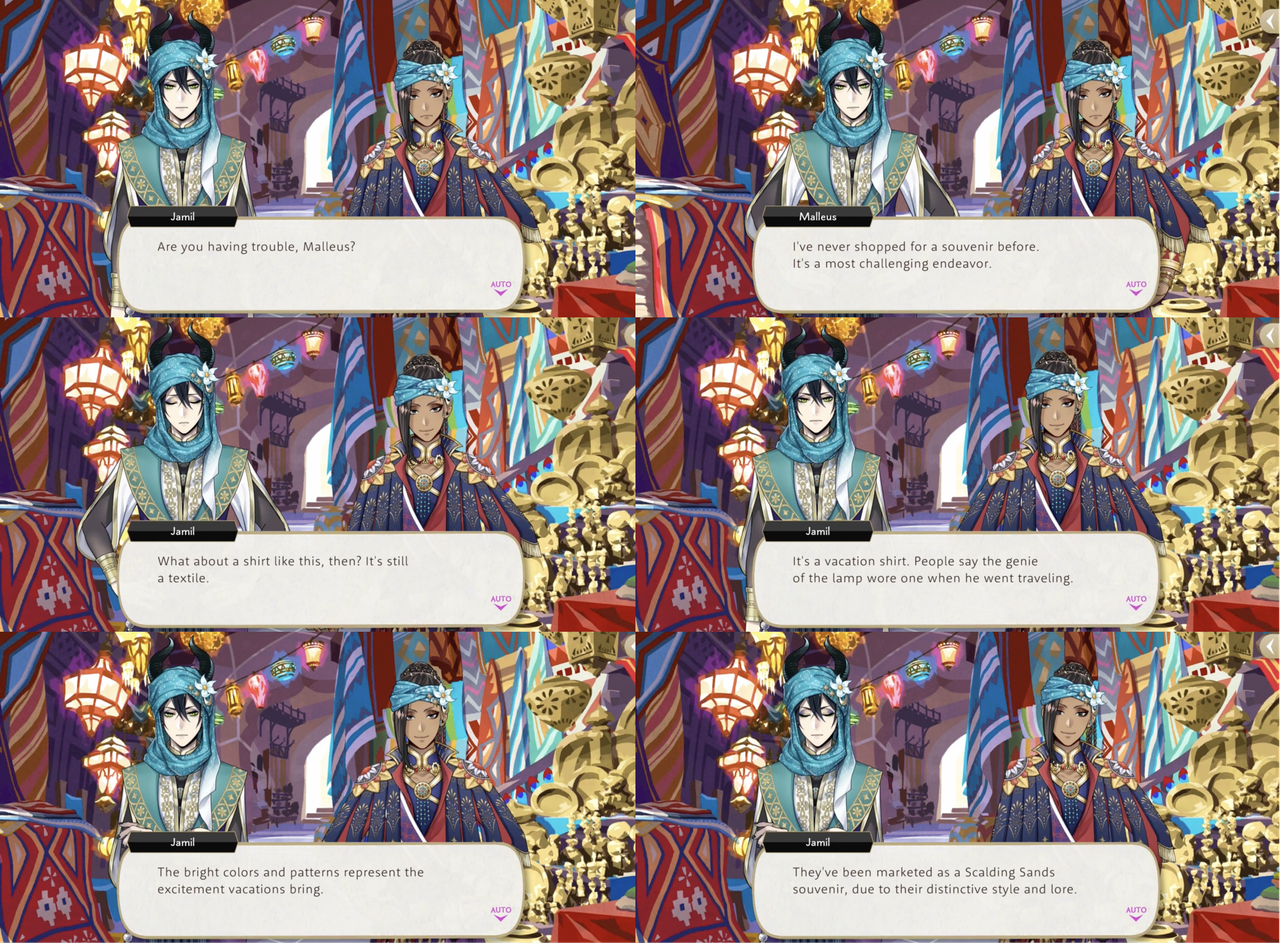
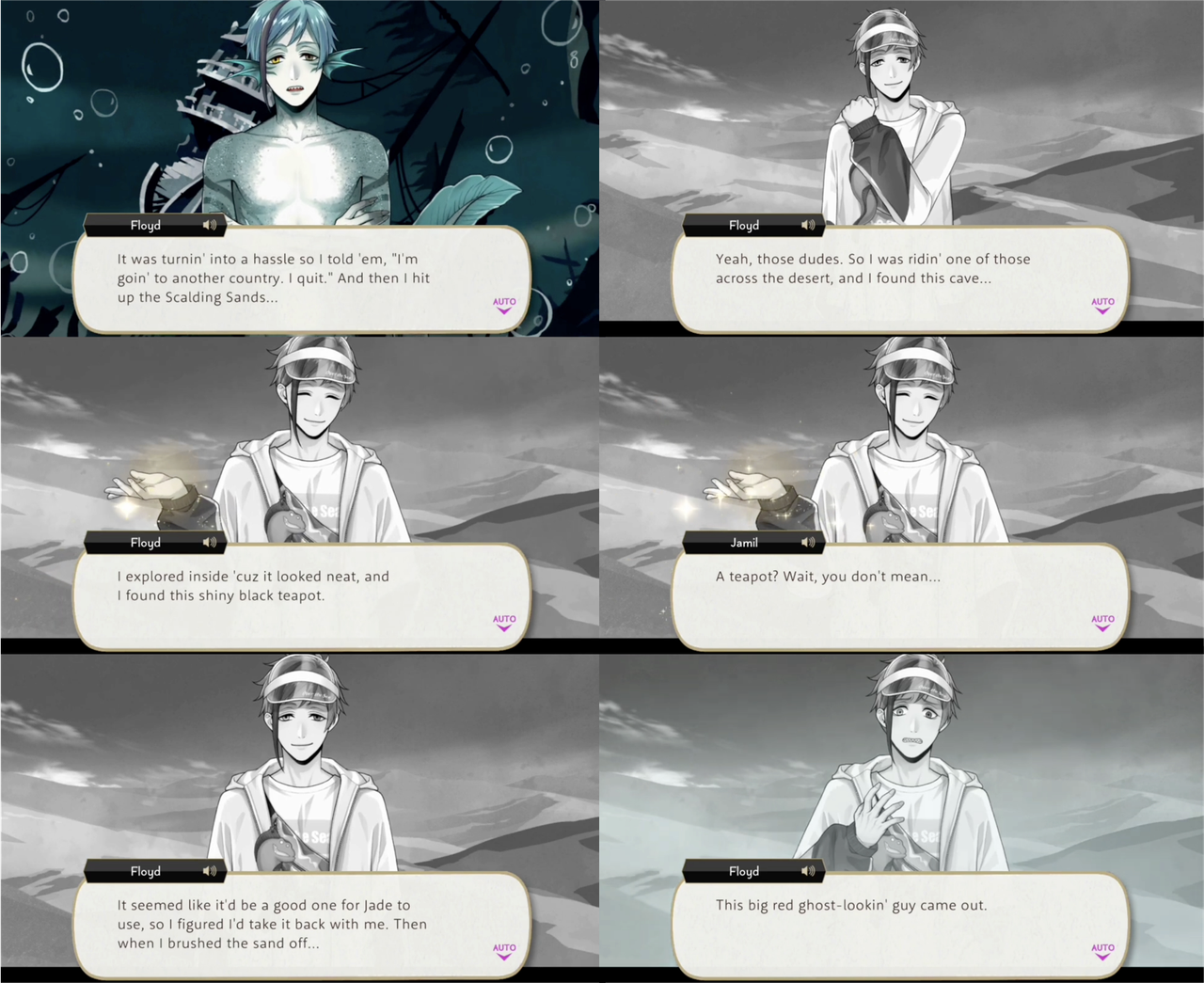
It is a little difficult to tell if the legends of “the genie of the lamp” differentiate between the two genies of Disney’s animated movie “Aladdin,” with Jamil saying that the genie wore a vacation shirt when he went traveling similar to the blue genie of the movie (“The bright colors and patterns represent the excitement vacations bring. They’ve been marketed as a Scalding Sands souvenir, due to their distinctive style and lore”), but when Floyd talks about a “big red ghost-lookin’ guy” coming out of a lamp he found in his dream Jamil says, “That’s the legendary lamp that the genie was trapped in!,” and Sebek says, “Isn’t he so powerful, he can transform a street thief into a genuine royal prince?!,” so it is possible that the actions of the blue and red genies of the movie have been combined into those of one genie in Scalding Sands folklore.

Jamil says that the white flowers being worn by the students for the festival “are jasmines. The young man gifted those flowers to the princess, and now they’re a symbol of the festival,” and a tradition of dancing under fireworks “stems from when people danced to celebrate the young man and princess’s marriage.”
This is possibly the same legend that Kalim describes in Book 5, saying:
“The Land of Scalding Sands has more legends than just those of the Sorcerer of the Sands. There is also a tale of a street thief who became king. One day, the thief met a princess and fell in love. He had a change of heart, and he came to regret his life of dishonesty and larceny. After that, he went on to rescue the sultan and princess from the villain who plotted to take over the land! Then he married the princess and became the next sultan, and everybody lived happily ever after!”
There is another reference to what is possibly the same legend in Book 7, with Kalim explaining:
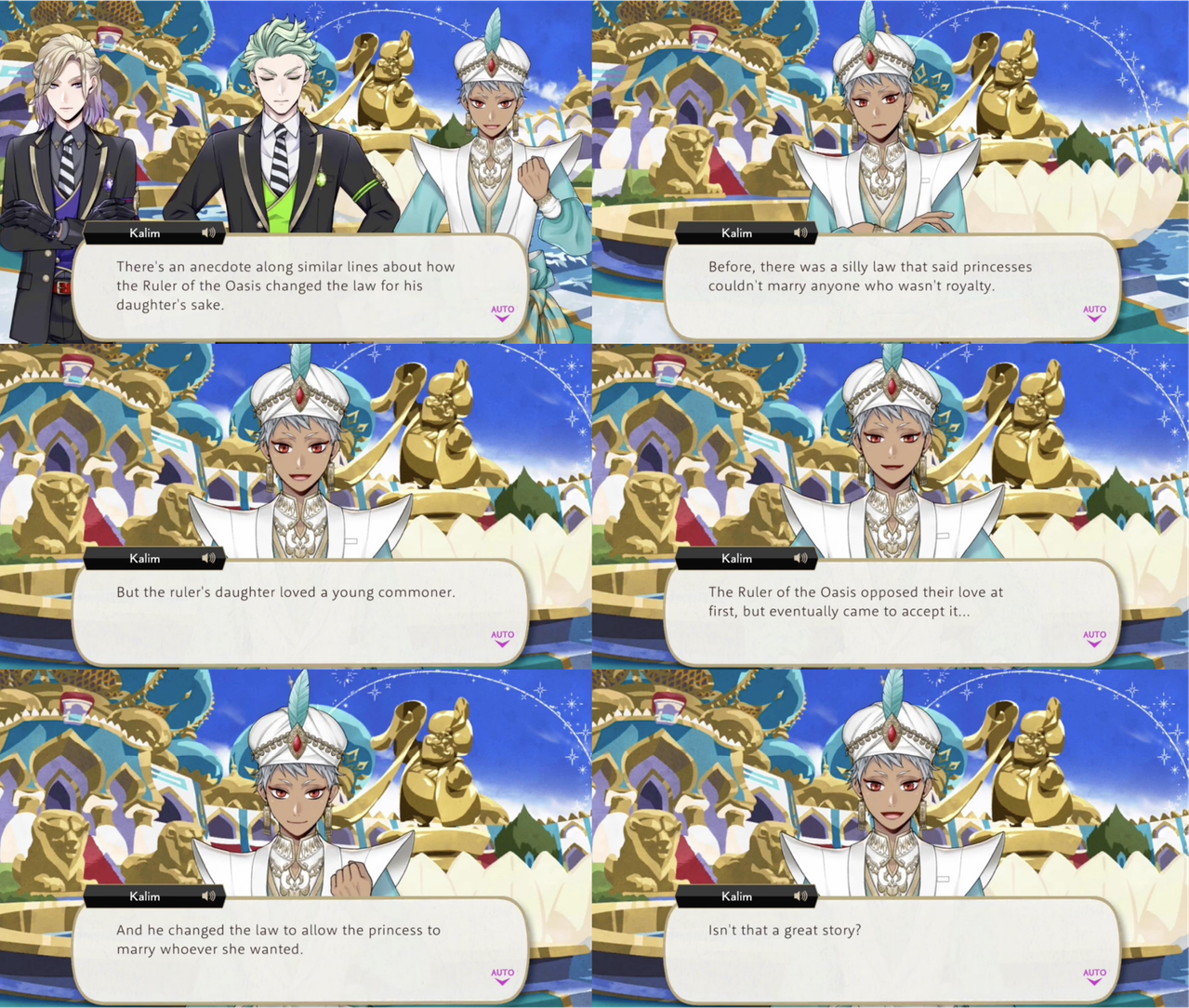
“There’s an anecdote along similar lines about how the Ruler of the Oasis changed the law for his daughter’s sake. Before, there was a silly law that said princesses couldn’t marry anyone who wasn’t royalty. But the ruler’s daughter loved a young commoner. The Ruler of the Oasis opposed their love at first, but eventually came to accept it, and he changed the law to allow the princess to marry whoever she wanted.”

Jamil says, “Legends state that (the Sorcerer of the Sands) wore a robe as black as the desert night,” the school uniforms of Jamil’s dream are red and black “like what the illustrious Sorcerer of the Sands wore,” and his signature color is said to be red, “a perennial favorite.”
Malleus comments on seeing the same shade of green frequently in Silk City and Jamil explains, “It’s called peacock green. Supposedly the princess from the legend liked wearing it. During the festival, it’s used as a base color for the decorations placed throughout the city.”
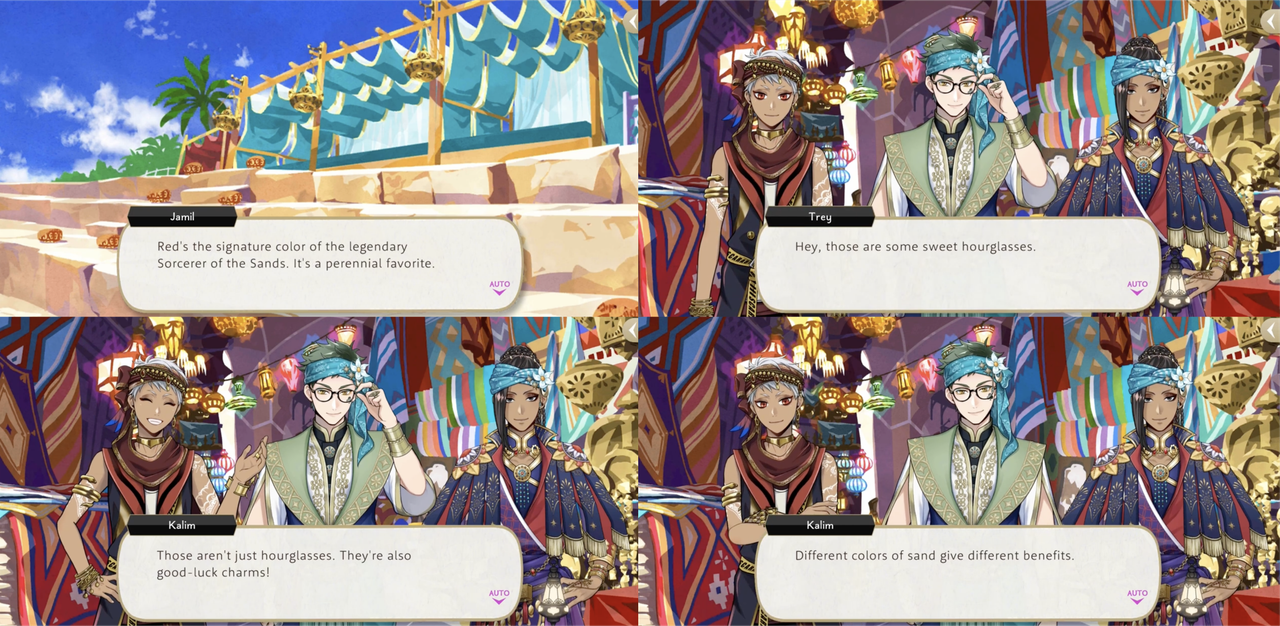
The colors red and peacock green come up again later on, the colors of different kinds of sand inside of good-luck charm hourglasses. Kalim says, “Different colors of sand give different benefits,” and Jamil explains, “This also comes from a legend, by the way.”
Cater says, “The peacock green one’s based on the princess Jamil told us about. She was really clever, so this color is for getting good grades,” and Jamil follows with, “The legendary Sorcerer of the Sands wore crimson. He worked tirelessly for his nation, so his color represents improved focus.”


Jamil mentions another Scalding Sands legend “about the princess of the oasis” during the NBC event, saying, “There was a procession of golden camels, peacocks, and all kinds of other animals, plus human dancers, all marching in a parade thrown by a young man…He shows up riding on the back of an elephant.”
The character of “Aladdin” from Disney’s animated movie has possibly been separated into multiple legendary figures in Scalding Sands’ lore. Kalim, for example, says, “The Sorcerer of the Sands chief exploit was saving the land from a street rat. That usurper tried to trick the sultan and princess,” and mentions “a depiction of when the Sorcerer of the Sands used his staff to banish a charlatan,” with the “street rat,” “charlatan,” “young man,” and “young commoner” being possibly the same but possibly different people, according to legend.
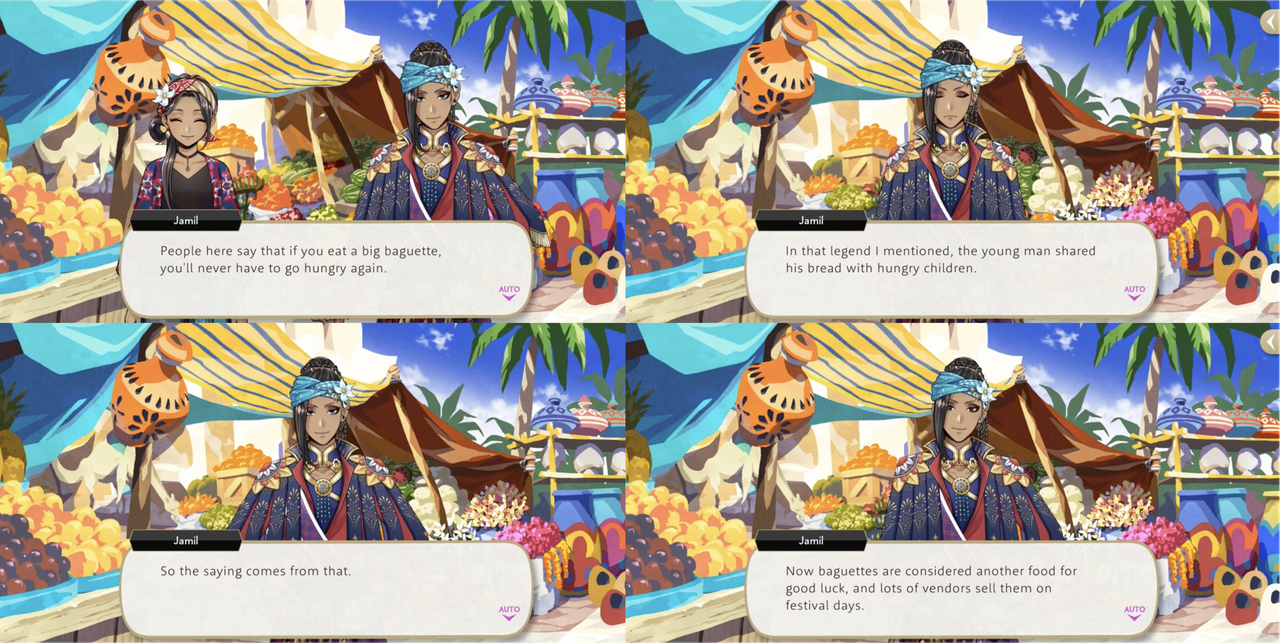
Explaining another local custom Jamil says, “People here say that if you eat a big baguette, you’ll never have to go hungry again. In that legend I mentioned, the young man shared his bread with hungry children. So the saying comes from that. Now baguettes are considered another food for good luck, and lots of vendors sell them on festival days.”
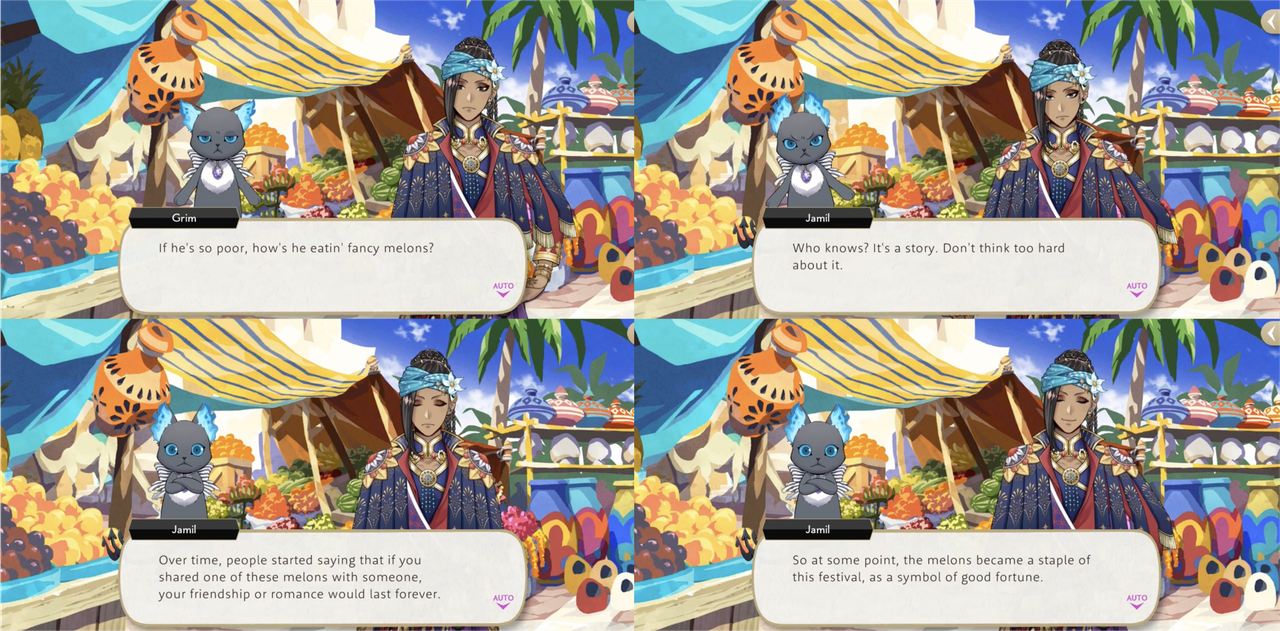
On the subject of the local signature fruit, Silky Melon, Jamil says, “Do you remember the kindhearted young man from the tale I mentioned before? Well, according to the legend, he didn’t have much money, but he still split a melon with his friend.” Grim asks, “If he’s so poor, how’s he eatin’ fancy melons?,” and Jamil responds, “Who knows? It’s a story. Don’t think too hard about it,” and says, “At some point, the melons became a staple of this festival, as a symbol of good fortune.”
Explaining urns for sale Jamil describes them as being “used to ward off bad things,” saying, “In one part of the young man’s tale, some people were chasing him, So he hid himself in an urn, and in doing so, evaded danger.”
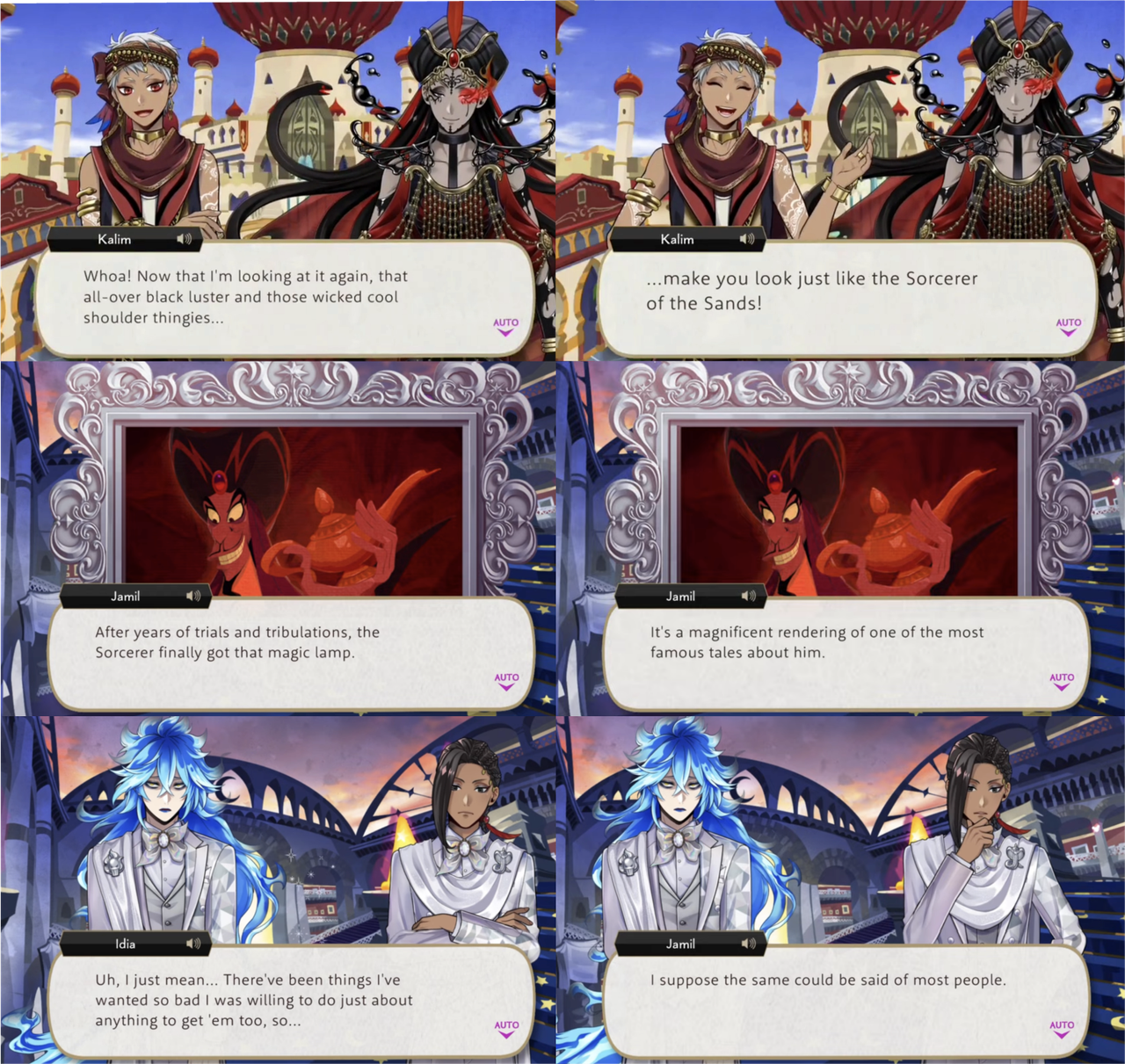
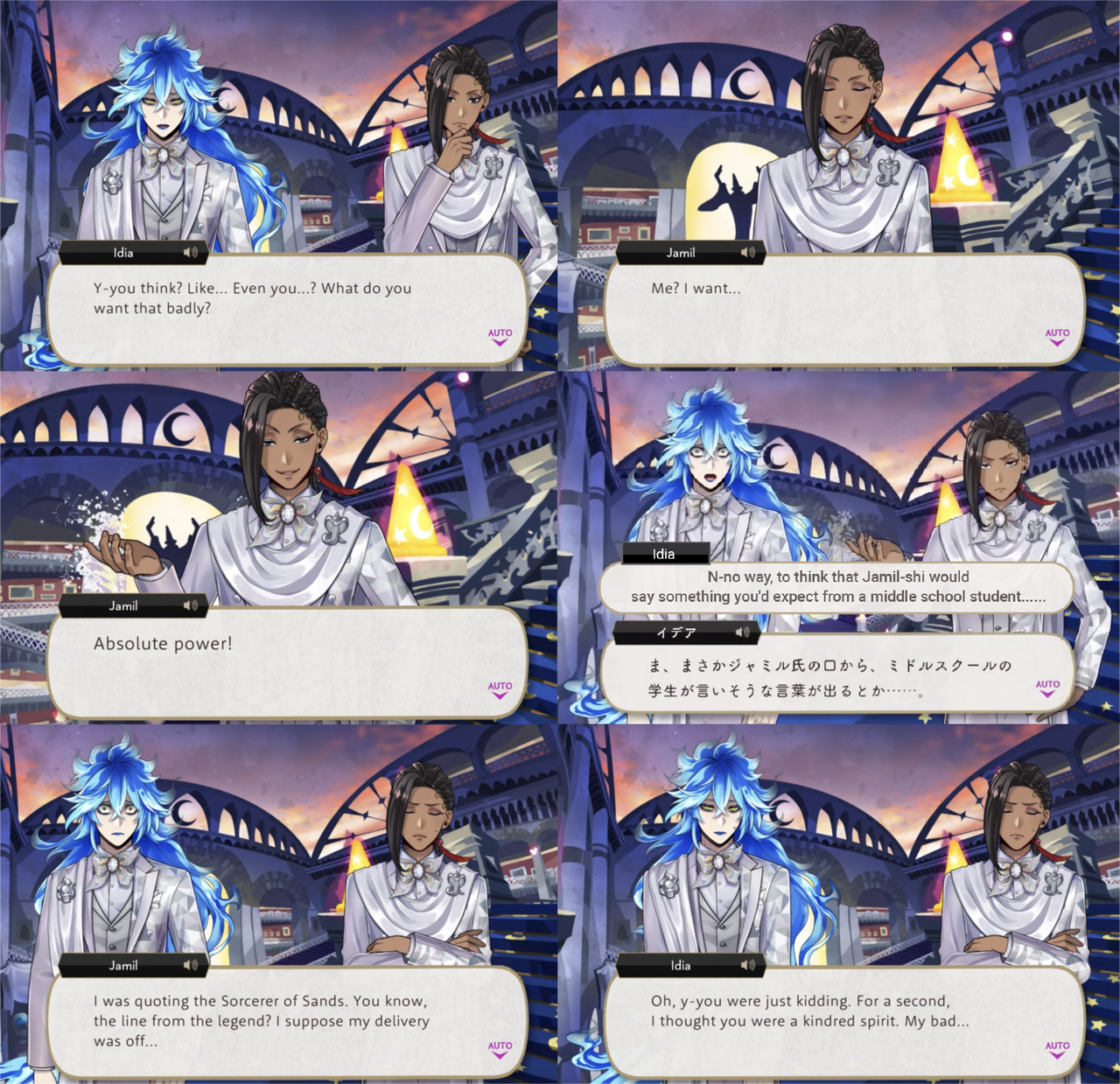
Kali says that Jamil in his overblot form makes him “look just like the Sorcerer of the Sands!,” and Jamil tells Idia, “They say the Sorcerer of the Sands had a lot of help from others getting that magic lamp. So I want connections, too, to keep my deepest desires from slipping out of reach.”
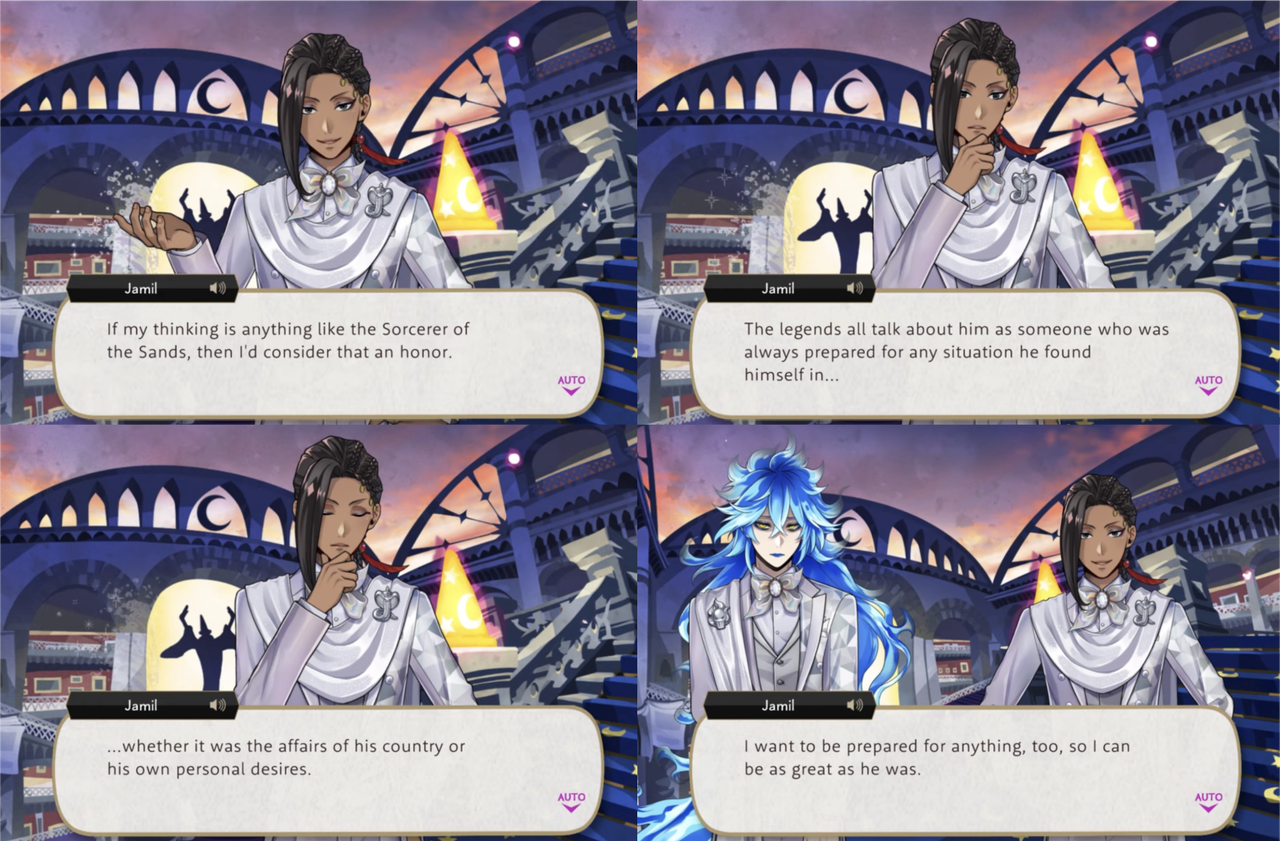
Jamil says, “If my thinking is anything like the Sorcerer of the Sands, then I’d consider that an honor. The legends all talk about him as someone who was always prepared for any situation he found himself in, whether it was the affairs of his country or his own personal desires. I want to be prepared for anything, too, so l can be as great as he was.”

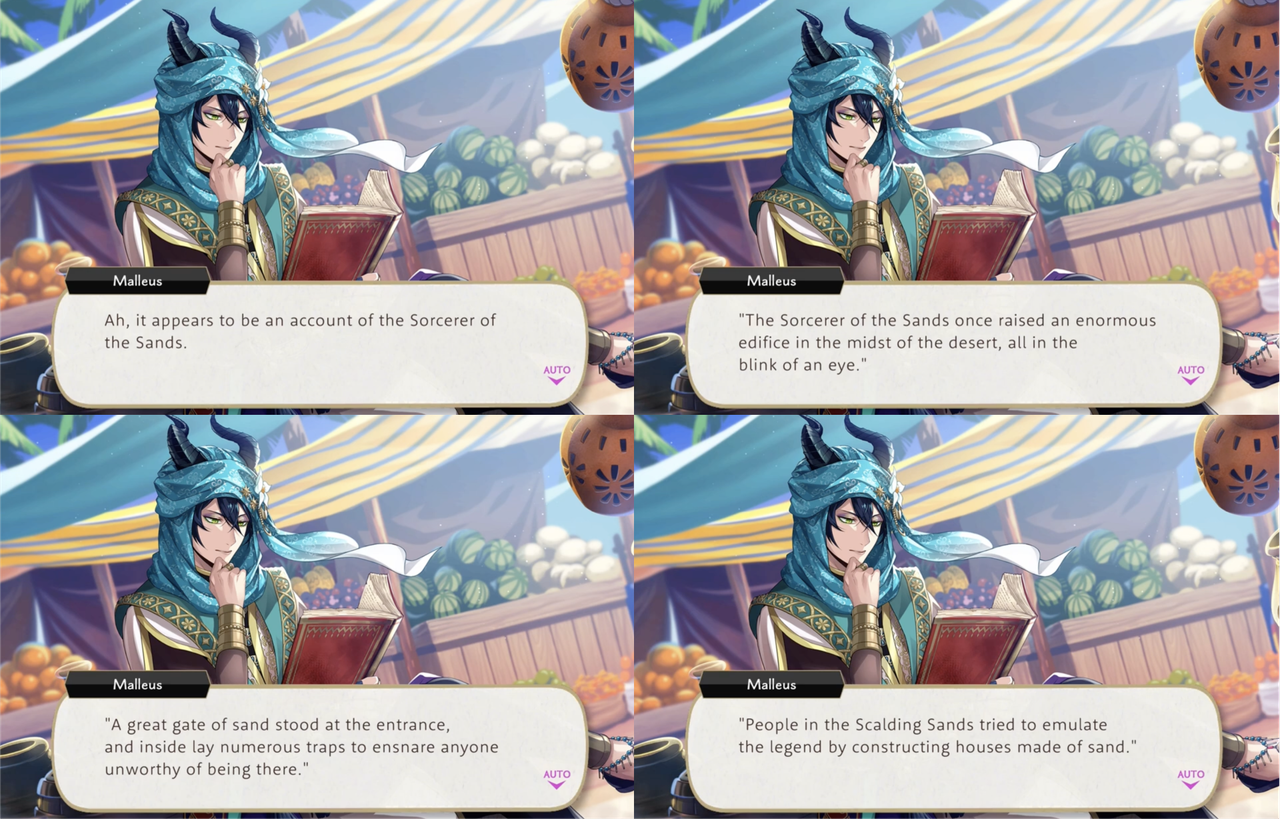
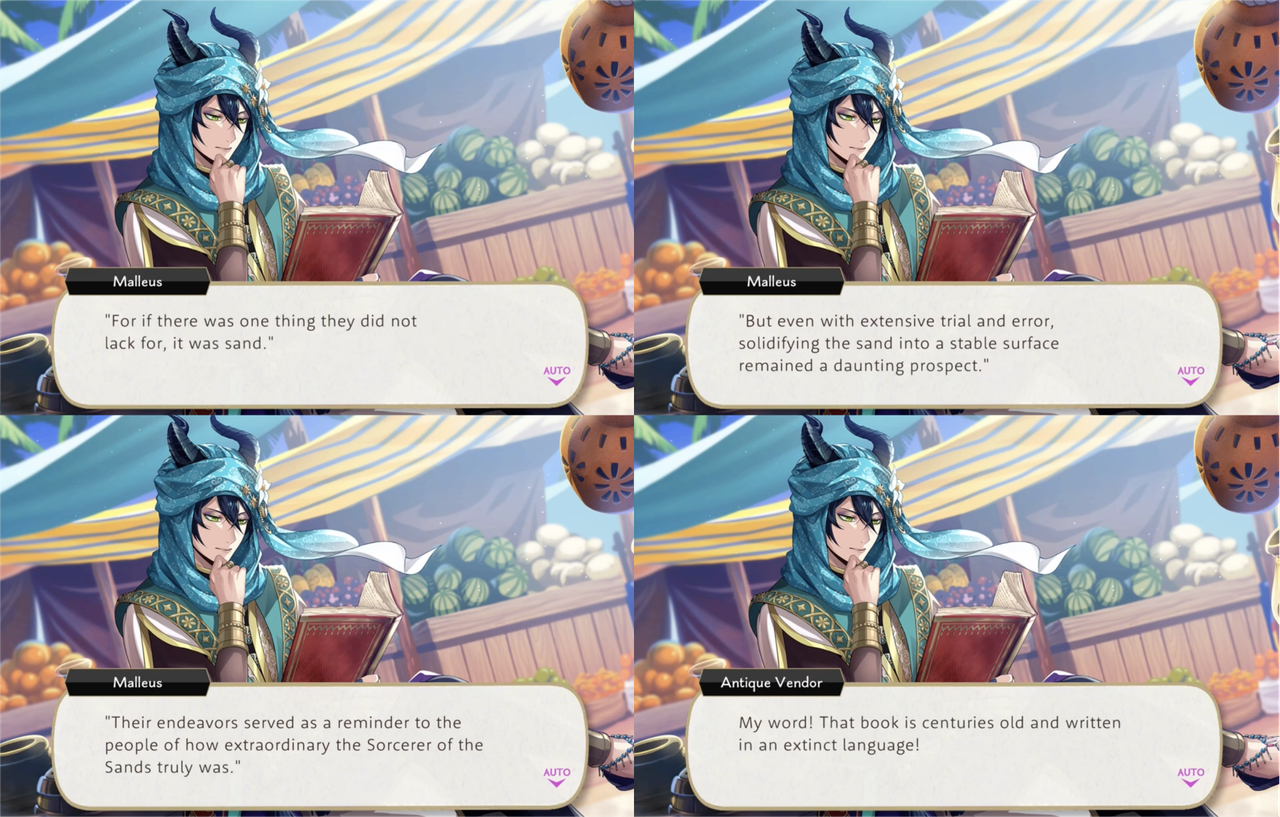
During his visit to the Scalding Sands Malleus reads a book that is “centuries old and written in an extinct language,” which says:
“The Sorcerer of the Sands once raised an enormous edifice in the midst of the desert, all in the blink of an eye. A great gate of sand stood at the entrance, and inside lay numerous traps to ensnare anyone unworthy of being there. People in the Scalding Sands tried to emulate the legend by constructing houses made of sand. For if there was one thing they did not lack for, it was sand. But even with extensive trial and error, solidifying the sand into a stable surface remained a daunting prospect. Their endeavors served as a reminder to the people of how extraordinary the Sorcerer of the Sands truly was.”
Jamil says, “Only one of the Great Seven who ascended to sovereignty was of ignoble birth. Yes—the Sorcerer of the Sands. With power and luck alone, he rose to power. His humble origins make his success an even more astonishing feat.”
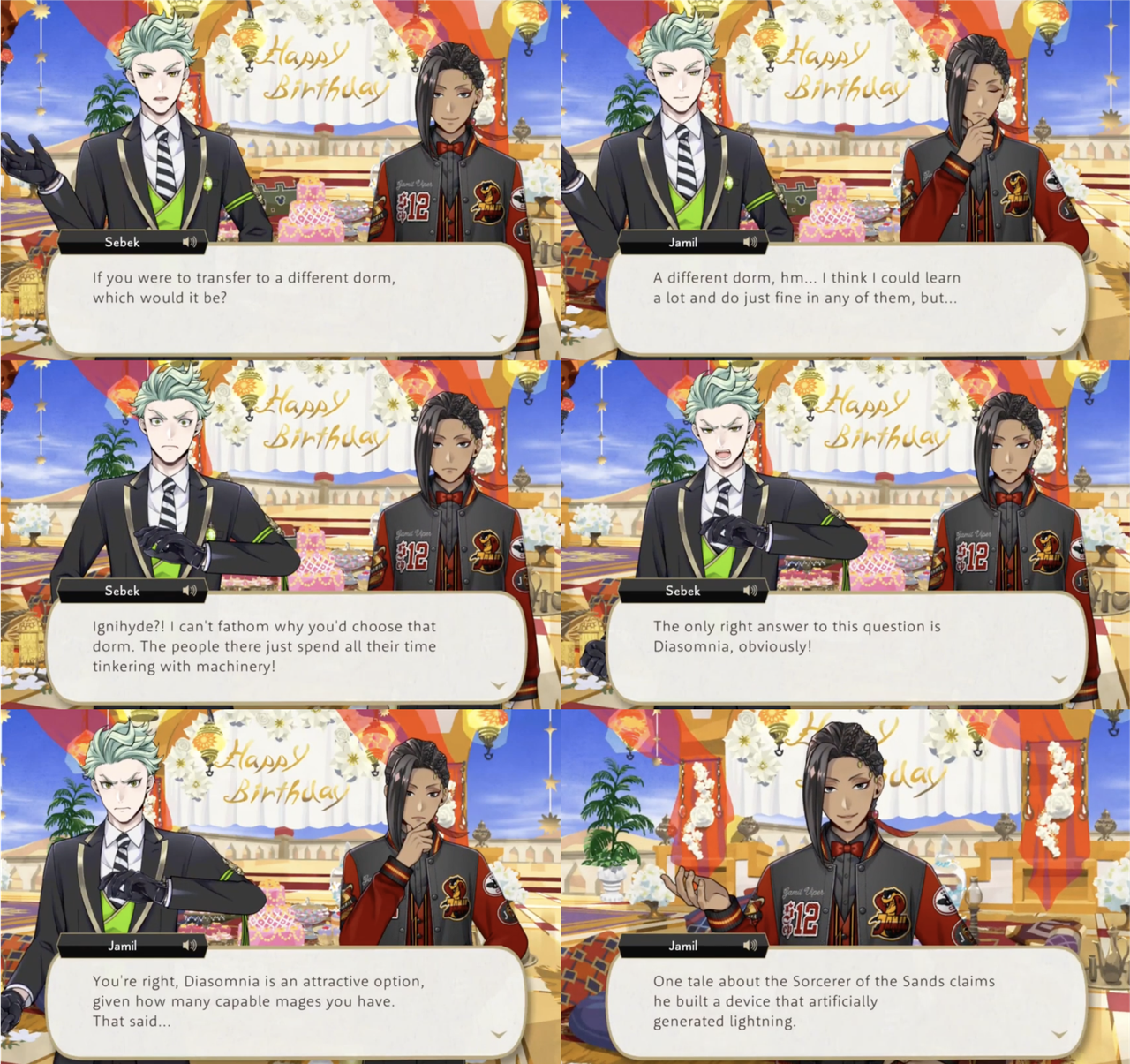
Jamil says that, were he to change dorms, he would transfer into Ignihyde, explaining:
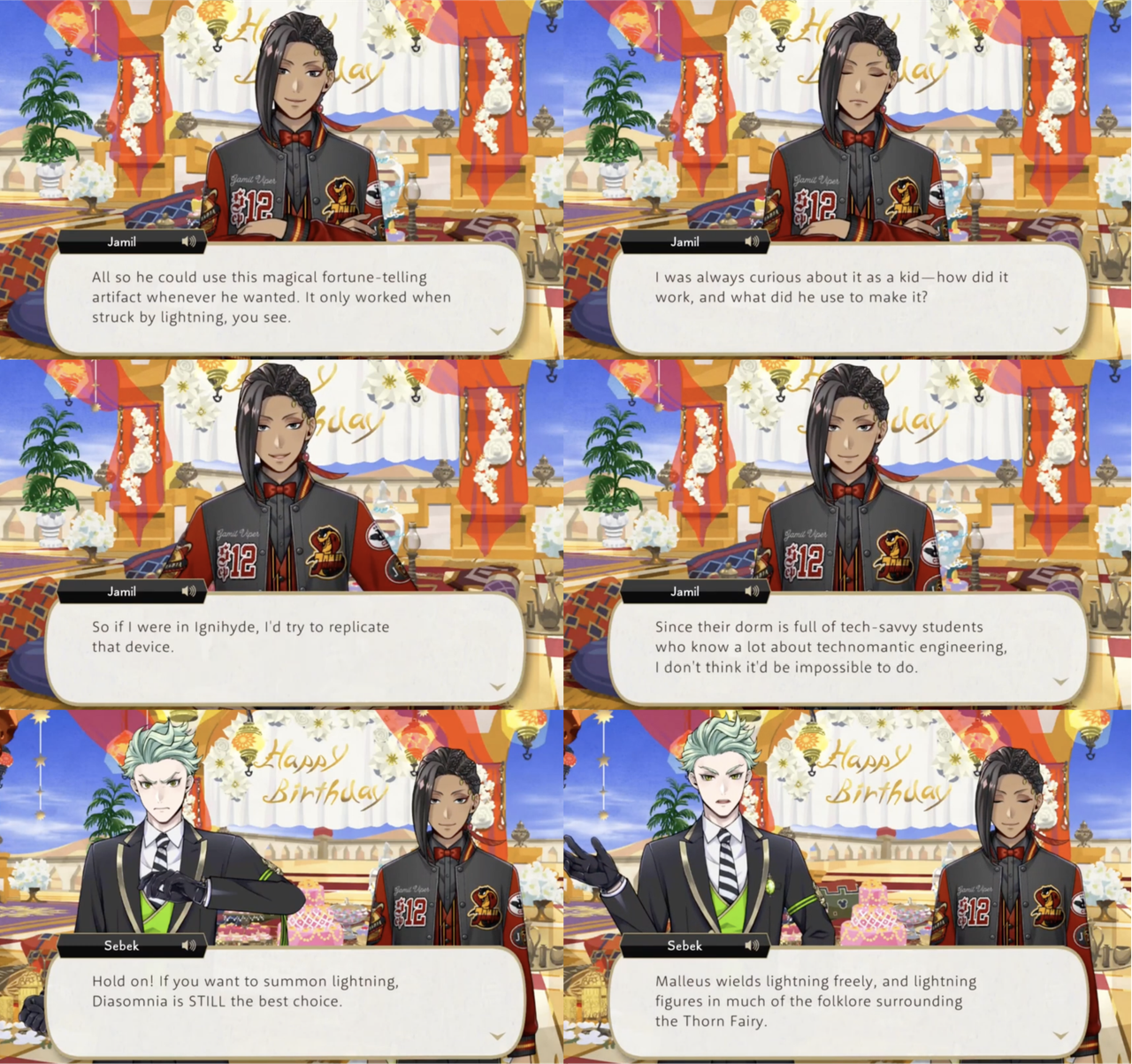
“One tale about the Sorcerer of the Sands claims he built a device that artificially generated lightning. All so he could use this magical fortune-telling artifact whenever he wanted. It only worked when struck by lightning, you see. I was always curious about it as a kid-how did it work, and what did he use to make it? So if I were in Ignihyde, I’d try to replicate that device.”
Sebek says, “I fail to see why mages should assemble machinery to generate lightning…” and Jamil responds, “…You have a valid point, actually. I’d like to know the answer myself. He was a sorcerer worthy of the Great Seven’s ranks… What was he trying to discern that required such an elaborate contraption? Since I can’t ask him, my only other option is to build it myself, right?”
This “device” is mentioned again during the fireworks festival, with Jamil explaining:
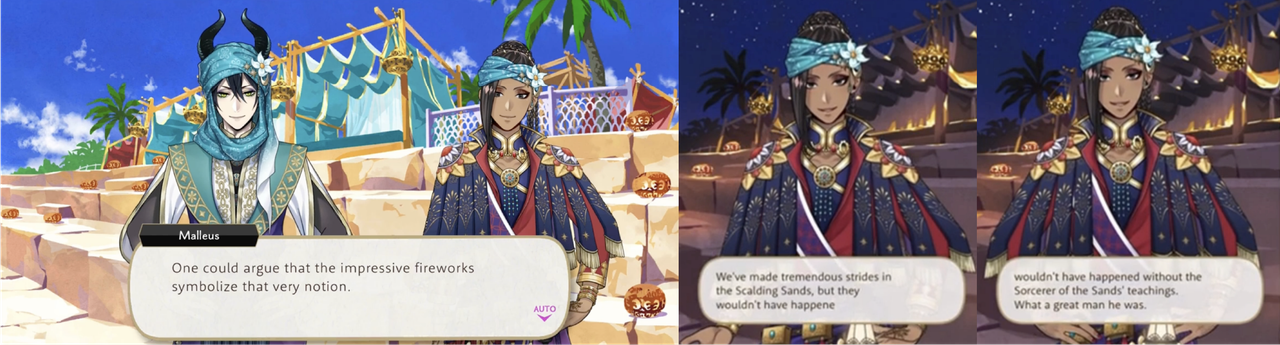
“I think the true appeal of the Scalding Sands is how we always push technological innovation. The Sorcerer of the Sands is most respected here. He was a very wise man, and legend has it he built a number of machines far beyond the technology of the time. They say he even had an artificial lightning generator. And so, to honor his example, our leaders hire mages and engineers specifically to research and adopt the most cutting-edge technologies. I think that’s what has enriched our people’s lives over time.”
Malleus says, “I’ve been struck by the prosperity of this land, where tradition and innovation work hand in hand.”
Jamil has a voice line of, “We’ve made tremendous strides in the Scalding Sands, but they wouldn’t have happened without the Sorcerer of the Sands’ teachings. What a great man he was.”
Kalim also references the device, saying, “Have you heard of the tool of divination passed down in the Land of Scalding Sands? It’s a magical hourglass that only works on stormy days when lightning strikes. The Sorcerer of the Sands built a lightning generator to speed up the process. They say it worked like a treadmill, using motion to generate lightning, but even MY suspension of disbelief has its limits!,” so it is possible that how much of the legend is considered folklore and how much is considered historical fact might be unclear.
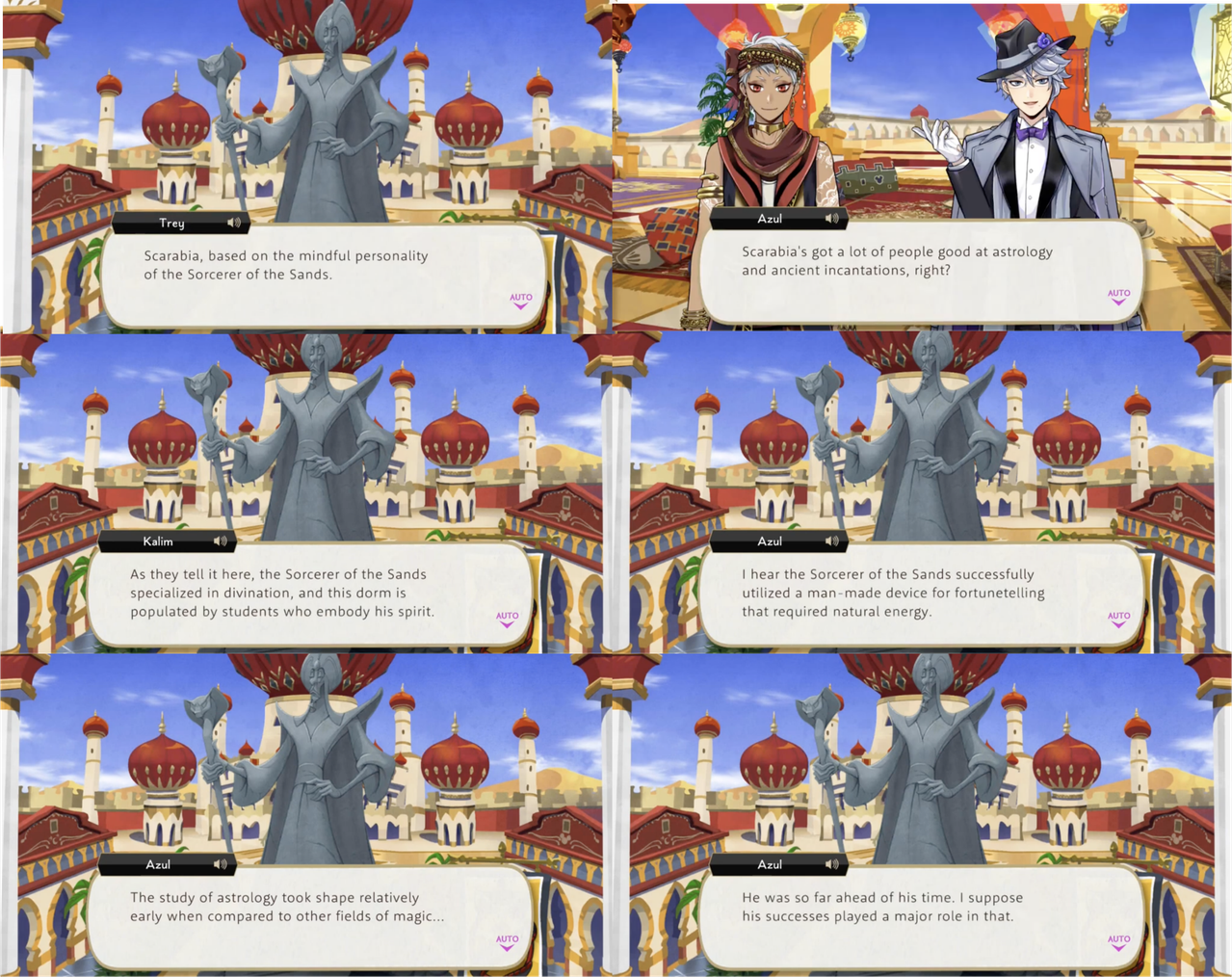
Azul says, “Scarabia’s got a lot of people good at astrology and ancient incantations,” possibly in relation to the Sorcerer of the Sands, with Kalim explaining, “the Sorcerer of the Sands specialized in divination, and this dorm is populated by students who embody his spirit.”

Azul says, “I hear the Sorcerer of the Sands successfully utilized a man-made device for fortunetelling that required natural energy. The study of astrology took shape relatively early when compared to other fields of magic…he was so far ahead of his time. I suppose his successes played a major role in that.”
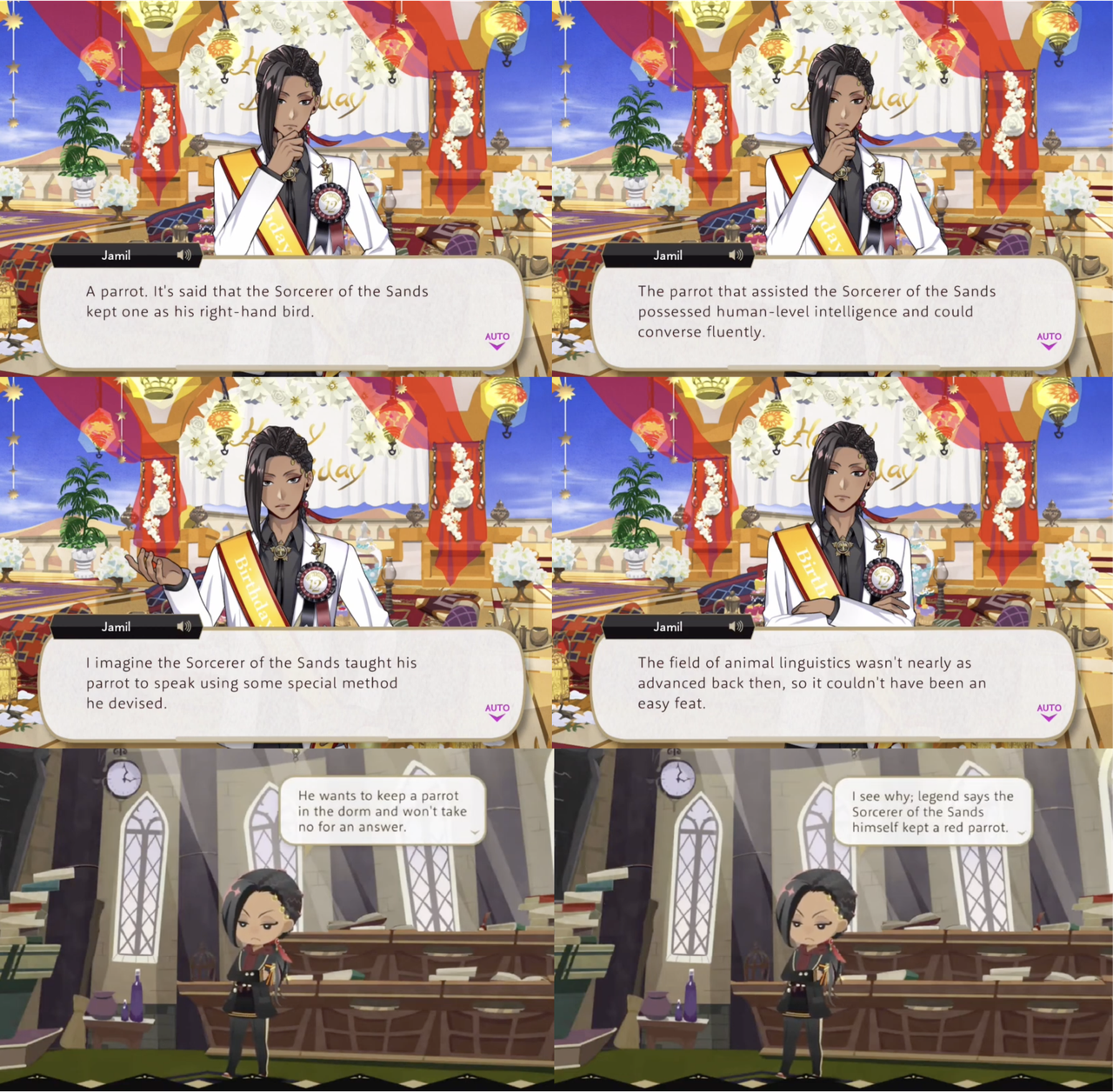
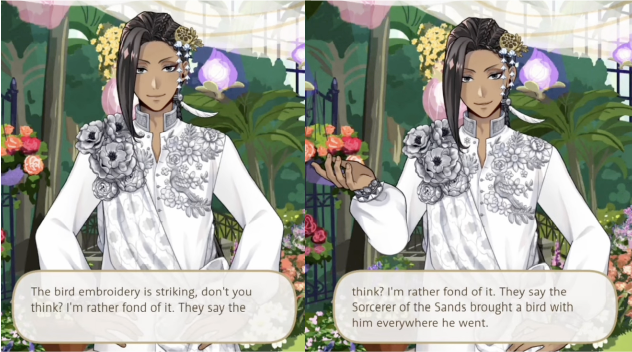
Jamil says, “It’s said that the Sorcerer of the Sands kept one as his right-hand bird. The parrot that assisted the Sorcerer of the Sands possessed human-level intelligence and could converse fluently. I imagine the Sorcerer of the Sands taught his parrot to speak using some special method he devised. The field of animal linguistics wasn’t nearly as advanced back then, so it couldn’t have been an easy feat.”
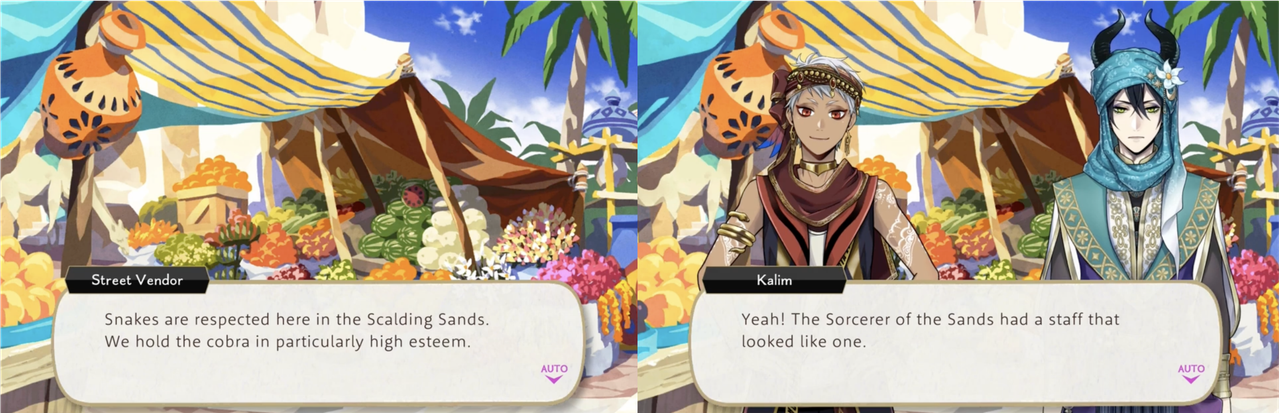
A street vendor in a local market says, “Snakes are respected here in the Scalding Sands. We hold the cobra in particularly high esteem,” and Kalim explains, “The Sorcerer of the Sands had a staff that looked like one.” Jamil has a Harveston outfit voice line of, “If I were to choose a plush animal for a sled race, I’d pick a snake. They can move with agility no matter where they are,” and an NBC voice line of, “The candlesticks in town hall had a snake motif. What fine taste that shows. I should look into finding something similar for myself.”
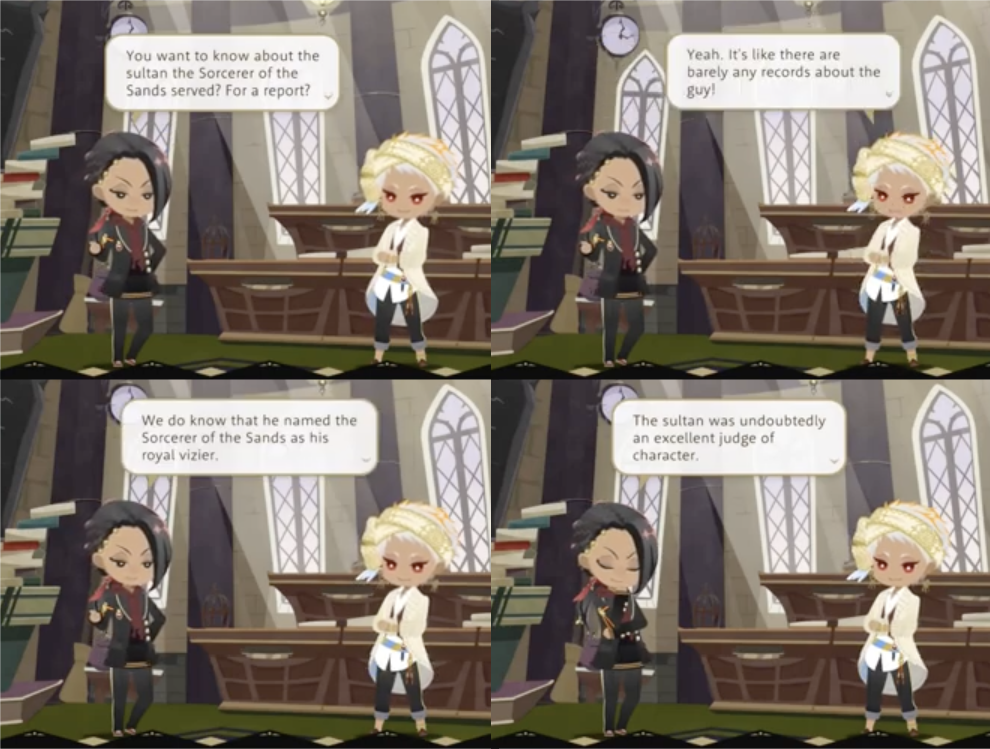

Kalim says, “There are barely any records” about “the sultan the Sorcerer of the Sands served,” and Jamil responds, “We do know that he named the Sorcerer of the Sands as his royal vizier. The sultan was undoubtedly an excellent judge of character. Kalim says that “the old sultan of the Scalding Sands” was “a master rider” of magic carpets, and, “They say he once raced with a bird and flew under an elephant’s legs!,” possibly in reference to a different sultan than the one who employed the Sorcerer of the Sands, or an example of two characters being combined in legends over time.

