

Original Game: Lantern of Wishes: Road to Freedom
EN Server: A Radiant Reenactment
There is an interesting pattern on EN where Jack will be re-characterized as less abrasive than he actually is, such as having the line “What does that have to do with me” changed to “Go on,” and a line about not being friends with the prefect removed.


This is possibly being continued in the Lantern of Wishes event:
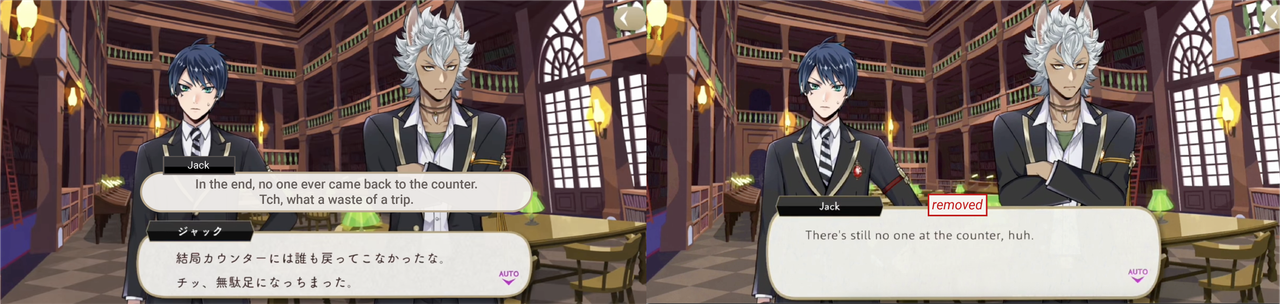
Original Jack: In the end, no one ever came back to the counter. Tch, what a waste of a trip.
EN Jack: There’s still no one at the counter, huh.
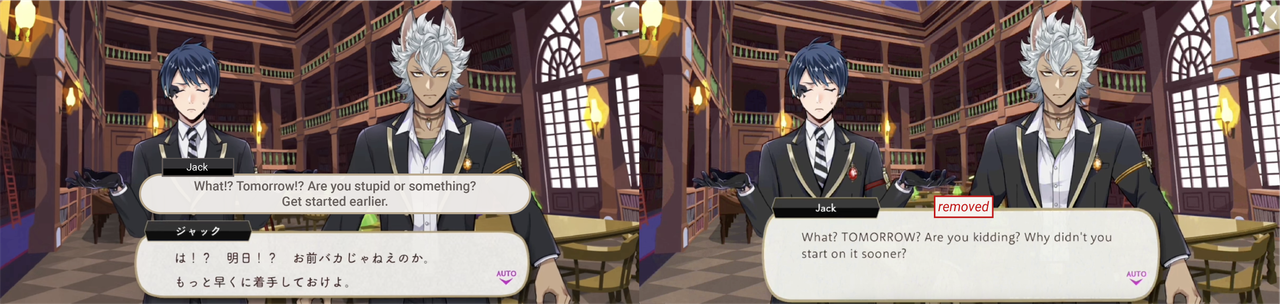
Original Jack: What!? Tomorrow!? Are you stupid or something? Get started earlier.
EN Jack: What? TOMORROW? Are you kidding? Why didn’t you start on it sooner?
This difference in Jack’s characterization between servers is possibly why EN players are sometimes surprised that Jack uses more rude language than almost anyone else in the entire game, second only to Leona (more here ->).
And the same thing might also be happening to Kalim! For a small grammar lesson, here is a perfectly accurate localization of Deuce:
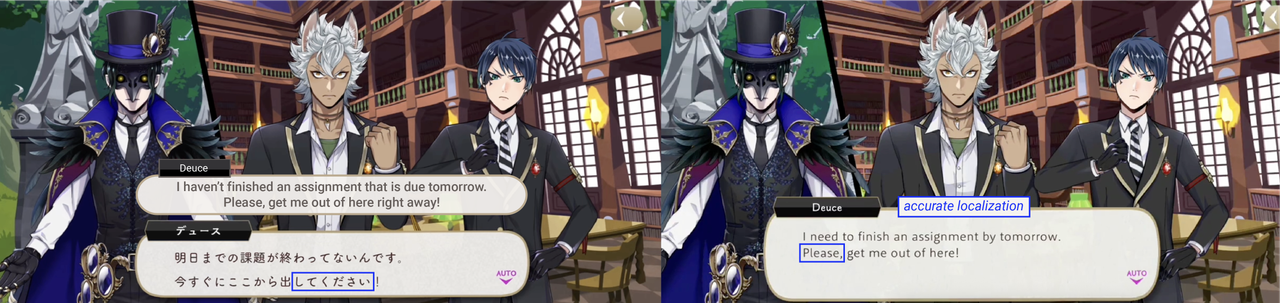
Original Game: ここから出してください!▶︎ Please get me out of here!
EN Game: Please get me out of here!
With the してください form of Deuce’s sentence he is making a polite request and saying “please,” as would be expected of a student speaking to a teacher.
※Note: in none of these examples does anyone actually use personal pronouns, so they could be saying “me” or “us,” but it has been written to match the EN-server interpretation.
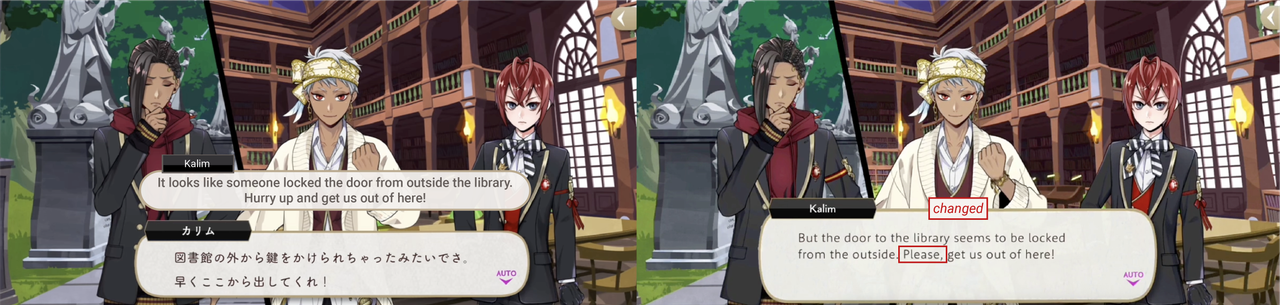
Here Kalim is using the exact same verb as Deuce but his verb form is not polite: he is speaking in a casual, commanding tone. It is not a request, it is an order. It is not exactly rude, but it is urgent, which EN has softened with “please,” which Kalim does not say.
Original Game: 早くここから出してくれ ▶︎ Hurry up and get us out of here!
EN Game: Please, get us out of here!
And this is characteristic of Kalim, who has possibly never spoken in polite forms with anyone, and also does not use honorifics even with older housewardens.
Characteristic of a teenager coming from privilege and wealth who is friendly but maybe not very sensitive to social cues and formality, making him sound unintentionally abrasive.

It makes sense that someone would use such phrasing with a servant but, as seen above, he uses the same verb form with Crowley: EN again softens his dialogue with “please,” but Kalim does not actually say “please” or use polite grammar.
Original Game: オレたちに譲ってくれ ▶︎ Hand it over to us
EN Game: Please let us have them!
These kinds of changes can run the risk of mischaracterizing characters like Jack and Kalim in subtle ways: Jack sounds less abrasive than he is in the original game, and Kalim sounds more polite than he really is. These changes maybe help English-language text flow more smoothly, but they maybe also affect how different players are perceiving the same characters.
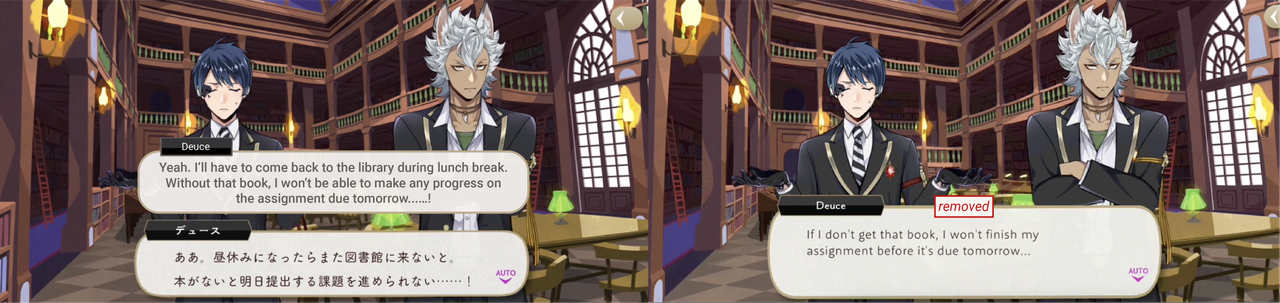
Original Deuce: Yeah. I’ll have to come back to the library during lunch break. Without that book, I won’t be able to make any progress on the assignment due tomorrow……
EN Deuce: If I don’t get that book, I won’t finish my assignment before it’s due tomorrow…
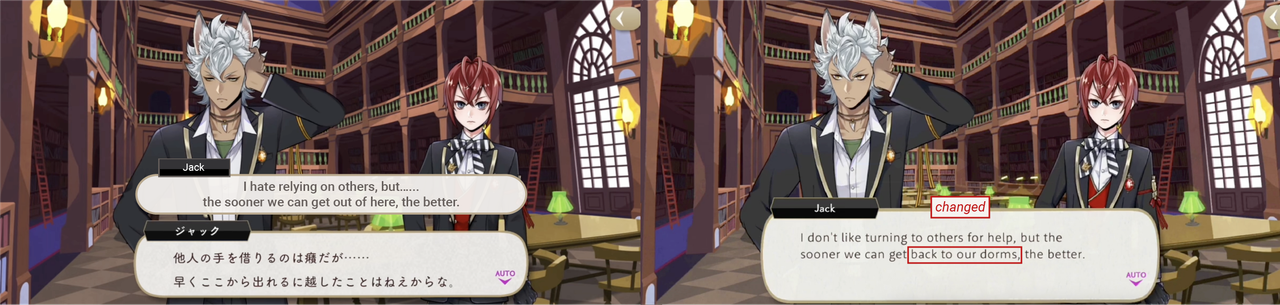
Original Jack: I hate relying on others, but…..the sooner we can get out of here, the better.
EN Jack: I don’t like turning to others for help, but the sooner we can get back to our dorms, the better.
(In the context of the scene none of the characters are trying to get back to their dorms, they are trying to go to class.)
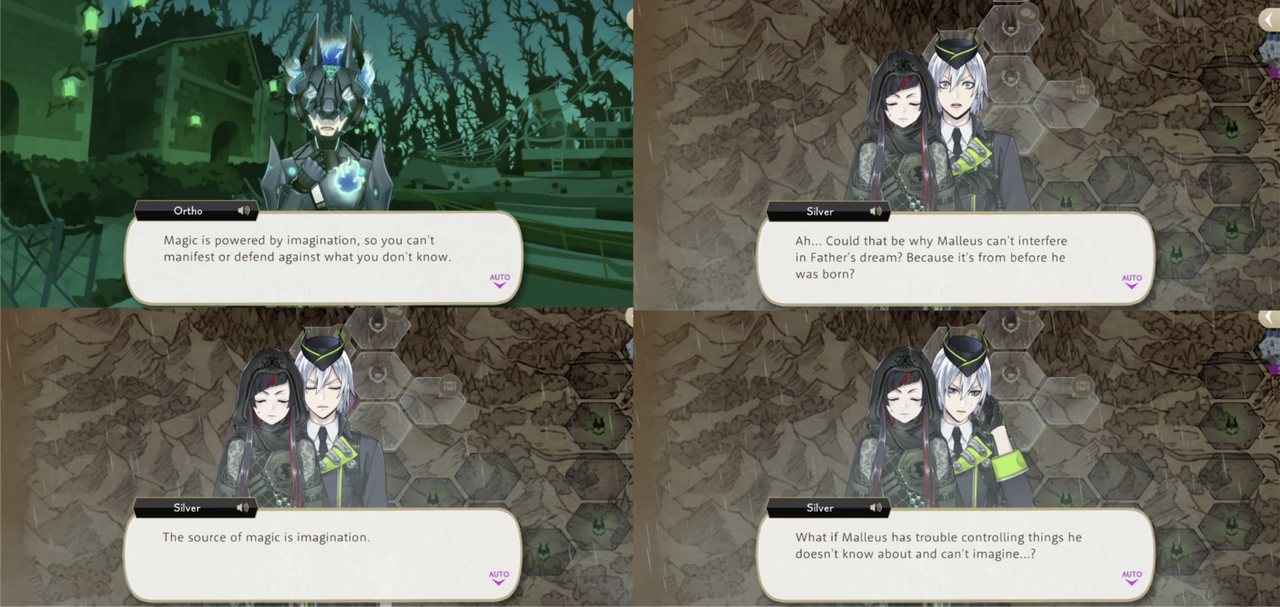
Imagination comes up often in Twst: in Book 7 the characters are trapped in dream worlds crafted by their own imaginations, but limited by the imagination of a person who cannot comprehend the concept of happiness beyond the absence of negative emotions.
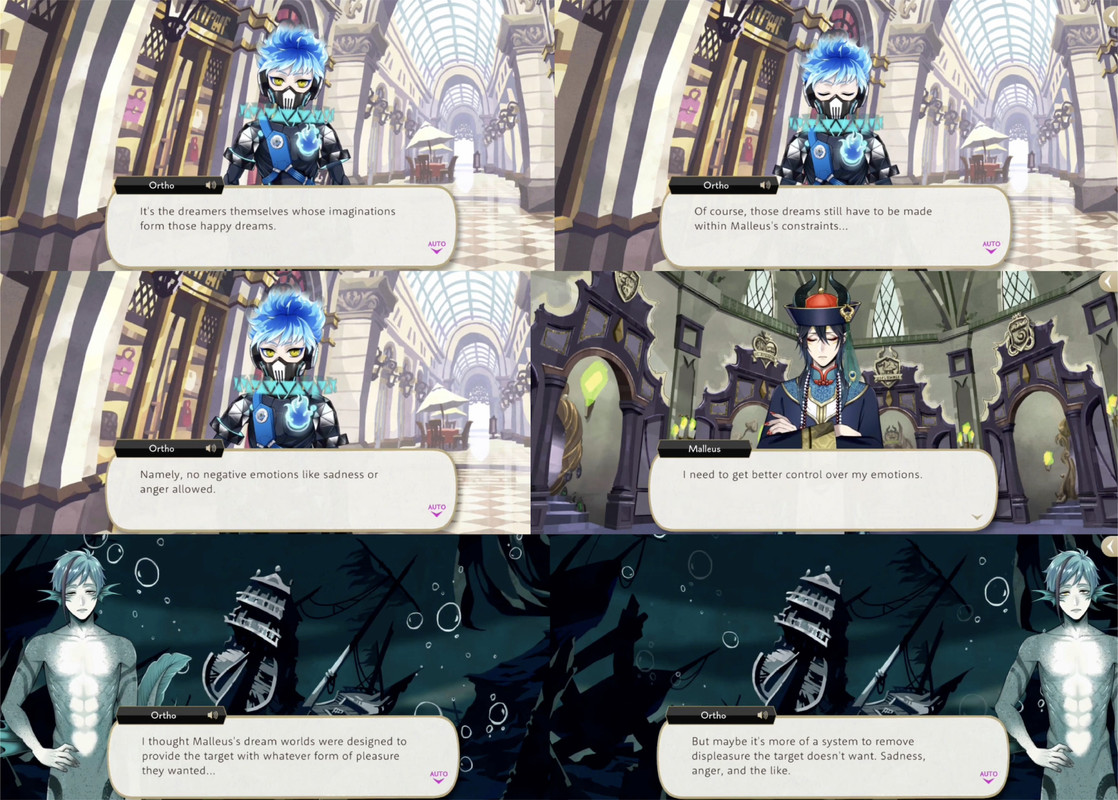
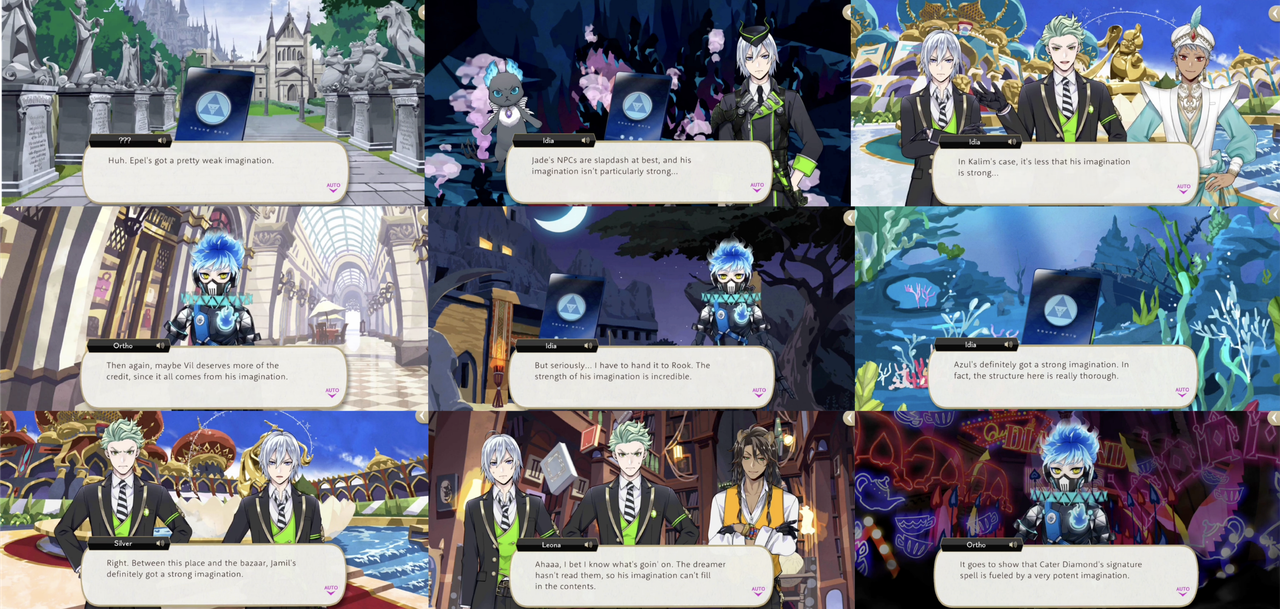
It is a fascinating concept, the groundwork for which was laid as early as Book 1 where we learn from Crowley, “The strength of magic is strength of imagination.” (using literally the word “imagination,” in English.)
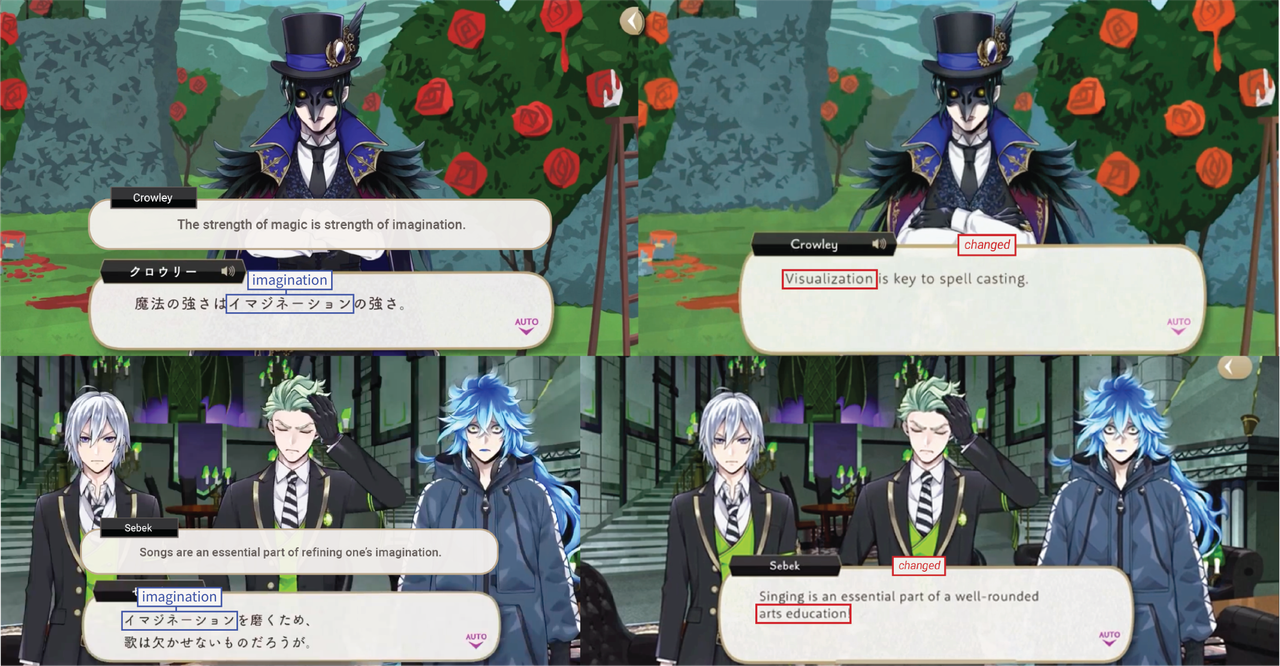
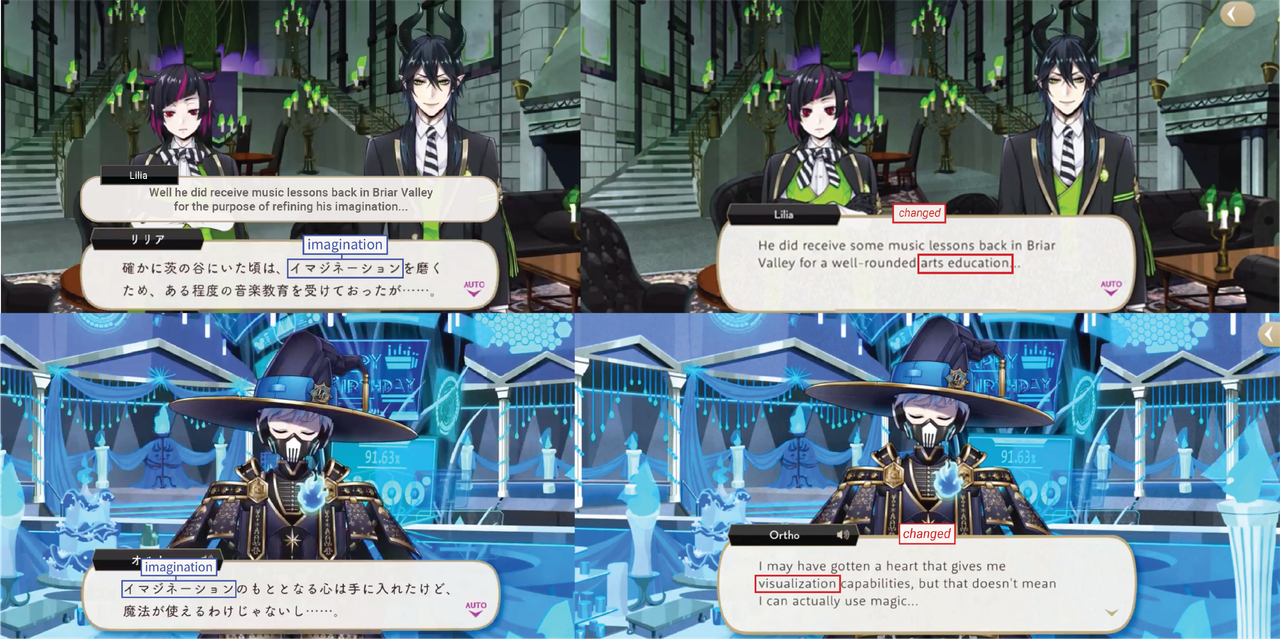
But this reference to imagination was removed from EN (replaced by things like “visualization” and “arts education”) until the Glorious Masquerade event which is possibly around the time that Aniplex USA received the scripts for Book 7 and realized that the word was more important that they’d thought (more here ▶︎).
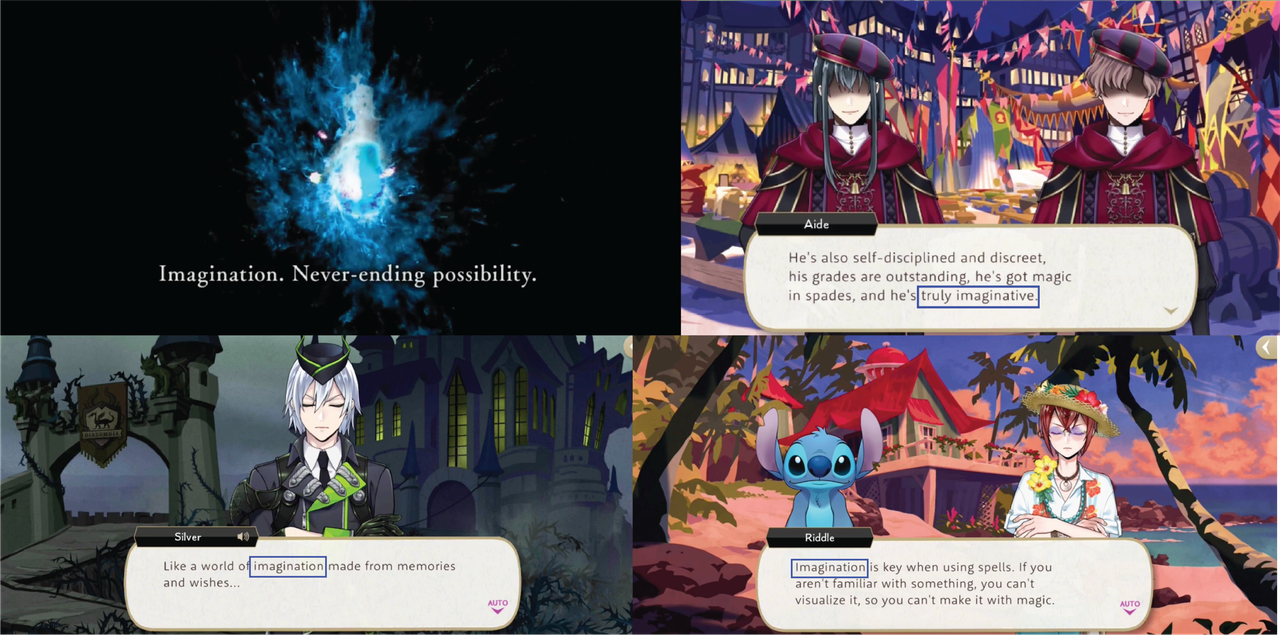
Whatever the reason, from Book 6 onwards it was suddenly no longer removed from the main story or events.
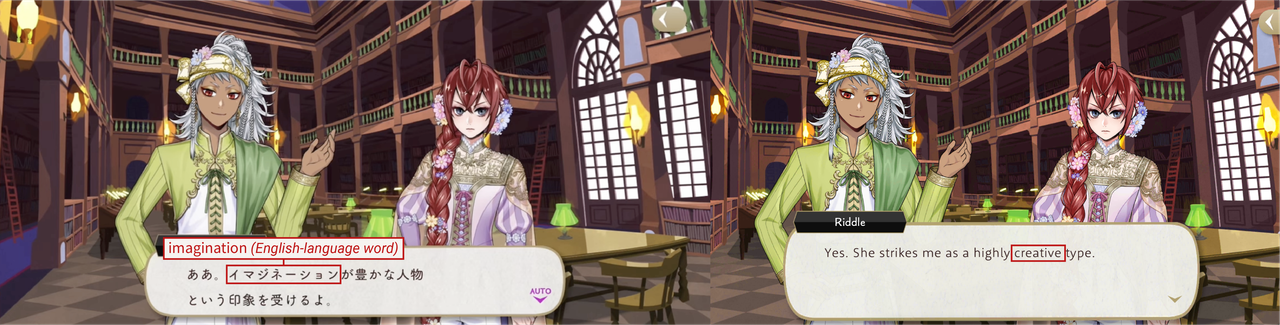
It was, however, removed from Riddle’s conversation with Kalim: instead of complimenting the Princess in the Tower’s imagination on EN, he compliments her creativity, instead.
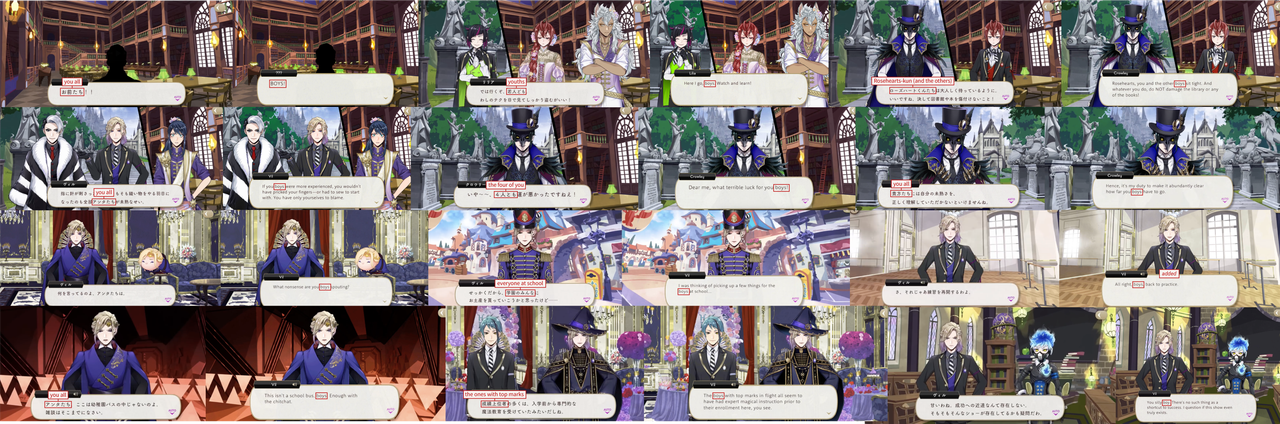
If you thought it was an odd characterization choice for the one person who has spoken out against needless gendering to be regularly referring to people by their gender, you are correct:
In five different instances in the Lantern event the word “boys” is added to dialogue where no one actually says it, and the person on the main cast who has their dialogue adapted in this way more than anyone else throughout the game is, curiously, Vil.
But this verbal tic of Vil’s in unique to the English-language adaptation and is non-canon to the original game, where he never does so.
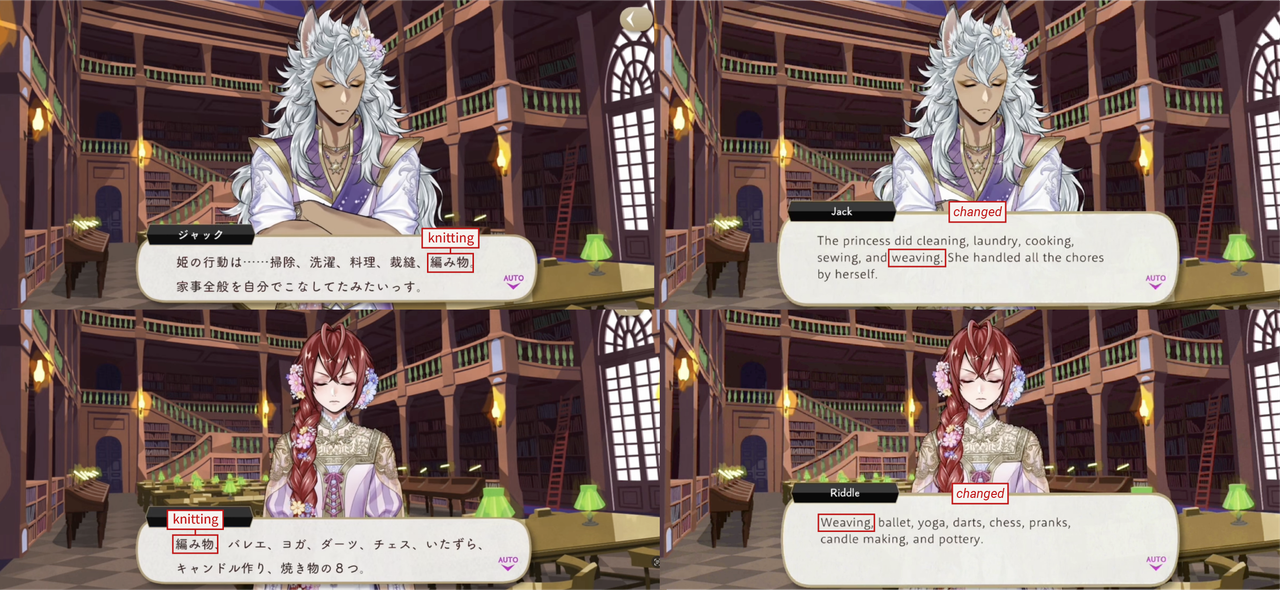
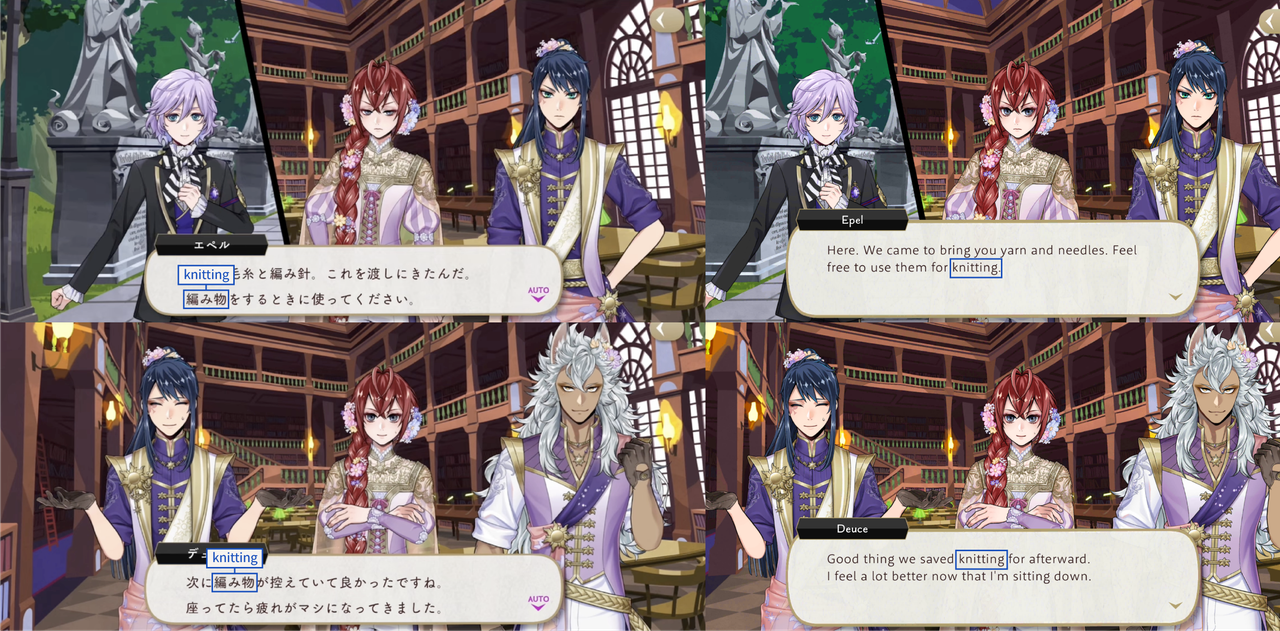
If you thought it odd that weaving was mentioned at first but then never again without any resolution, the actual word used was “knitting,” which was accurately translated later in the event to match both the Japanese-language adaptation of the Rapunzel movie and the original song.
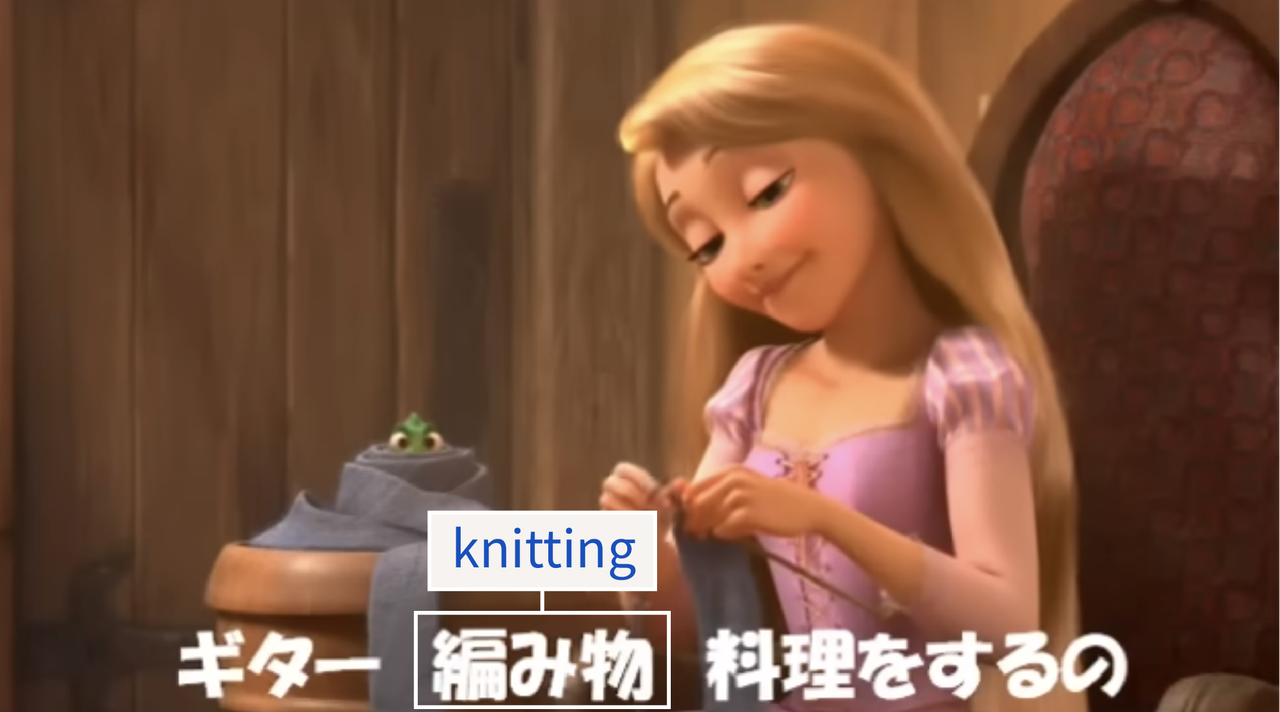
The word used in the original game does not mean “weaving.” Not sure where that localization came from.
In the original game Deuce announces that tea has been prepared for the upperclassmen (Kalim and Riddle), changed on EN to announcing that tea is ready for everyone.
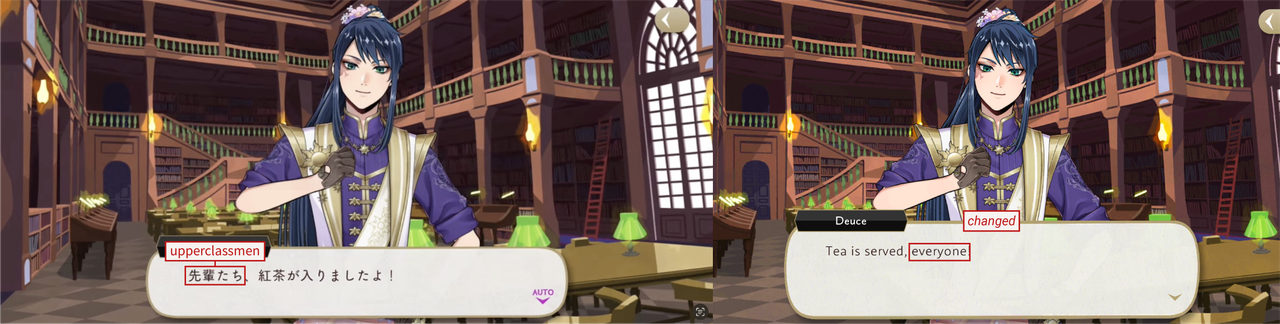
A strict respect for hierarchy is an important part of Deuce’s character and possibly a holdover from his pre-NRC days as an aspiring yankee.
This seems to be difficult to portray about Deuce in English, and the official translation of the first novel added the line “Are you trying to overturn the natural order of upperclassmen and lowerclassmen?!” to Deuce’s dialogue, possibly so that English speakers are able to understand this about his character, even though that is something that Deuce has canonically never said in any retelling of Twst (and when he shows more subtle signs of respecting hierarchy it gets removed, such as here).
Changes to the English-language adaptation of the first Twst novel have been catalogued here ▶︎
 Twisted Wonderland Reference Note