
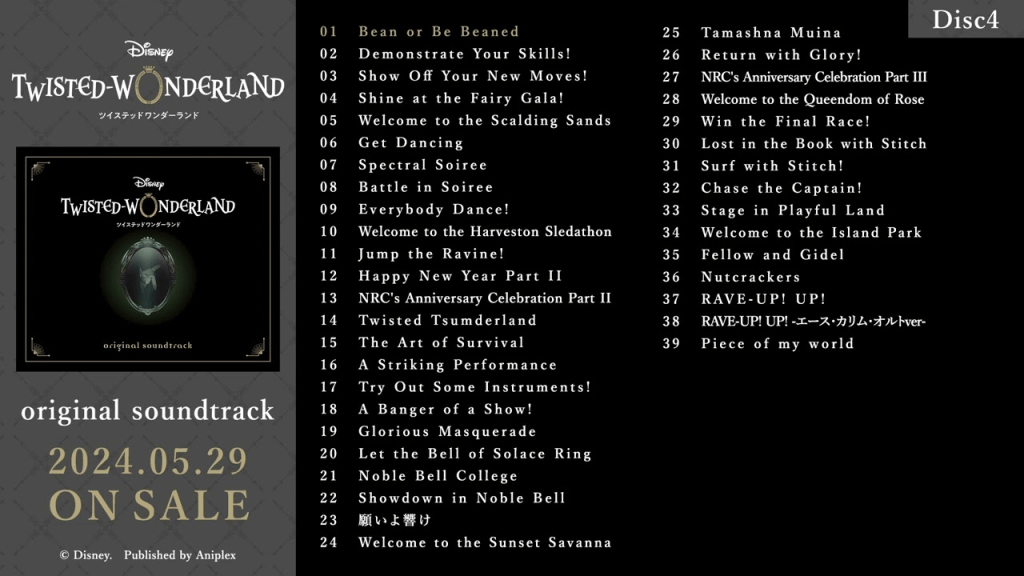
Q: How did you first come to be involved in the music for Disney’s Twst?
“Aniplex reached out to me in the summer of 2018, I submitted about four demo tracks, and that is how it all began.
The first track I created was the main theme that plays at the login screen, ‘Theme of Twisted-Wonderland’ (Disc 1 – 01). I looked through the materials for Twst for the first time and immediately thought, ‘Let’s use this sound!’ My aim for the song was to portray a glamorous dark fantasy.
The track starts with a bell-like sound, followed by a chorus, creating a composition that is both cute and mysteriously heavy. I often use bells in my music for Twst because they can convey a sense of glamour but also a dark weightiness. I also had the thought that bells can help set the stage of the academy where the story takes place. I used different types of bells to produce various timbres.
The other tracks I submitted as a part of the demo were ‘My Room’ (Disc 1 – 02), which plays on the home screen and was inspired by Ramshackle Dorm, ‘College Days’ (Disc 1 – 23), a versatile track used in scenes portraying daily life and the rhythmic track ‘Escape the Ghosts!’ (Disc 2 – 05) from the prologue.
Q: Twst is a unique, never-before-tried project inspired by Disney villains—how did it feel being approached to compose the music for it?
“As I reviewed the illustrations of the characters, the scenario, etc. my first impression was that the characters were truly wonderful. You can tell what they were based on at a glance, and the intricate detail of the costumes, accessories and designs drew me in. The story of daily life at a school alongside characters inspired by fearsome villains seemed very compelling. So, while I did feel a lot of pressure, I was also really looking forward to it and felt honored that they reached out to me.”
Q: Could you tell us about the production process?
“First, I receive a list of requests. Sometimes there will be specific instructions such as, ‘This is going to be key, so please include this kind of sound.’ For example, for the limited-time event ‘Stage in Playfulland: Dancing Dolls and the Amusement Park of Illusion,’ I received the request ‘include whistling’ for the track ‘Fellow and Gidel’ (Disc 4-35).
To start, I create a digital demo track based on those requests. I’ll receive feedback on the demo, record with musicians and complete it. Most of Twst’s demos received immediate approval, for which I am grateful, but it can also make me nervous as the creator (laughs). Sometimes Toboso-sensei will kindly share her thoughts on the music, and I really appreciate her encouragement. I have heard that she will write while listening to my music, and I am so glad that I can contribute in such a way.
A lot of the instruments that we use are, naturally, those that are commonly found in orchestras. On tracks related to Scarabia I used instruments commonly used in folk music, for the limited-time event ‘Lost in the Book with Stitch: Summer Seas and Spaceships’ I used instruments that produce sounds reminiscent of Hawaii, and for ‘Master Chef’ I used an old-fashioned, honky-tonk piano. I also use flutes and piccolos quite often to better portray the fantasy-like nature of the world.”

Q: What sort of thing do you generally keep in mind during production?
“I am careful about arranging the melodies and atmospheres in such a way that listeners will be able to feel the influences of the original works that inspired them.
During production, though, I try to maintain a bit of distance from the original music upon which the tracks are based. If I focus too much on remaining true to the original music there is a risk of the final product being too close of an homage, as I love the original works so much…since some tracks are used over and over again in stories and events I aim for a balance of leaving a strong impression but not so much so that it becomes repetitive, while also not interfering with story progression or dialogue.
Sometimes I will be too cautious and the music will start sounding generic. I have found that getting just to the point where I suspect I am going too far tends to be just right. I pay careful attention to maintaining that balance.
Q: Are there any other unique challenges to this project?
“In terms of the villains theme, in the early stages the music tended to all sound the same, so differentiating between the dark tones became a process of trial and error. As the story progressed I became more familiar with the characters and gained a strong sense of who they each are, so now I feel as though the music can effectively portray the differences between each person and each dorm.
‘Twst’ is my first time making so much music for a single project over such a long period of time—I have already composed over 200 tracks—and it is a daily challenge for me. Every single time I will think, ‘I don’t have anything else left in me…!’ and every time I am able to overcome that hurdle, thanks to everyone’s support.
Whenever I hit a roadblock I listen back to the Twst tracks that I have already composed, think to myself, ‘How did I do this last time?’, and try to return to that space. I am the type of person who loses all confidence whenever they hit a snag, so I encourage myself by repeating, ‘It’s going to be all right! You’re doing this, you’re doing this!’”

Q: Could you tell us about the themes for the dorms, and stories from production?
“The first dorm theme I composed was ‘Heartslabyul Dorm’ (Disc 2-06). Rather than being an exciting piece it portrays the strict discipline and sternness of the Queen of Hearts, as well as a sense of having entered a mysterious world. Although the dorm becomes quite lively as the story progresses this theme’s key point is that it begins and ends quietly.
The theme ‘Savanaclaw Dorm’ (Disc 2-11), was the one I struggled with the least. I wanted to express the dry atmosphere of the savanna and the feeling of distant horizons shimmering with heat, so I sampled a variety of chant-like voices.
On the other hand, ‘Octavinelle Dorm’ (Disc 2-18) was the most challenging theme. While it has a jazz-like feel, I incorporated an unusual chord progression that is not typical of traditional jazz. I wanted to create the sensation of floating underwater, so I included noise meant to represent bubbles. I like to think that the use of steel drums helped with capturing the atmosphere of the deep sea.
The theme ‘Scarabia Dorm’ (Disc 2-22) goes full throttle on producing the types of sounds heard in the Oriental Scale, and incorporates instruments such as the sitar, a string instrument from India. I love this kind of music, personally, so I had a lot of fun composing it.
The theme ‘Pomefiore Dorm’ (Disc 3-01) gives off a noble and elegant impression. While it features a waltz rhythm, the point is not to evoke a glamorous ballroom dance but rather to emphasize its solid rhythm and a melody that exudes a sense of gallantry.
The theme ‘Ignihyde Dorm’ (Disc 3-07) is the most unique, I think. It has various sequences that gradually build up to combine into one at the end. Listening to it now, I wonder, ‘How is it that I layered all those sounds?’ It’s a complex piece, and I’m quite fond of it.
The theme ‘Diasomnia Dorm’ (Disc 3-13) aims to craft a cold, beautiful, and—above all—majestic atmosphere. I wanted to create a piece of music that instills a sense of nervous tension just by listening to it, as if one might incur Malleus’ wrath for the slightest misstep.”
Q: How about the theme Ramshackle Dorm’ (Disc2-01)?
“This song emphasizes even more absurdity than ‘My Room,’ and it came with the challenge of portraying the feeling of something being rundown through sound alone.
An oboe is the star of this piece, and when I asked the musician to create a sound that was ‘absurd and pathetic, like it’s falling apart,’ they managed something that was genuinely depressing to hear. It was so sad that I immediately followed with, ‘It’s okay to make it just a bit more lively…!’ and requested a different tone, which resulted in the final product.”
Q: How were the individual tracks for the Overblot battles created?
“There are no bass phrases or sounds that are shared throughout every theme; instead, entirely different tracks were created based on each individual character. I took the unique anger and sadness each character must have felt according to how it was that they were driven to overbold, and expanded upon it.
‘Showdown in Heartslabyul’ (Disc2-10) was where Riddle, always so suppressed, explodes with the regret of everything that he was denied as a child. Rather than an eerie aura there is a rhythm sharply carving out its own way to portray his anger and sadness.
Leona’s ‘Showdown in Savanaclaw’ (Disc2-17) was based on a lion running through the savanna. After creating the first version I also submitted another with more melancholy, as I felt the initial incarnation was possibly too bold and did not properly convey the depths of Leona’s frustration and sorrow. But the first version was highly praised and ultimately selected for the game. Leona’s overblot is characterized more by anger than it is by sadness. It inspires imagery of Leona charging valiantly ahead, despite his rage, which makes me feel that the initial version was indeed the right choice.
Azul’s ‘Showdown in Octavinelle’ (Disc 2-21) has a jazziness that is reminiscent of the dorm’s theme. To represent writhing octopus tentacles I used arpeggios (broken chords played one note at a time) on the piano and I was surprised to later learn that arpeggios were also used to represent the sea in the original ‘The Little Mermaid.’

The story of Chapter 4 was filled with Jamil’s hatred, and I found myself really able to relate to him, thinking, ‘Yes, I totally understand that feeling!,’ which made me like him even more. I set out to make ‘Showdown in Scarabia’ (Disc 2-26)- the most ominous of all the overblot battle music. While I sang the choruses of the other six Overblot battle songs on my own, for this one I added male and female voices to create the atmosphere of frightening incantations infused with envy.
I received instructions to make Vil’s ‘Showdown in Pomefiore’ (Disc 3-06) majestic and dramatic. I included tragic-sounding blocks that bordered on cliché. Then there comes a key change, and I remember feeling so happy when Toboso-sensei listened to this track and said, ‘I am able to feel the sadness of not being able to become number one. The oppressive scariness is very characteristic of Vil.’
Out of all the overblot battle tracks, Idia and Ortho’s ‘Showdown in Ignihyde’ (Disc 3-11) took the most time to produce. Similar to the dorm’s theme song it goes in the direction of digital Eurobeat, so every instrument (except the guitar) was recreated digitally and it features a lot of different sounds. I believe that the chaotic noises effectively convey the brothers’ anger, frustration, anguish, and woe.
Malleus’ ‘Showdown in Diasomnia’ (Disc 3-14) was designed to be full-on goth rock, which I really enjoyed creating as I am a fan of goth metal. While the choruses of the overblot battle songs are mostly gibberish, there is a part in this track where Malleus is explicitly mentioned by name. It might be interesting to listen for that detail.”

Q: The theme songs of the three schools from the story have been included as well.
“The ‘Night Raven College’ (Disc1-24) track, designed with NRC itself in mind, was initially supposed to have a more mischievous atmosphere. But since it is the theme for the school I also wanted it to have a touch of elegance, so I incorporated a waltz-like feel. I think it reflects the design of the school uniforms and the main theme, ‘Theme of Twisted-Wonderland,’ as well.
‘Royal Sword Academy’ (Disc1-25) has a dazzling, sunny atmosphere. My instructions were to create a sparkling song, which was the complete opposite of everything else I’d been doing, so I remember struggling to make it sparkle enough. Ultimately I arrived at this atmosphere of a heroic, sword-wielding prince on horseback to suit the white school uniforms worn by the students.
The theme song of Noble Bell College, attended by Rollo Flamme and featured in the limited-time event ‘Glorious Masquerade ~The Crimson Lotus Flowers and the Bell of Salvation~,’ titled ‘Noble Bell College’ (Disc4-21) was inspired by ‘The Bells of Notre Dame,’ so I definitely wanted bells involved. It starts with a somewhat heavy bell sound to portray how high strung Rollo is. The event’s music emphasizes solemness, heavily incorporating a mixed chorus of about eight men and women.”
Q: Are there any other particularly memorable tracks?
“The mini-games in Chapter 6 use three distinct tracks. Since they are quite different from the game’s usual setting (especially ‘The Legend of the Underworld’, which dips into a genre I had little experience with), I had fun drawing inspiration from various old games to create them.
The starting screens are so reminiscent of games from that time that I went, ‘Woah!’ when I saw them. But I had a lot of trouble clearing ‘The Legend of the Underworld,’ to the point that I could no longer progress through the main story—that is how hard it was (laughs).
Also ‘Time for Summoning’ (Disc1-4), which plays during the gacha summoning animation. It was created to enhance the excitement of doing the gacha, and it’s a personal favorite of mine. While recording ‘Special Lessons’ (Disc1-16) for the third anniversary one of the performers themselves told me, ‘This is a good song!,’ and I have found that I enjoy listening to it as well.”
Q: How about the events, for which you are always creating new music?
“For the first event, ‘Happy Beans Day ~Reclaim the Golden Harp!~’ and the event of alternative perspectives ‘Happy Beans Day ~The Harp-less Brawl~,’ I kept things fresh by changing how the instruments were incorporated while maintaining a consistent atmosphere, pace and genre. I watched ‘Mickey and the Beanstalk’ for inspiration and there are subtle homages paid via some of the phrases that I used.
I used ‘Steamboat Willie’ (similar to ‘The Turkey in the Straw’) for ‘A Banger of a Show!’ (Disc4-18) in ‘Port Fest ~Brass Beat of the Sea Breeze~’. The 3 tracks from ‘Fairy Gala ~Festival of the Spring-Calling Fairies ~’ ‘(Walk That Runway!’ (Disc3-23), ‘Learn Those Moves!’ (Disc3-24) and ‘Stun at the Fairy Gala!’ (Disc3-25)) share a consistency while also being different from one another, and I’m fond of all three.
Leona (implemented as an SSR) had a glamorous atmosphere completely different his usual self, which I think I was able to portray through a track reminiscent of dancing fairies. ‘Demonstrate Your Skills!’ (Disc4-02), ‘Show Off Your New Moves!’ (Disc4-03), and ‘Shine at the Fairy Gala!’ (Disc4-04) from ‘Fairy Gala if ~A Festival of Illusions with Fairies~’ also maintain a consistent theme while the music itself evolves. I incorporated digital-like sounds as a nod to Ortho’s involvement.”
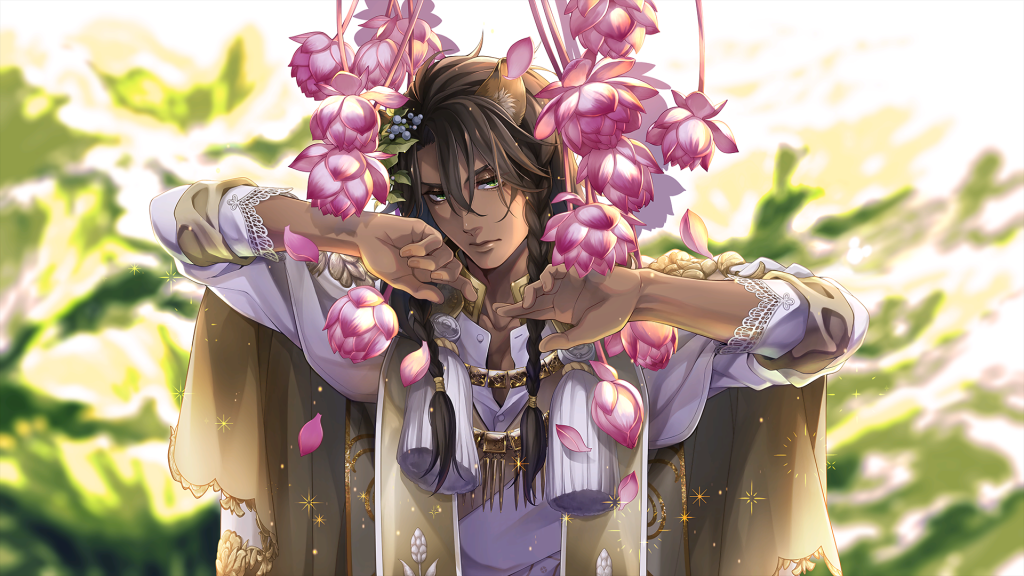
Q: What was the production process like for the theme song ‘Piece of my world’ (Disc4-39)?
“Right after it was decided that I would be involved in the music for this project I immediately started working on this theme song. It begins with a tune for dancing to, and then at the interlude the rhythm adopts a waltz-like, classical atmosphere, and then it returns to something more danceable. I enjoy the structure of this song very much.
I had never really done music for an all-male group before, and there are 11 members in the Night Ravens—it was my first time directing so many people. Recordings were lively and bustling like Night Raven College itself, as if we had all come together for a club activity. There are multiple versions of the song, each with different variations in the performances and interludes, and I hope everyone is able to enjoy what makes them unique.
I also directed the voice actors in their performance of ‘Piece of my world -NRC 17 ver- Full size’ featured in Chapter 5 of the main story. Their performances and singing were wonderful; they were perfect. I didn’t have very much experience with recording songs by voice actors, and I was awestruck just by being in the same room.
‘Absolutely Beautiful Full size’ (Disc3-05) also appears in Chapter 5, and we recorded it at the same time. I was also responsible for writing its lyrics, but to be honest, I very anxious about this one up until the moment that the vocals were recorded. The power of the voice actors’ singing is truly incredible. Vil-sama presided through Aiba Hiroki-san’s voice, and the charm of ’It’s not just about strength!’ was portrayed with complete clarity. Jamil raps during the song and Futaba Kaname-san gave an incredibly skilled performance, which is another highlight to listen for.”

Q: There is also ‘Wish Resound’ (Disc4-23), which appears in ‘‘Glorious Masquerade ~The Crimson Lotus Flowers and the Bell of Salvation~.’ It’s performed by the voice actors for Malleus (Kato Kazuki-san), Azul (Tamaru Atsushi-san) and Idia (Uchiyama Kouki-san).
“I was asked to create something that would sound like it came straight out of a musical. I explained this to Kato-san, and it became a melodious, ‘Malleus-sama On Stage’ song. Kato-san is able to sing in a completely different style for rock songs, but for this he provided the ideal musical performance.
Tamaru-san also perfectly portrayed Azul’s slightly condescending tone, while Uchiyama-san skillfully put across Idia’s withdrawn personality while simultaneously making his voice stand out more than that of anybody else, creating a fascinating and delightful contrast.”
Q: ‘RAVE-UP! UP!’ (Disc4-37) from ’Stage in Playfulland’ is another track that garnered a lot of attention.
“It had a lot of people asking ‘What’s Rave-Up-Up?’ (laughs). It came from a request for a song that everyone could sing together, with easy-to-remember, catchy phrases, which I struggled with quite a bit. I tried fitting so many different words to the melody. While repeating ‘RAVE-UP! UP!’ to myself I found it amusing and catchy, which resulted in the finished song.
There are two versions of this track as well: the full-sized show version by Kita Shuhei-san and Remi-san (Disc4-37), and the version by Ace’s voice actor Yamashita Seiichiro-san, Kalim’s voice actor Furuta Kazuki-san, and Ortho’s voice actor Aoi Shouta-san (Disc4-38). Each team brings a completely different color to the song. The show version has suspicious-sounding interjections by Fellow’s voice actor Sugita Tomokazu-san, which are also fantastic, and I couldn’t help but laugh the first time I heard them! (laughs).”
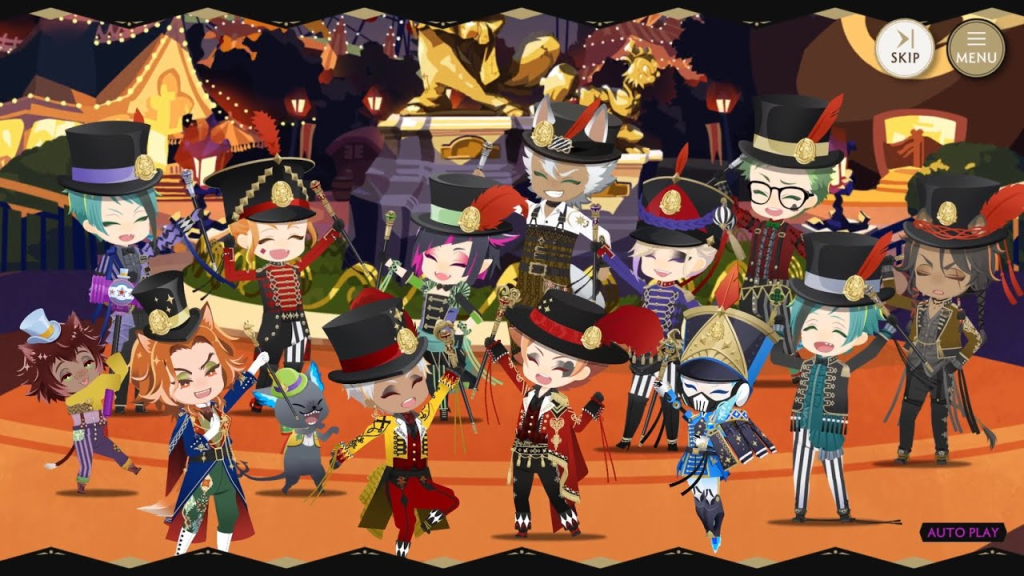
Q: Who is your favorite character?
“When faced with ‘Whose hand will you take?’ at the start of the game, I chose Idia. I enjoyed how he speaks so quickly and uses otaku slang.
As I went through the story I found myself liking so many of the characters. I really liked Jamil in chapter 4, and thought Vil-sama was wonderful in chapter 5.
Currently, in Chapter 7, I like Sebek. He’s loud, but he is so straightforward and he gets cuter every day. When I saw ‘SSR Sebek [Eternal Night Armor],’ I was determined to get him! I used a set of 10 Magical Keys and was overjoyed to pull him on my first try. I was able to see an even cuter Sebek after groovying the card, and with that he became my oshi character. Also, when I saw Rollo’s character design, my first thought was ‘this one is a winner!’ His hairstyle and high-strung demeanor are just amazing.”
Q: Do you have a message for everyone?
“Thank you all for your patience! I am so happy that you are now able to hold the Twst soundtrack CD in your hands and listen to the music anew. I hope you all are able to enjoy it in your own way, creating playlists of your favorite songs. It would be wonderful if everyone were able to immerse themselves in the world of Twst through its music, and to feel as though all the characters are right there by your side.”
 Twisted Wonderland Reference Note