
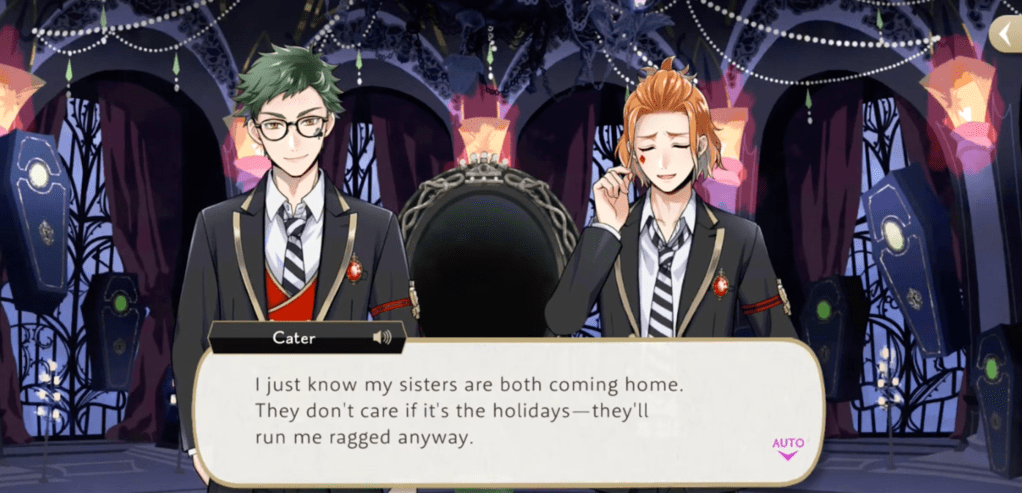
In an infamous translation slip, EN-server Cater has two older sisters, but also has no siblings at all (corrected in a later updated).

How does a mistake like this happen? The likely culprit is: grammar.
Cater’s original line is 「いやいや、男きょうだいはオレだけ」
The literal, word-for-word translation of this line is “Nope, I’m the only male sibling”.

This is an odd way to express such a sentiment in English. Why couldn’t he just say “I don’t have any brothers”?
Because the English language has something that the Japanese language doesn’t: a word for “brother” that does not insinuate age, with even twins differentiate between who was born first and who was born second, as that is just how the language is set up.
Does this mean that, if you want to tell someone you have a sibling in Japanese but don’t want to reveal whether they are older or younger than yourself, you just can’t? Kind of, yes.

Grammatically Cater cannot say “I do not have any brothers,” so he went with “I am the only male sibling,” instead.
This apparently confused the team behind the English-language adaptation, who may have assumed this was a roundabout way to say “I am an only child” and changed the line to something more natural in localization, despite how Cater’s two older sisters have had a very significant impact on the character.
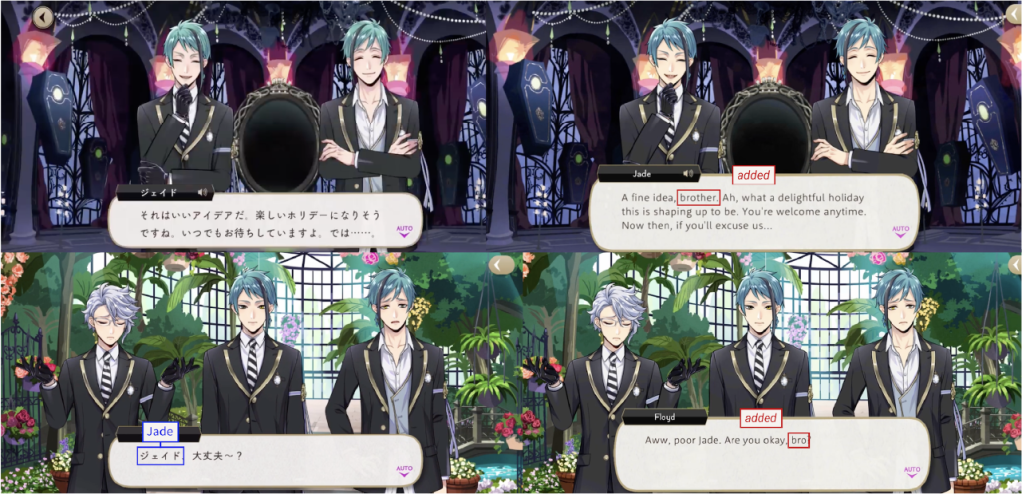
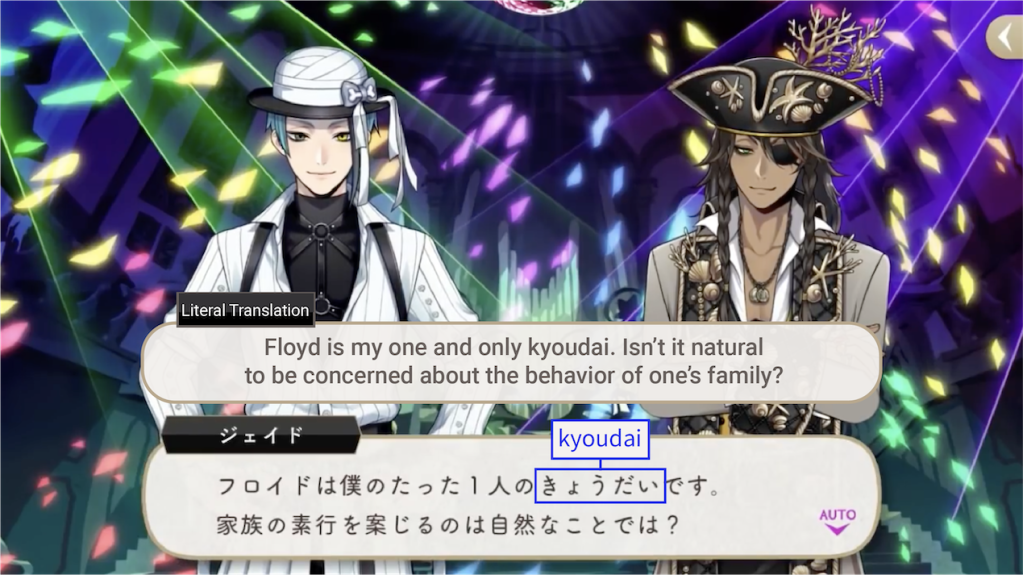
And then there are Jade and Floyd, who never say brother to refer to one another at all, though their dialogue will sometimes be changed in the adaptation to have “brother” or “bro” added where they never said it:
You might say that there are kind of two genres of words for “sibling” (and its variations) in the Japanese language:
- Calling: The kind you use in place of your sibling’s name
- Describing: The kind you use just to describe how you are related to one another

Ortho is an excellent example of the “calling” pattern: he does not call Idia by name, only by “Nii-san” for “older brother.”
On EN this has been localized as “Idia,” because that is the American-English-language equivalent of what Ortho is doing: calling Idia.

(This is aspect of their relationship is so important that it comes up directly in Book 6, when Ortho is dismissed from his role of Idia’s younger brother and actually does call him “Idia-san,” for possibly the first time in his life. More here.)

In English this would be the equivalent of refusing to call your older brother anything but “older brother,” even when he is not in the room and you are talking to an unrelated person.
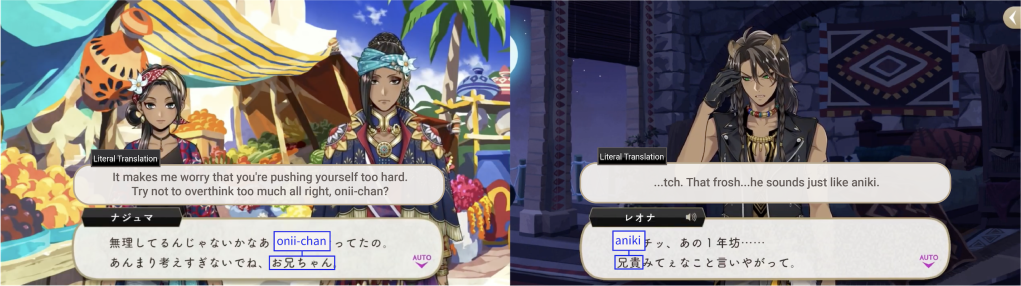
Other examples in the game of the “calling” pattern are Najma and Leona, who use “onii-chan” and “aniki” (respectively) for their older brothers in sentences that would, in English, exchange those words for their siblings’ names.

And an important moment in Jack and Ruggie’s relationship is a line where Jack asks permission to call Ruggie “aniki”!
If Ruggie had said yes, Jack would have started calling him “aniki” in the same way as Ortho calls Idia “nii-san.”

Then there is the “describing” pattern: words like kyoudai (siblings), otouto (little brother), etc.

These words are closer to their English-language equivalents in that they are used to describe familial relationships, but not used in place of your sibling’s name.
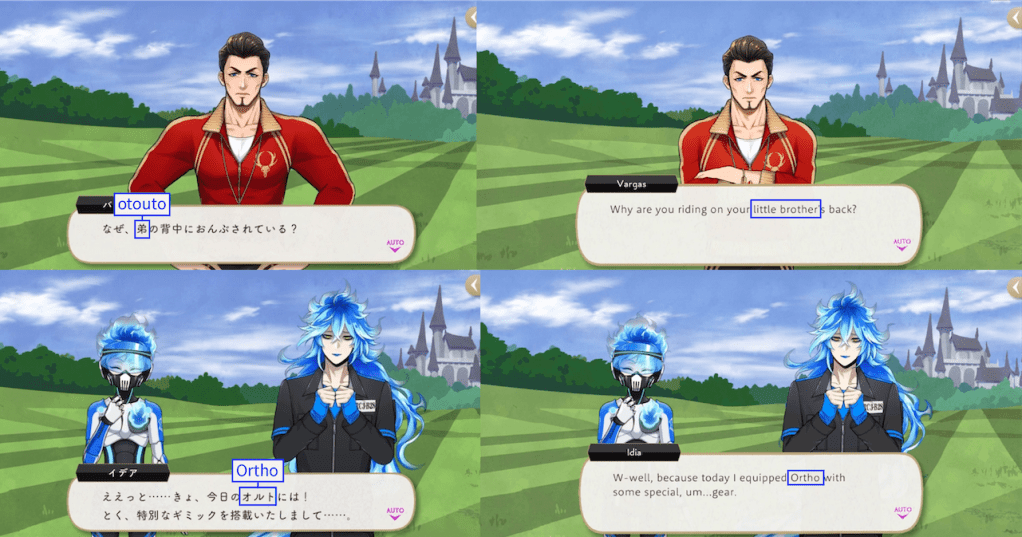
Idia will describe his and Ortho’s relationship by saying that they are “kyoudai” or “he is my otouto,” for example, but grammatically he is not substituting Ortho’s name with those words–he calls Ortho, Ortho.

“Calling” pattern words (nii-san, etc.) do double duty in this way: you can both say “He is my nii-san” and replace your brother’s name with “nii-san,” but whereas you can say “We are kyoudai,” you would not replace your sibling’s name with “kyoudai.” The rules are different!
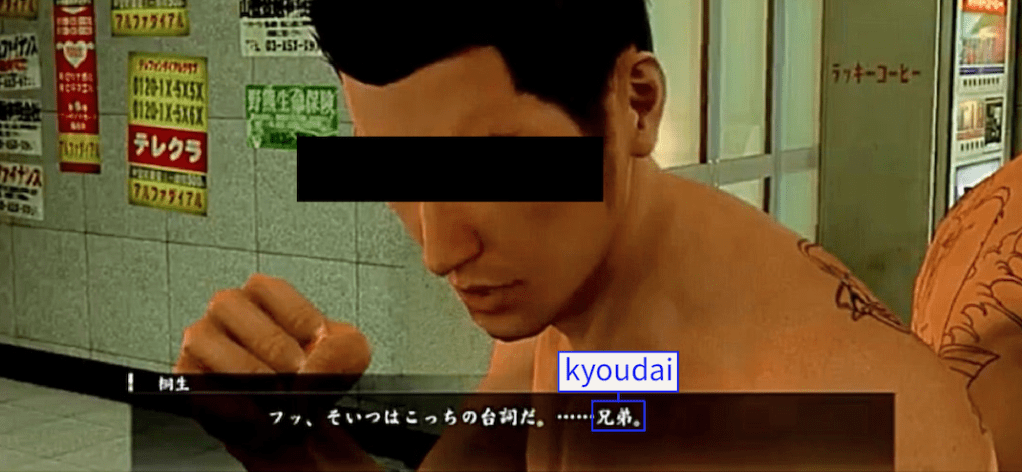
(Note: this is for everyday conversation! Japanese is a very flexible language and grammar is often played with in places like certain yakuza-based media franchises.)
And another word that falls into the “describing” pattern? “Futago,” for twin!
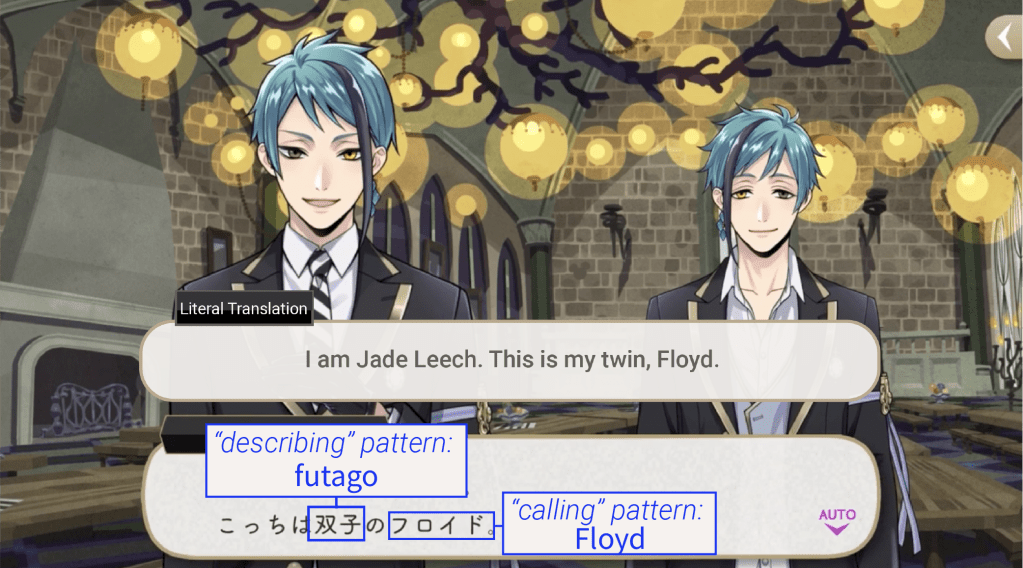
Jade and Floyd can and do describe one another as “futago” or “kyoudai”, but when they talk to/about each other as individuals they call each other by name, because there just isn’t an age-neutral equivalent word like “brother” for them to use, and canonically neither twin is any older than the other.

To summarize:
- Jade and Floyd describe each other as kyoudai, but do not call each other kyoudai
- Jade and Floyd describe each other as futago, but do not call each other futago
- Jade and Floyd do not describe or call each other ototuo or onii-san or any variation thereof
- Jade and Floyd call each other by their first names, exclusively
 Twisted Wonderland Reference Note