
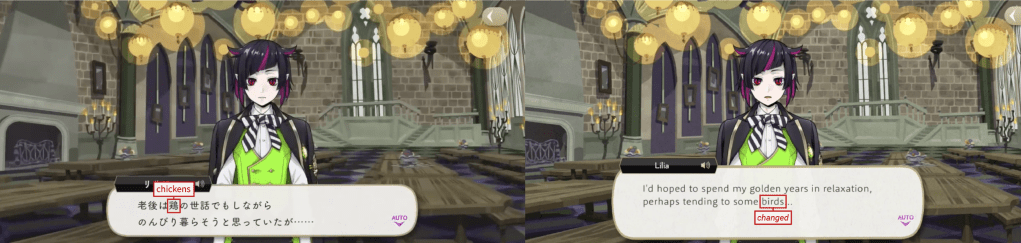
While EN Lilia does not specify the kinds of birds that he would like to tend to after he retires, originally he says that he would like to tend chickens.

The prefect’s original response option was a line of exclamation points, which was changed to “SWEET MERCIFUL SEVEN” on EN.

This might have been a call-back to Crowley saying the same thing during Fairy Gala (also changed from what was originally a line of exclamation points and question marks).

Original Malleus: Lilia came to the castle, having been summoned by the royal guardsmen.
EN Malleus: That was when Lilia, a royal guardsman at the time, came to the castle.

In the original game Malleus says that Lilia was summoned by royal guards, but on EN this was changed to Lilia himself being a royal guard himself at the time, which he was not (Lilia resigned from the royal guard before Malleus was born).
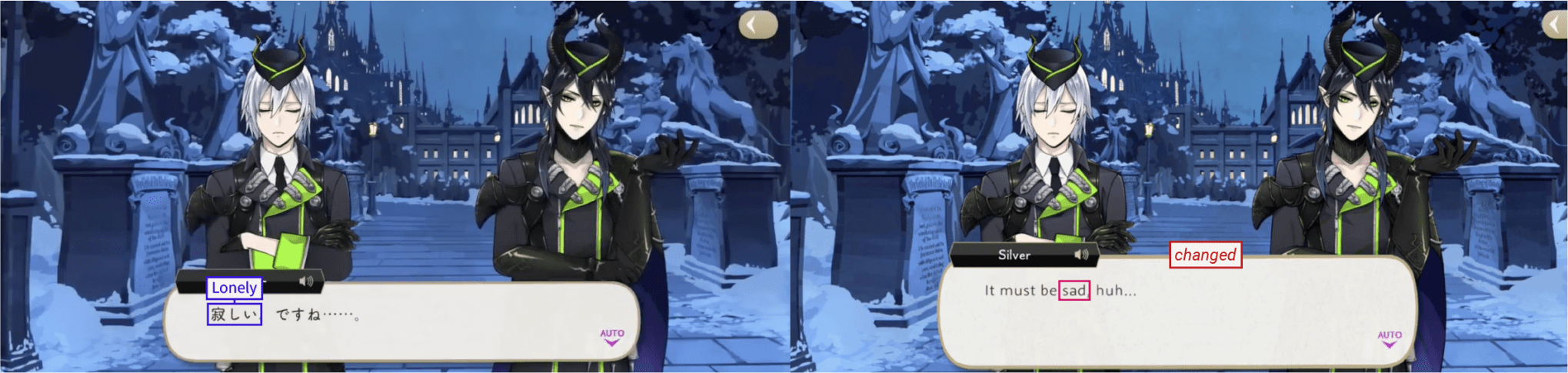
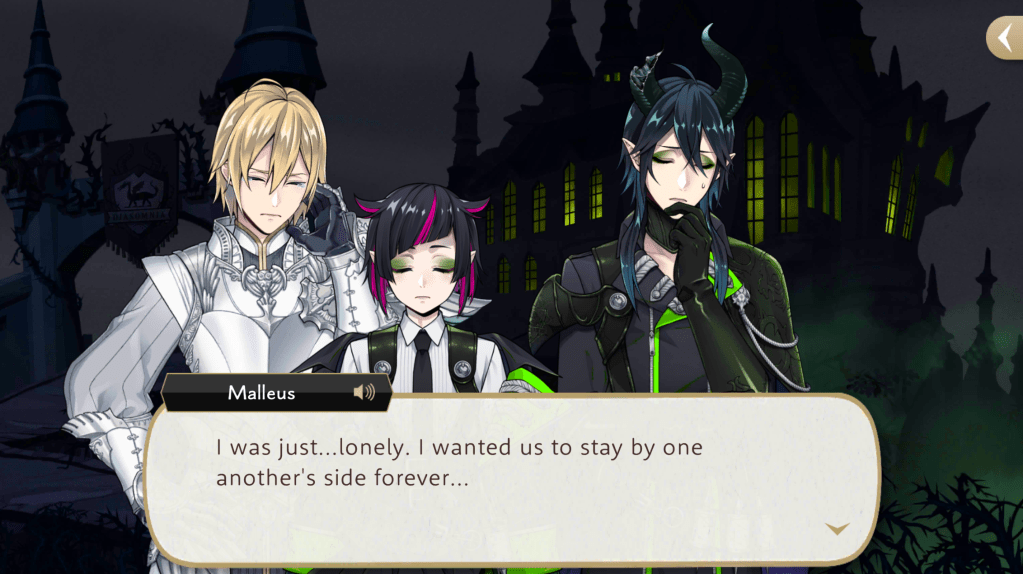
On EN “lonely” was changed to “sad” in Silver’s dialogue about Malleus, which Malleus denies, but Malleus coming to terms with with loneliness, specifically, is significant to the overall story of Book 7, with Malleus admitting he was lonely in the end.
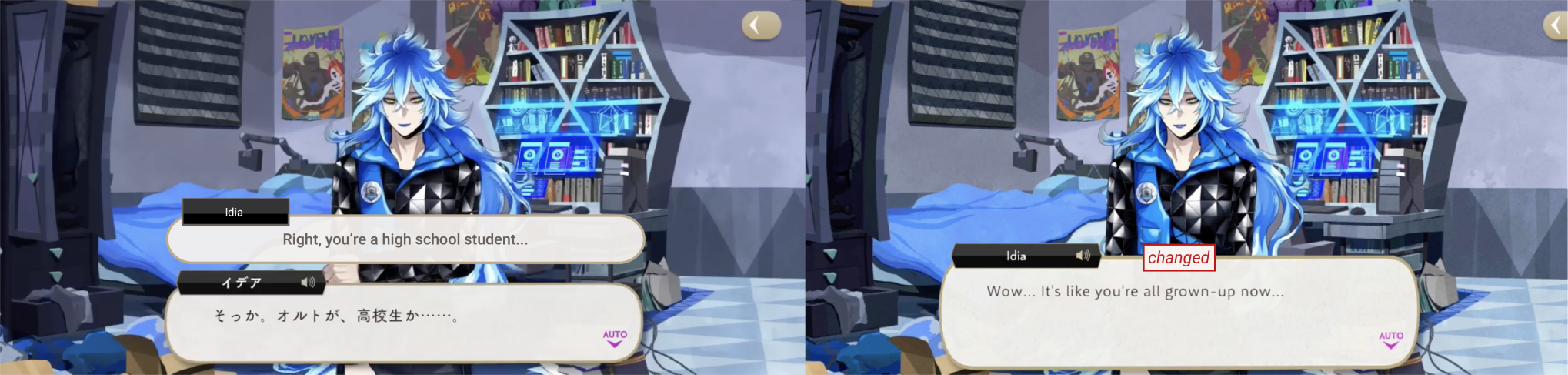
Original Idia: Right, you’re a high school student…
EN Idia: Wow…it’s like you’re all grown up now…
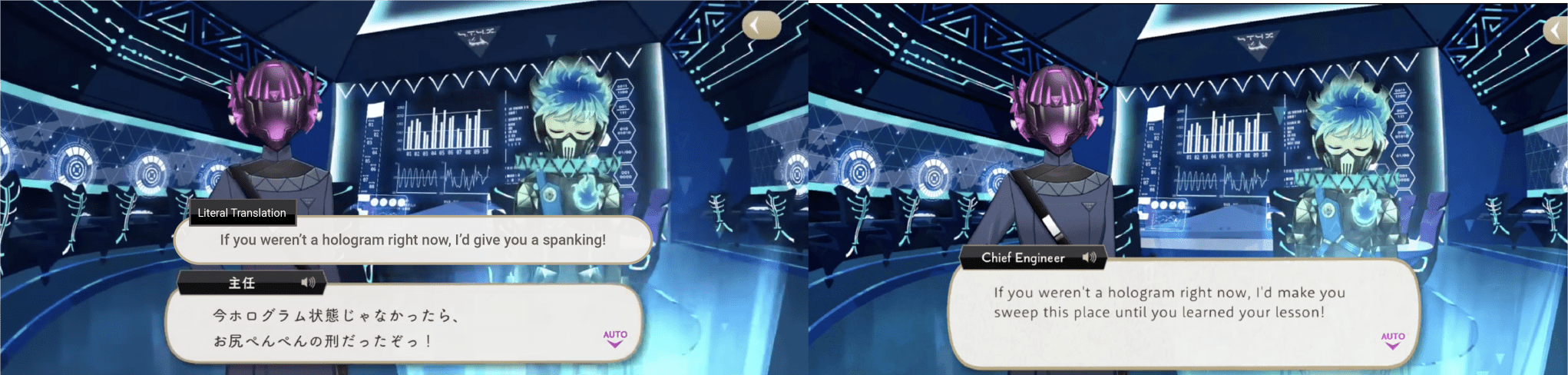
Original Chief Engineer: If you weren’t a hologram right now, I’d give you a spanking!
EN Chief Engineer: If you weren’t a hologram right now, I’d make you sweep this place until you learned your lesson!
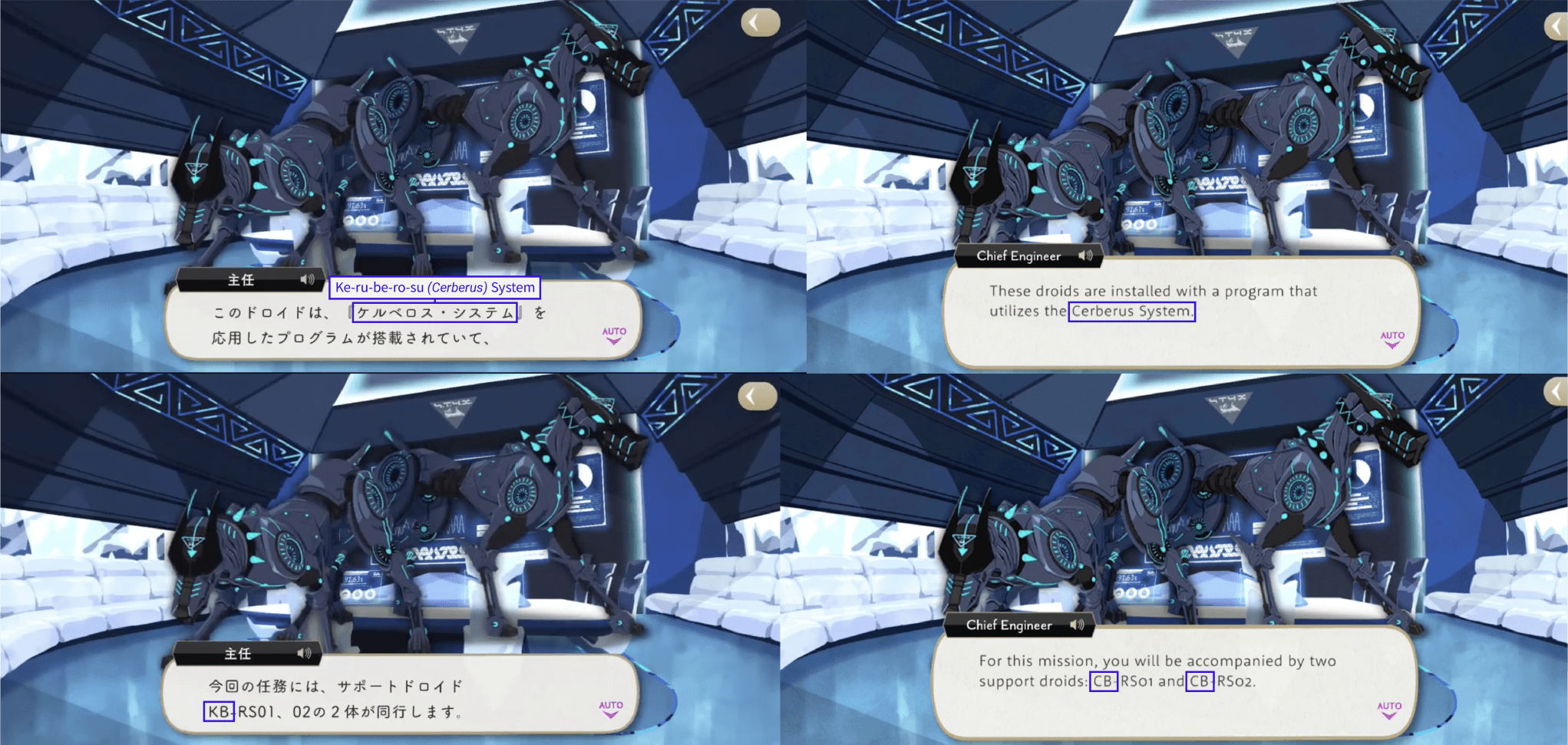
Ortho’s two robotic dogs are named “KB-RS01” and 02 in the original game, as “Cerberus” is pronounced with a hard “k” sound rather than the soft “c” sound of the English-language pronunciation. This is likely why their names were changed to “CB-RS01” and 02 on EN.

Small trivia: Cerberus is also the name of the character in Cardcaptor Sakura voiced by Onosaka Masaya, voice of Idia and Ortho’s father.
Their mother was voiced by Tange Sakura, voice of Kinomoto Sakura.

If you thought it was strange that Ortho referred to his father as “ma’am,” this was likely just a proofreading error on EN.

“Ma’am” has been added to almost all the dialogue between the Chief Engineer and the STYX staff, likely because it is difficult to portray how politely they are speaking to her in English.
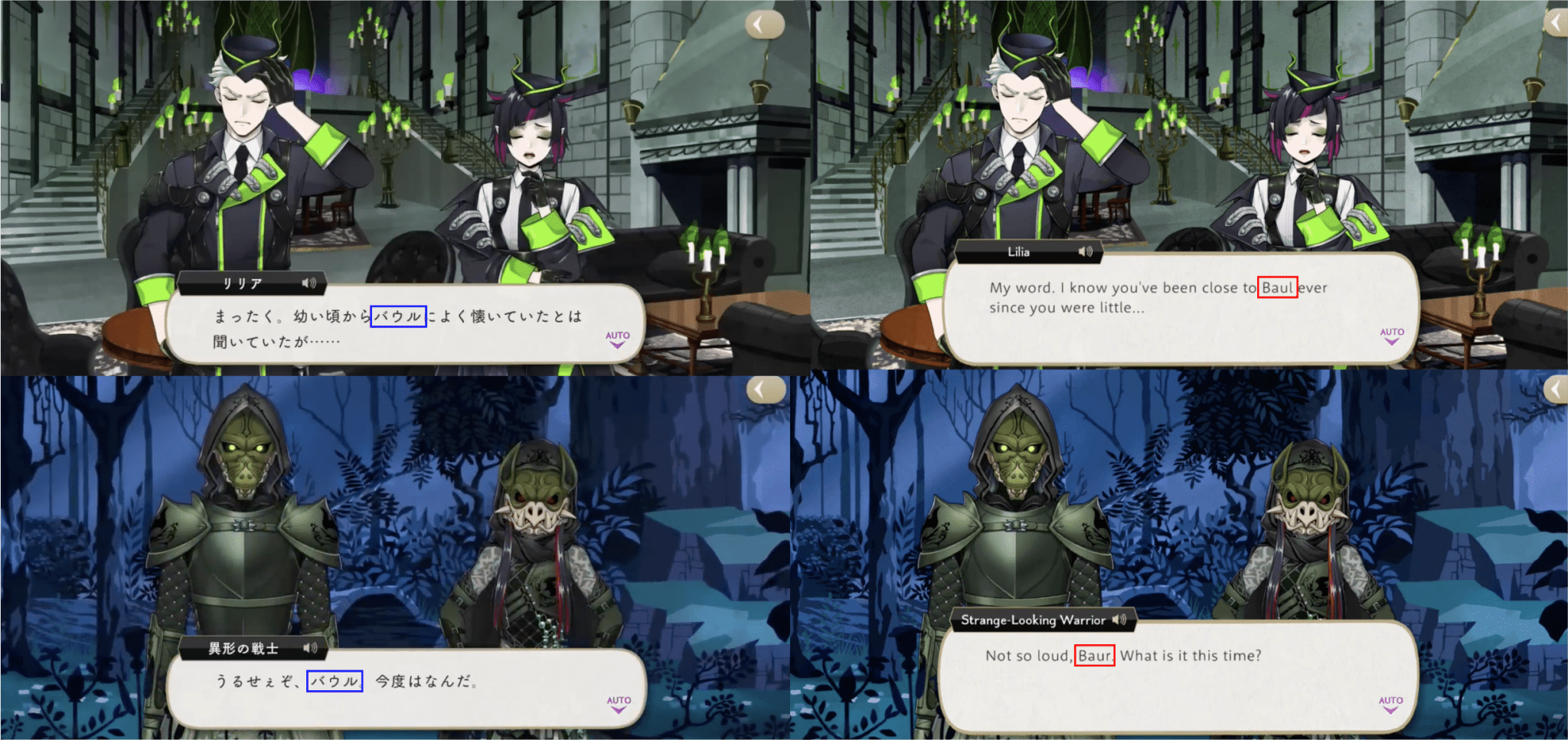
Baul’s name was changed from “Baul” to “Baur” on EN. It is consistent on JP: バウル

Maleanor’s magestone is called “Princess Glow,” changed to “Majestic Amber” on EN.

Maleanor threatens the invading armies with her “lightning bolt of judgement” in the original game.
This was changed to “lightning” on EN.
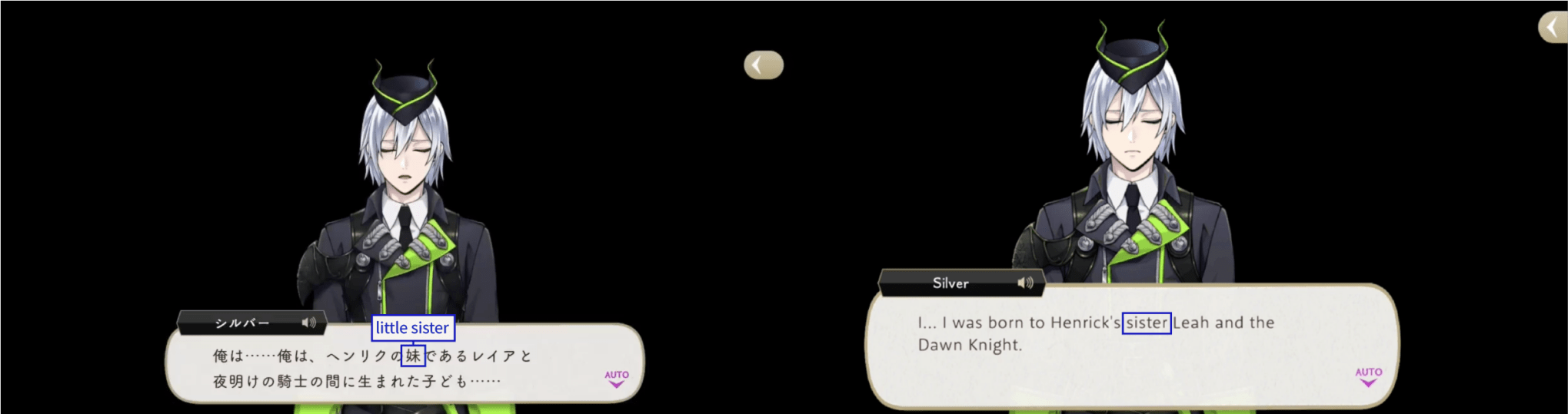
In the original game it is specified that Silver’s mother Leah was Henrick’s little sister.
More on referring to siblings in Japanese, here.
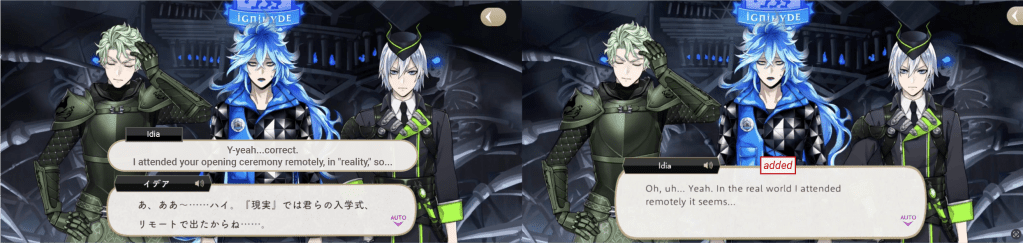
Original Idia: Y-yeah…correct. I attended your opening ceremony remotely in “reality,” so…
EN Idia: Oh, uh… Yeah. In the real world I attended remotely it seems…
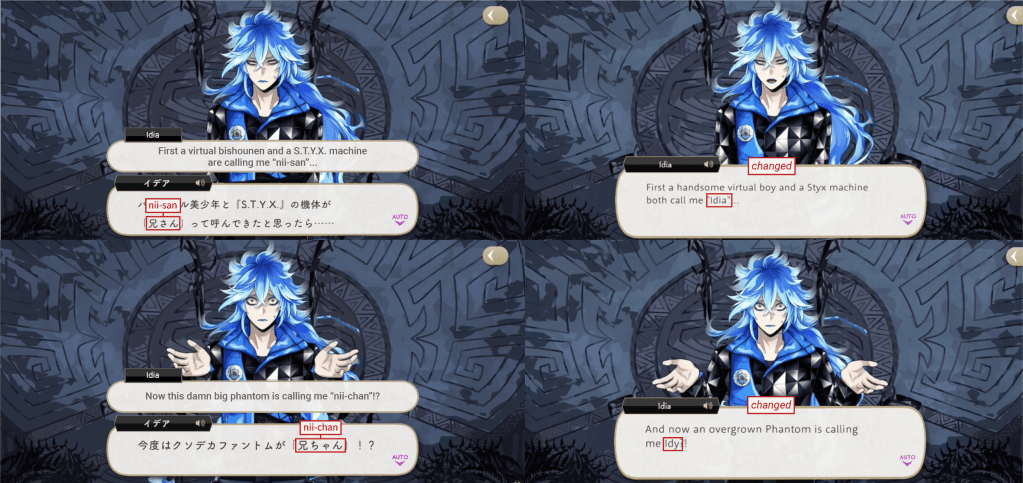
A lot went on in Book 7 with Idia being called “big brother” in two different ways by (what he believes are) three different people, the nuances of which didn’t really make it to EN. More here ->

The word “high school” was removed from Idia’s dialogue which is usual for EN (more here ->).

Original Neige: Now then, please listen. “Yaho with Everyone”!
EN Neige: I hope you’ll enjoy our song!

Original Rook: Ah……ah……this song is……Yaho, yaho ♪ A fun song~ ♪
EN Rook: Ah…ah…I know this song…*singing*
(A clip of Rook singing was removed from EN, as well as the background music of Vil and Neige singing together, viewable above.)

Original Floyd: Eh, whatever. I’m not interested in land anymore anyway……
EN Floyd: Eh, whatever. I ain’t interested in school or anythin’ up on land anymore.

Floyd’s line about he and Jade hatching was written as “eggs,” plural, on EN, but he does not specify in the original game, so this does not invalidate the theory that the twins possibly hatched from the same egg.
We have seen this grammar-guessing from EN before, with Jamil (more here ->).
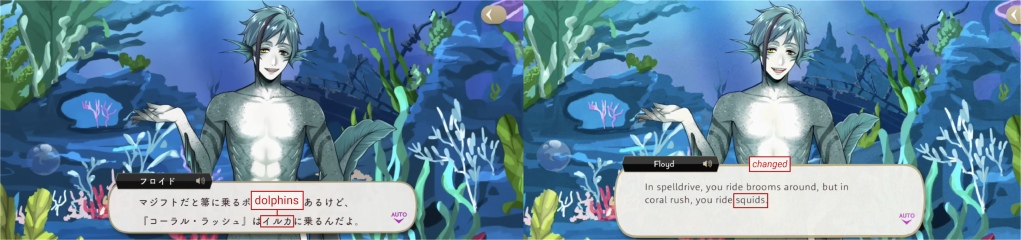
Floyd originally describes an undersea sport as being played by athletes riding dolphins.
This was changed on EN to athletes riding squids.

EN Floyd compares the students standing close together to takoyaki on EN, but in the original game he compares them to dango.

“Male high school student” was changed to “student” in Ortho’s dialogue, which is a common change on EN.
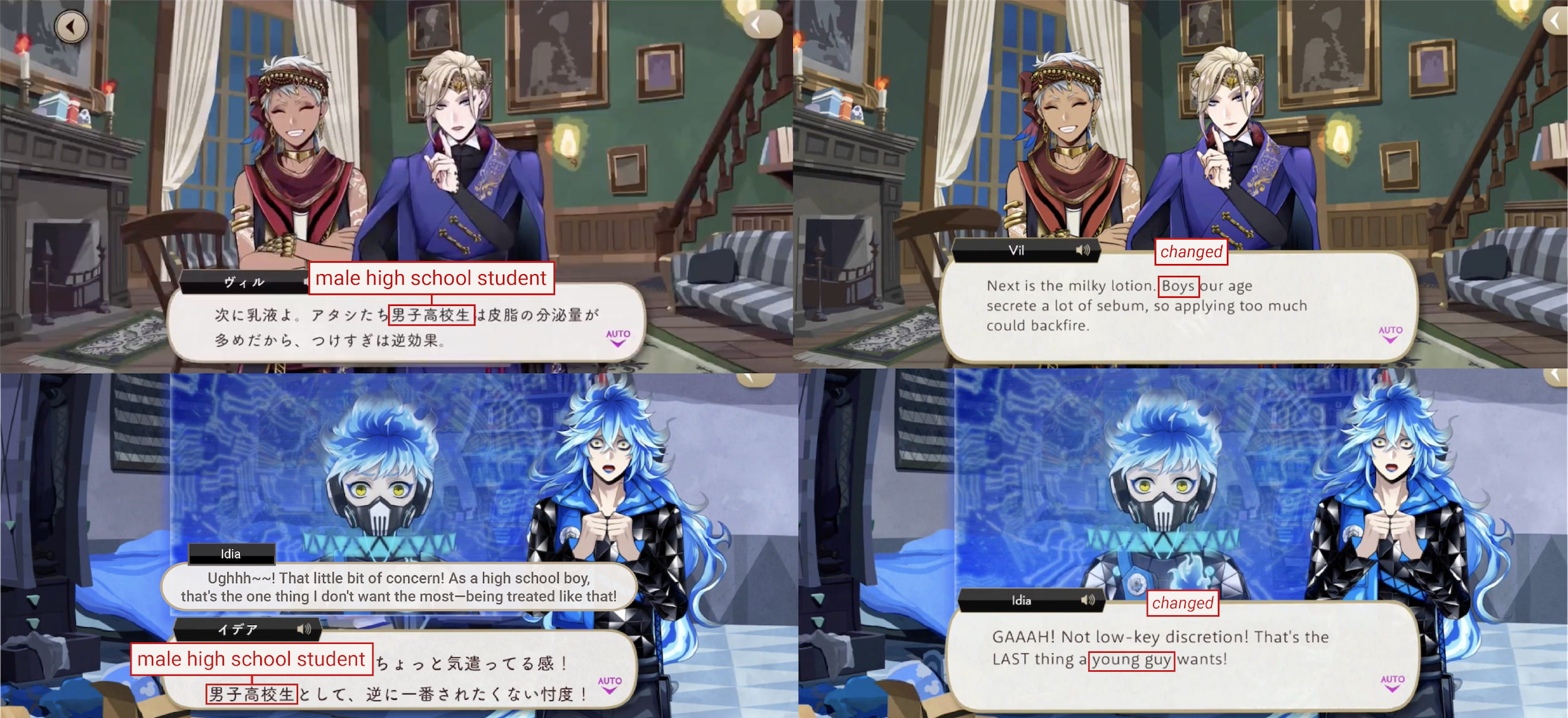
“Male high school student” was changed to “boys” when said by Vil in Book 5, and changed again to “young guy” when said by Idia in Book 7.

Leona is consistently repeating “Be Prepared” in the original game, removed from everywhere on EN except for one exception in Book 6 where it was translated directly, but something fascinating happened in Book 7:

There are two different adaptations of Scar’s “Be Prepared” in Japanese-language localizations: the original animation uses 準備 (junbi) while the Lion King musical adaptation changed to 覚悟 (kakugo). Both words can be “to prepare” in English, but they have different nuances in Japanese.
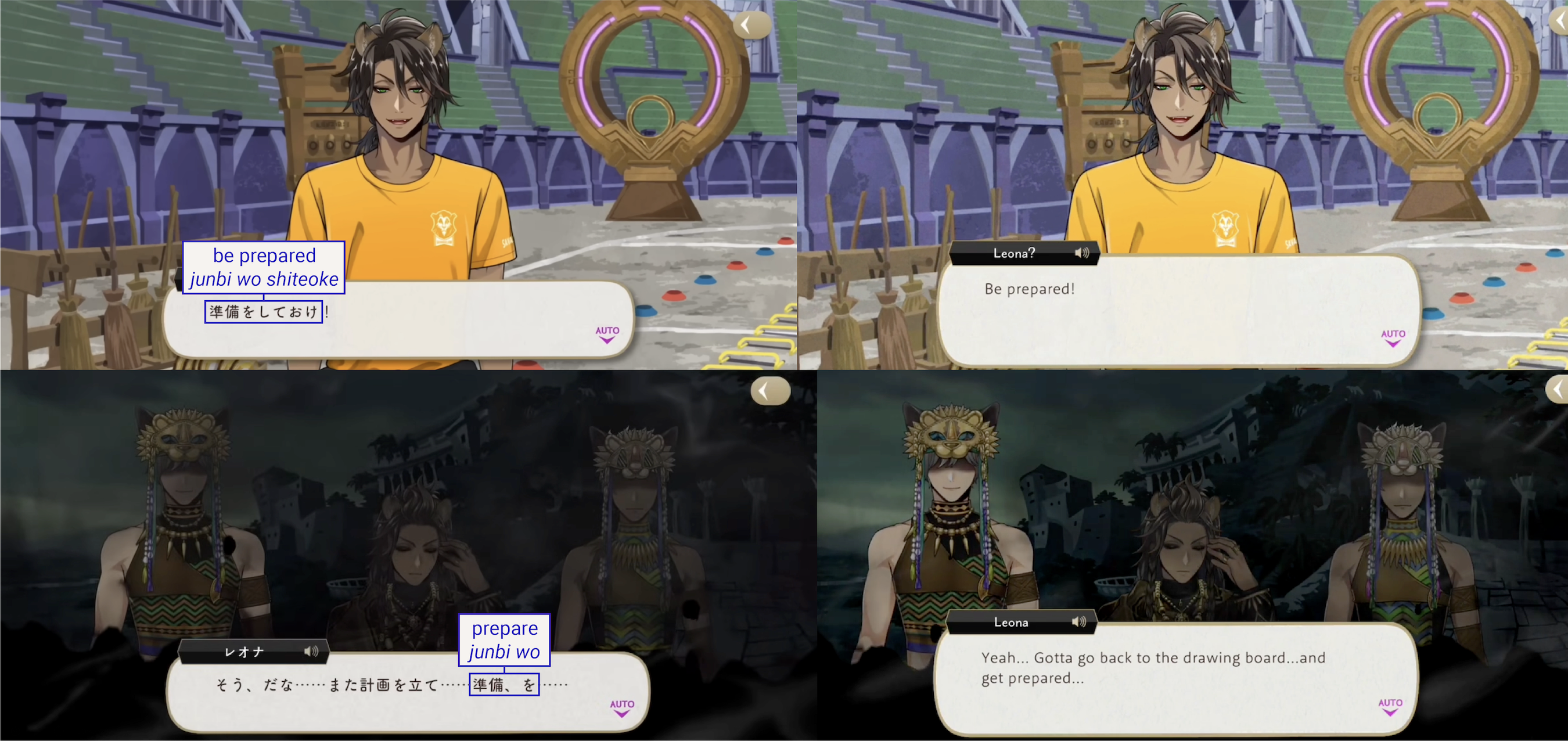
From Book 1 to Book 6 Leona has, consistently, used only the musical-adaptation version of “Be Prepared,” but in Book 7 this changes: he uses Scar’s 準備 (junbi) from the original animated movie, instead, both in Jack’s and in his own dream.
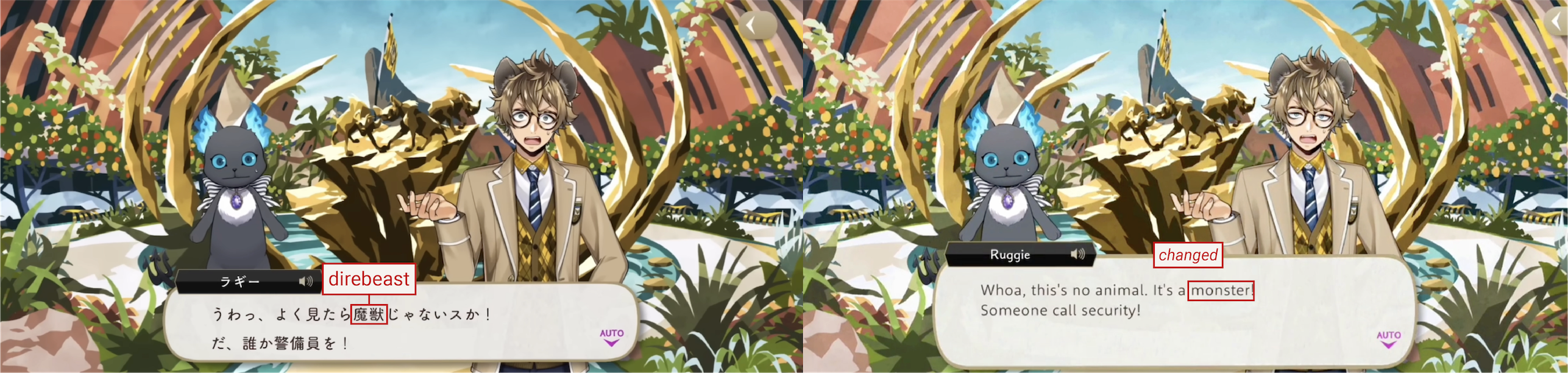
Ruggie referring to Grim as a direbeast in the original game was changed to “monster” in the EN adaptation. More here: Grim – Animal, Monster, Cat, Dire Beast, Tanuki (pt1)
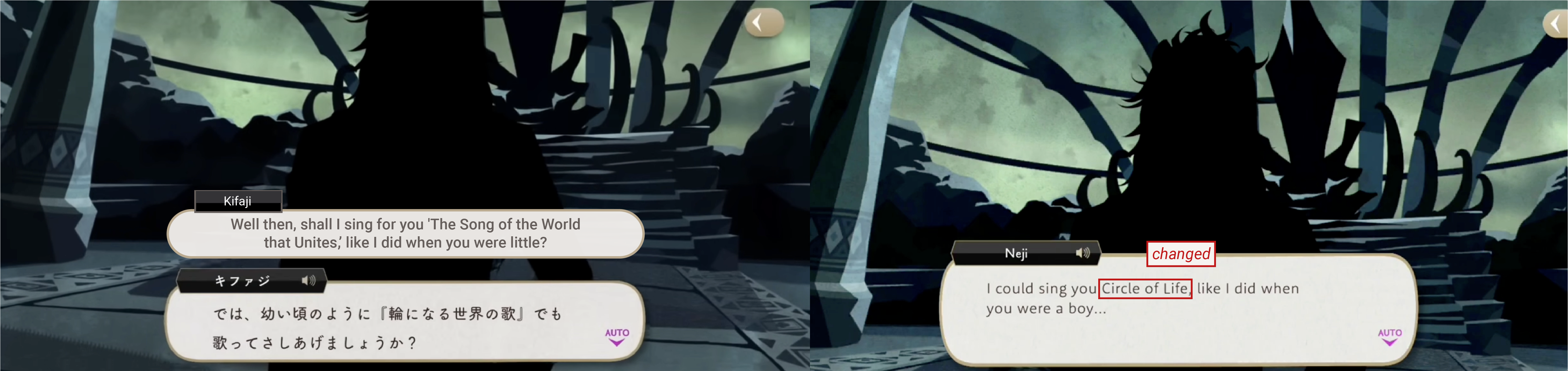
In the English-language adaptation of the game Kifaji says the name of the song from the Lion King movie, “Circle of Life,” which he does not do in the original game.
Kifaji’s original line is 「輪になる世界の歌」, which is close to “The Song of the World that Unites,” but not quite: 輪 can mean circle (it is found in both the words for “ring” (指輪) and “collar” (首輪), for example), but it has more nuance than that: it can also mean close to things like “harmony” or “unity.”

The English-language name of the song “Circle of Life” was kept for Japanese-speaking audiences and not localized.
「輪になる世界の歌」 is not the Japan-release name of the song but is alluding to the song without stating it directly, while EN chose to go with a more direct approach.
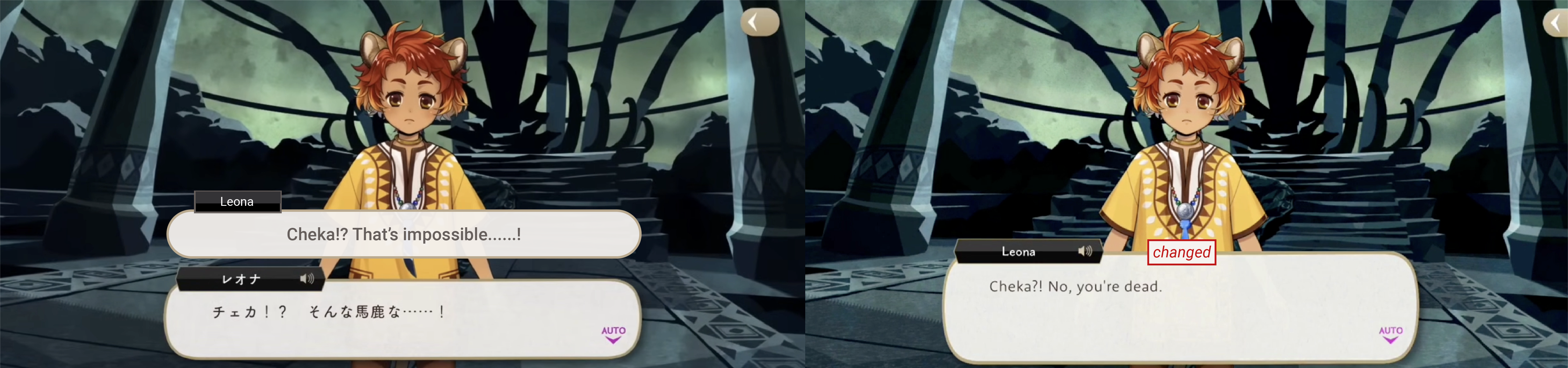
Original Leona: Cheka!? That’s impossible……!
EN Leona: Cheka?! No, you’re dead.
*Note: the wording that Leona uses here「そんな馬鹿な」can be a lot of things in English, such as “That’s ridiculous,” “That can’t be,” “It can’t be true,” etc. You use it when you are suddenly doubting something and it is not a statement of fact, just a rejection of what is being seen/felt, and the EN version maybe loses a bit of Leona’s shock/grief/confusion. It possibly meant to be a reference to Scar’s “Mufasa? No, you’re dead” line from the Lion King. For the curious: Scar’s localized JP line from The Lion King is not「そんな馬鹿な」。
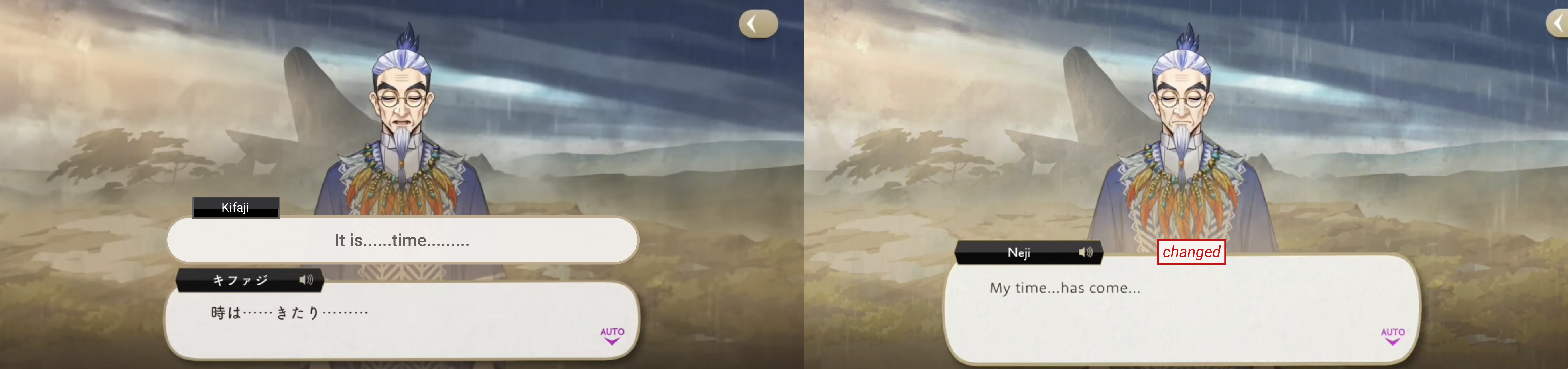
Original Kifaji: It is……time………
EN Kifaji: My time…has come…
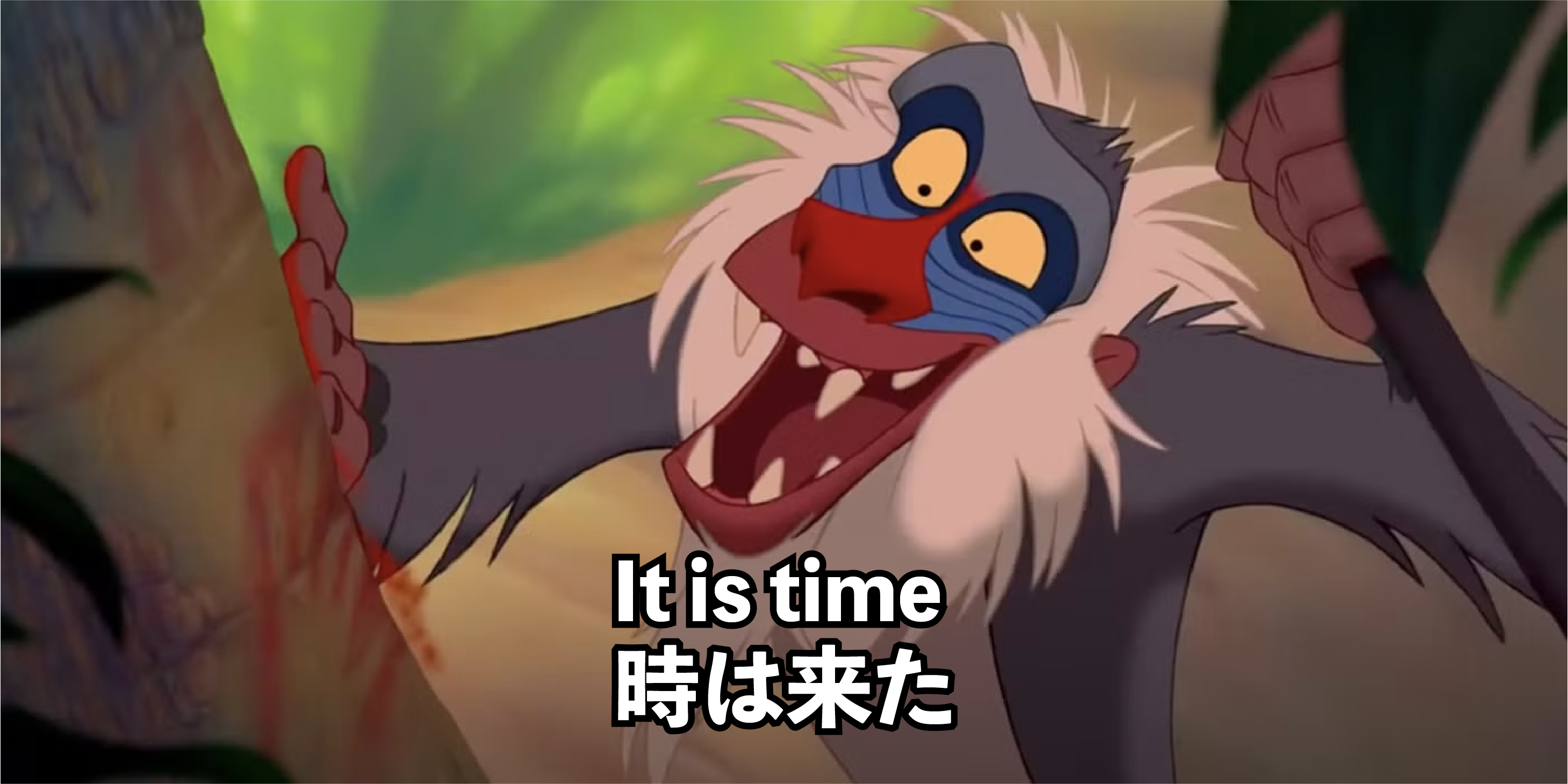
In the original game this is a reference to Rafiki’s line from the original animated Lion King: “It is time.”

“Minced meat cutlet sandwich” was again changed to “ham and cheese sandwich” for EN, much like in Book 2.

ハンバーグ is mentioned multiple times in Book 7-12-1, which EN translated as “hamburger,” but it is actually closer to salisbury steak.
Hamburgers are different, written as ハンバーガー。

Canonically there has been no dialogue to insinuate that the characters in Twst know what hoverboards are, but the word “hoverboard” has now been added to dialogue twice on EN.
In both instances the characters originally compared the objects to skateboards.

“Egg of (profession)” is a Japanese-language idiom that can be used to describe someone who is in training to become something, like a law student being an egg of a lawyer, or an aspiring idol being an egg of an idol. (screenshot source: imsopopfly)
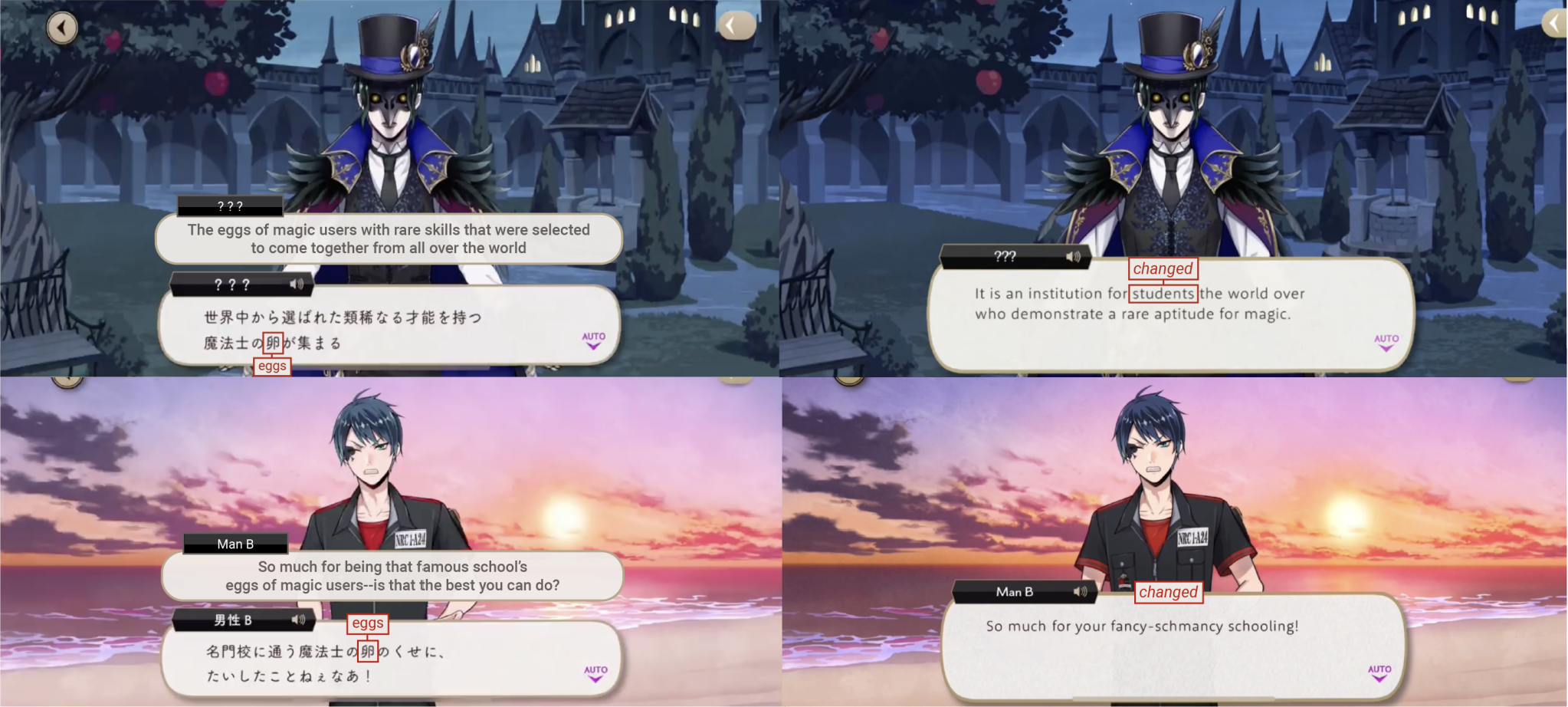
“Egg of a magic user” comes up often in Twst, possibly because the story is by Toboso Yana, famous for her use of puns, and wordplay comes up constantly in the game.
Crowley’s “whip of love,” for example, is a both the Japanese-language expression for “tough love” and a literal magical object that he uses to bind people and is always accompanied by a whipping sound. More here ▶︎

As “egg of thing” is not a typical turn of phrase in English it makes sense that this was changed in the English-language adaptation for the game.
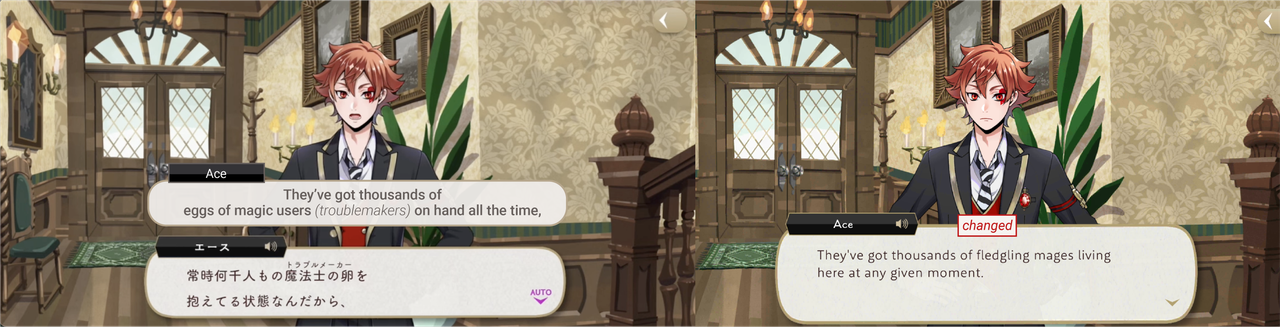
At first it was removed, but eventually the EN team started incorporating it as “fledgling” instead of “egg.”

While this is possibly the closest that the English language can come to recreating Yana’s wordplay, it is not quite encapsulating the same symbolism.
As Yana herself explains, “Eggs are a good symbol of things that can never go back to how they were once they have been broken.” (link to tweet)

“Egg” was also changed to “fledgling” in Book 7-12-2. More on eggs in Twst ▶︎


Ace repeats the word “ダサい” so often that it is practically a verbal tic (more on Ace’s speech patterns here ▶︎), typically localized on EN as “lame” or “pathetic,” when it is not removed from his dialogue.
It also comes up in a pivotal moment in the prologue when Ace dismissing the prefect for saying “lame” things gets turned back onto him by Grim, ultimately convincing him to work with Deuce to keep them from getting expelled from NRC.
The word arises during another pivotal moment in Book 1, when Ace refuses to run away from an overblotting Riddle and tells Cater that only being willing to fight when he knows he can win is “too lame.”
Cater uses this same phrasing with Ace in Book 7, but as the word “lame” was removed from Ace’s dialogue on EN, Cater’s phrasing was changed from “lame” to “weak:”
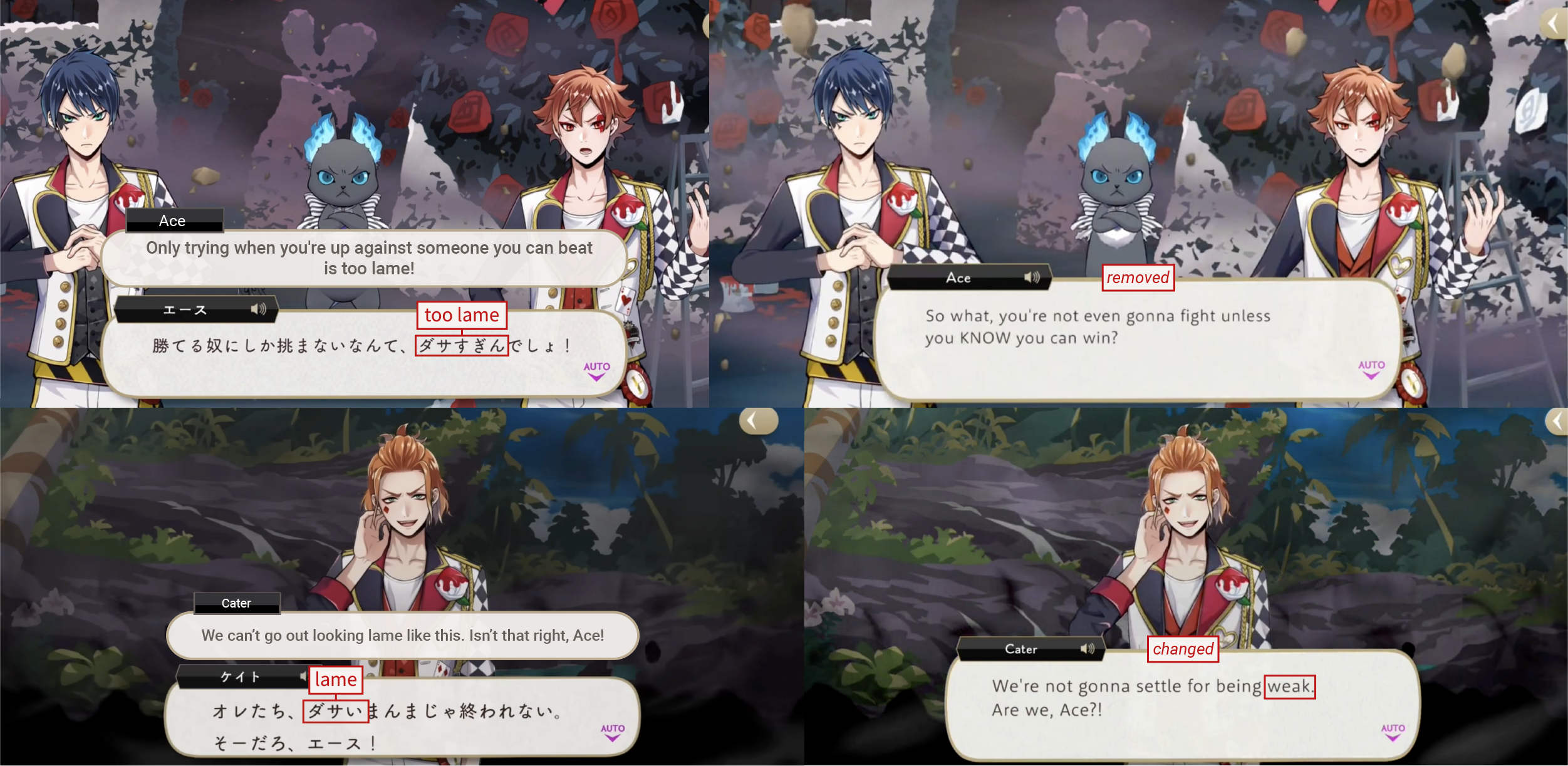
Original Cater: We can’t go out looking lame like this.
EN Cater: We’re not gonna settle for being weak.
When Ace breaks down in Book 7 and finally agrees to stand and fight, his wording was changed for EN:

Original Ace: If I run away now, I’ll seriously look way too uncool……!
EN Ace: Running now would make me a pathetic coward to end all pathetic cowards…
(When the same word (カッコ悪い) comes up later in Riddle’s dream it is translated more literally as “cringe.”)
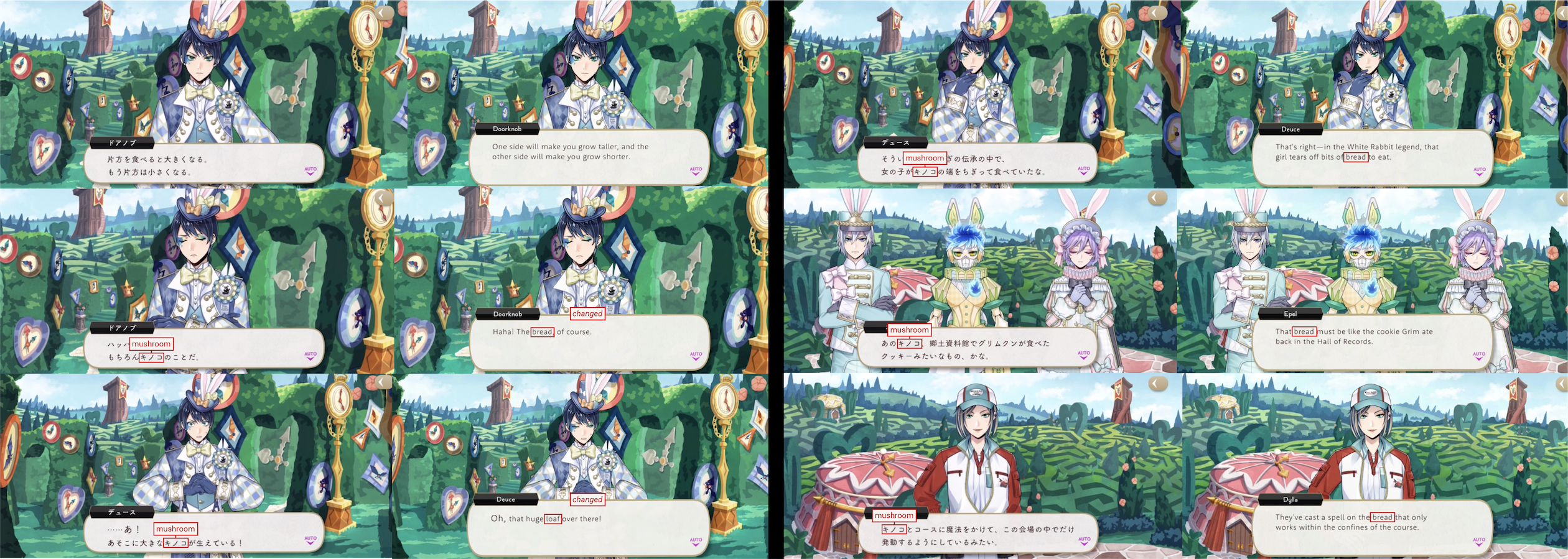
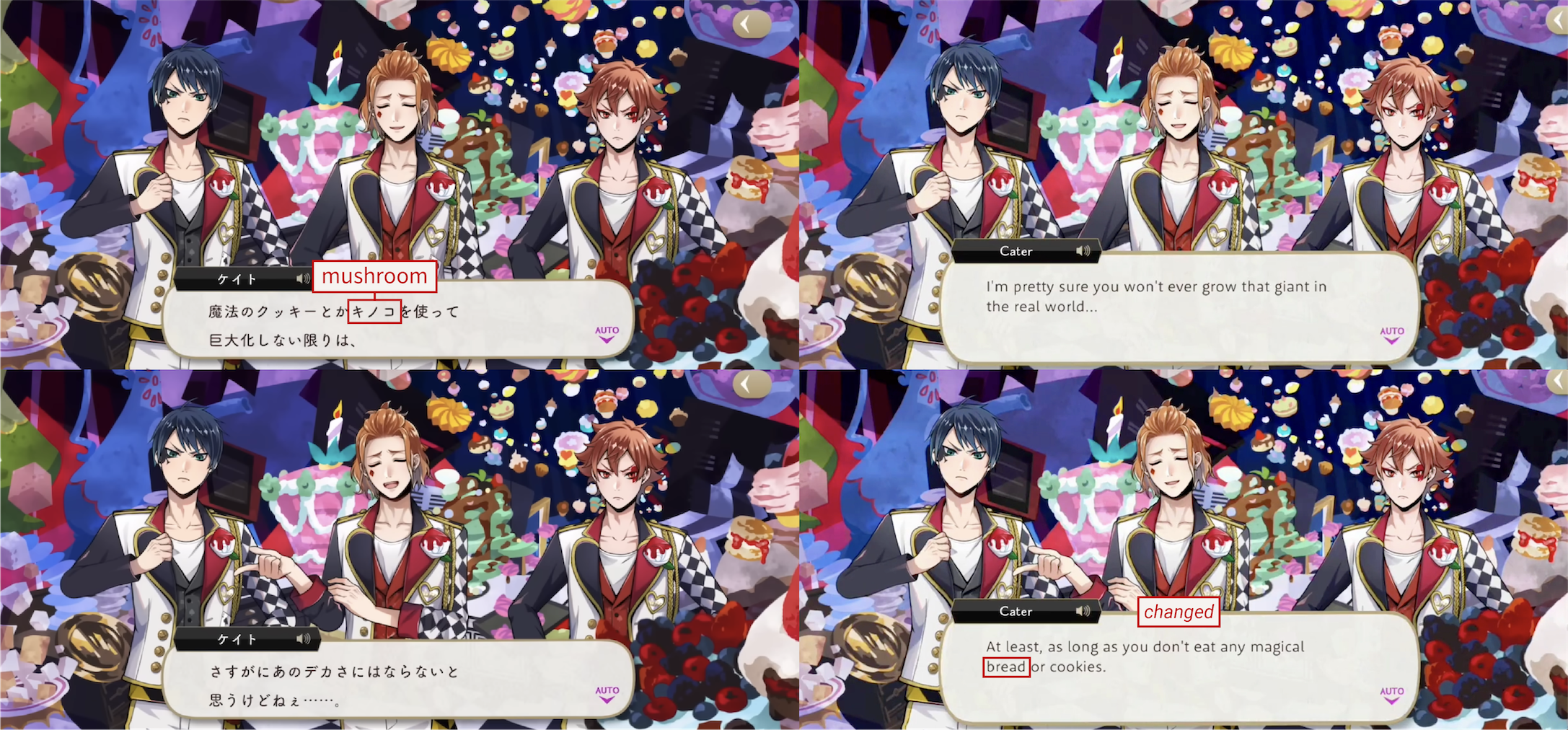
During the White Rabbit Fes event Deuce eats parts of a mushroom to grow bigger and smaller in a reference to the original Alice in Wonderland movie. On EN, however, “mushroom” was changed to “loaf of bread.”
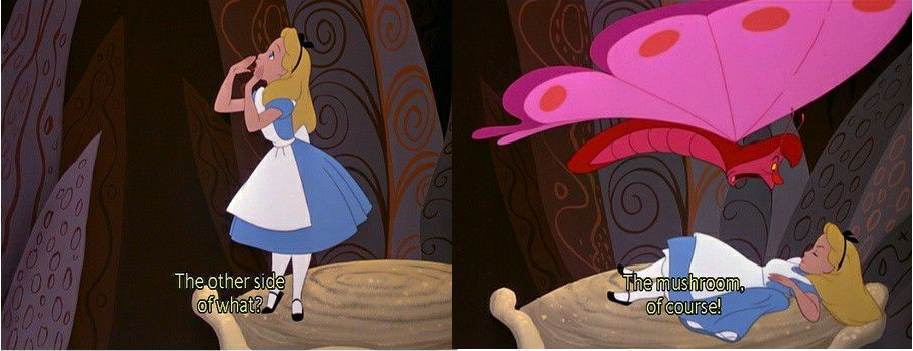
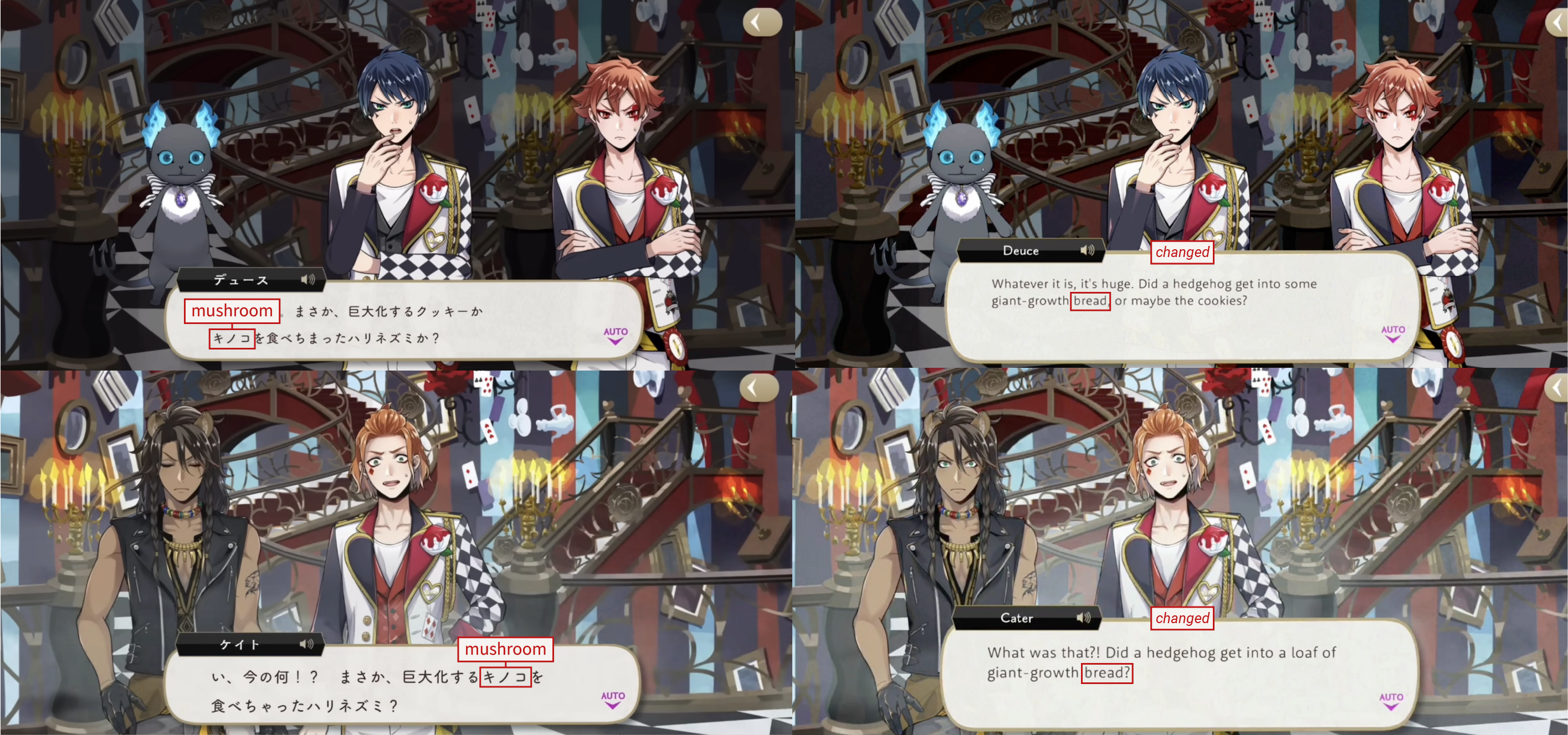
“Mushroom” was again changed to “loaf of bread” in Book 7 for EN.
In Book 1, the tune that Chenya hums whenever he disappears was written as “Ha ha ha ha…!,” as though he were laughing.
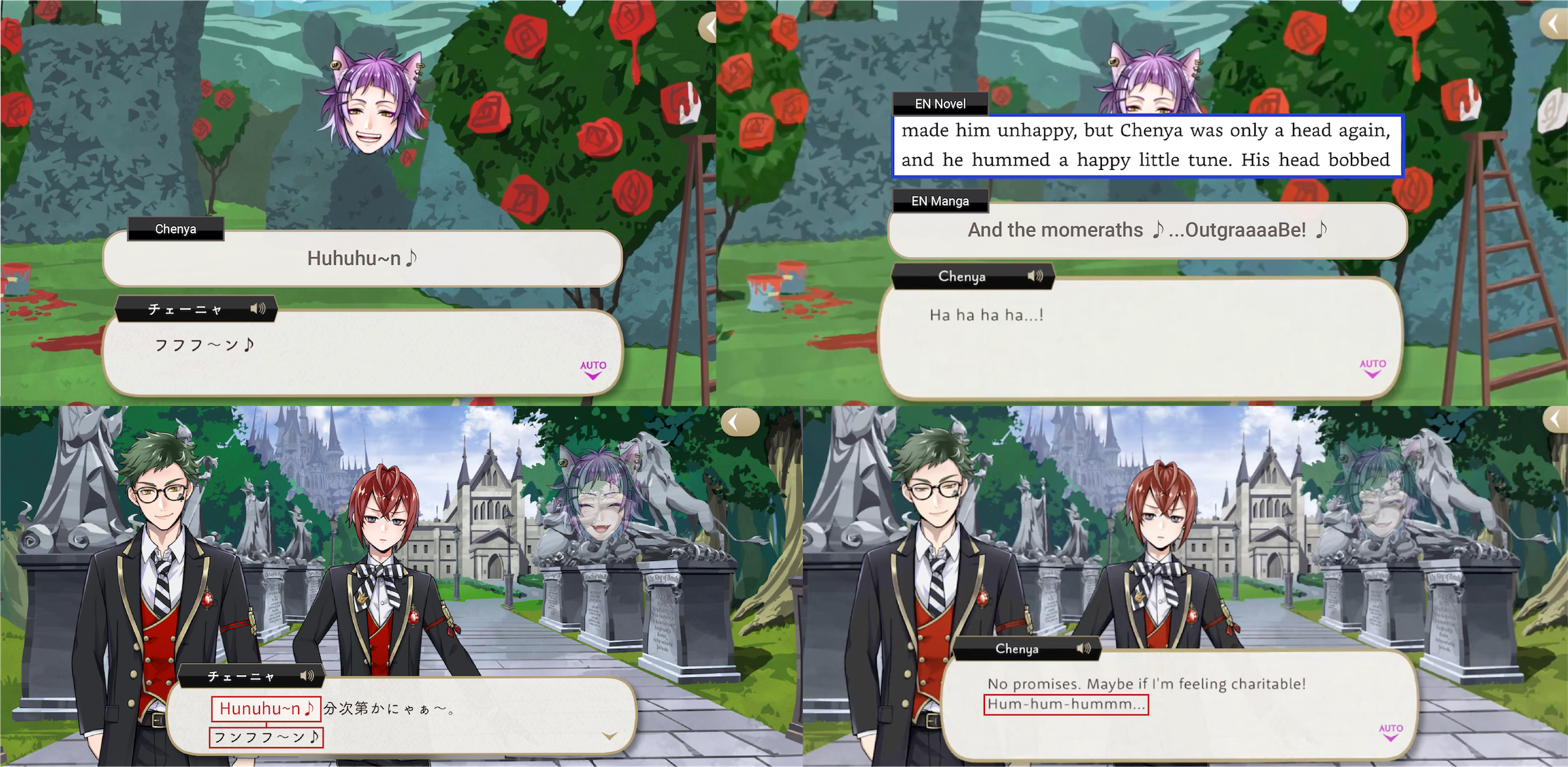
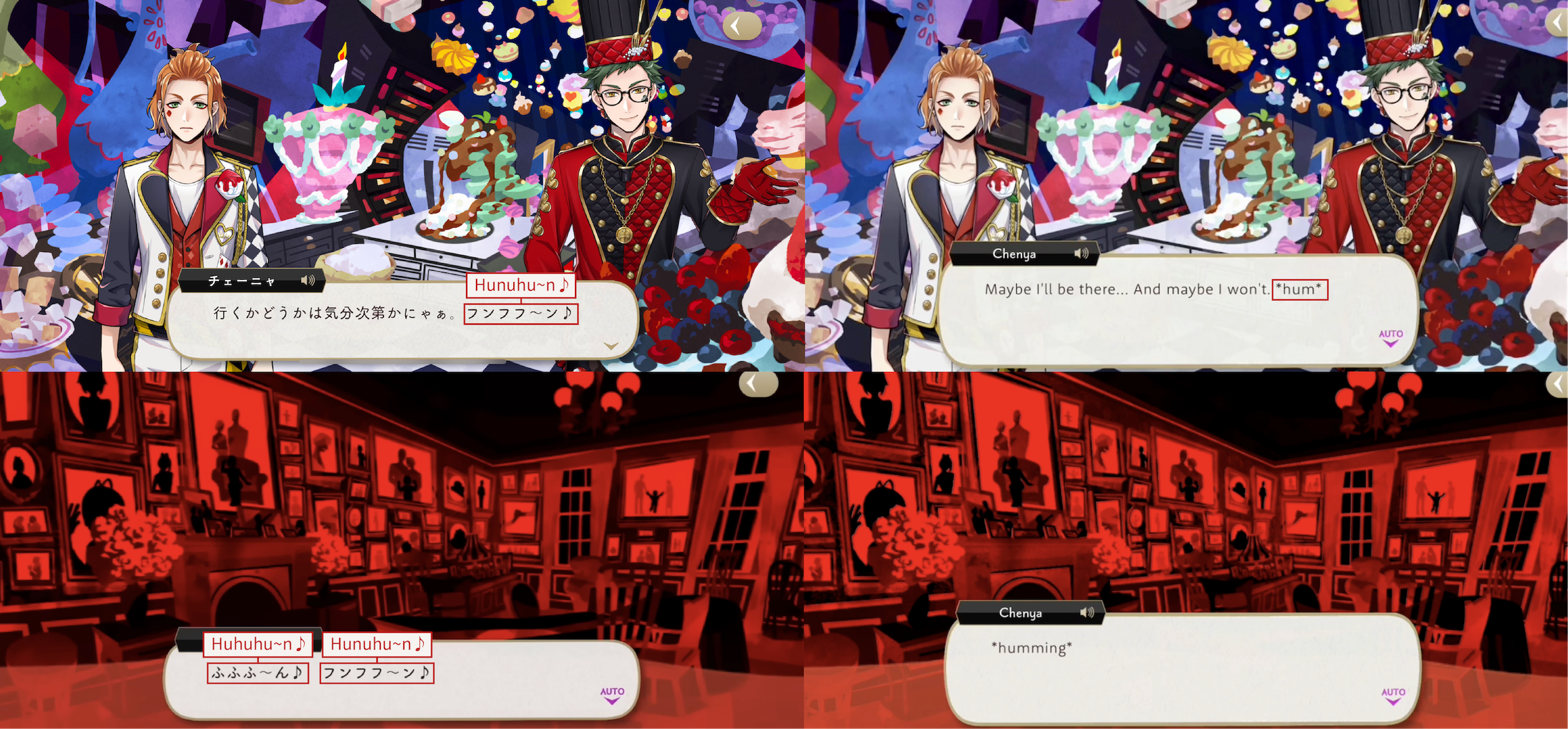
This was changed to “hum-hum-hummm…” in Book 5 and to just “*hum*” and “*humming*” in Book 7.
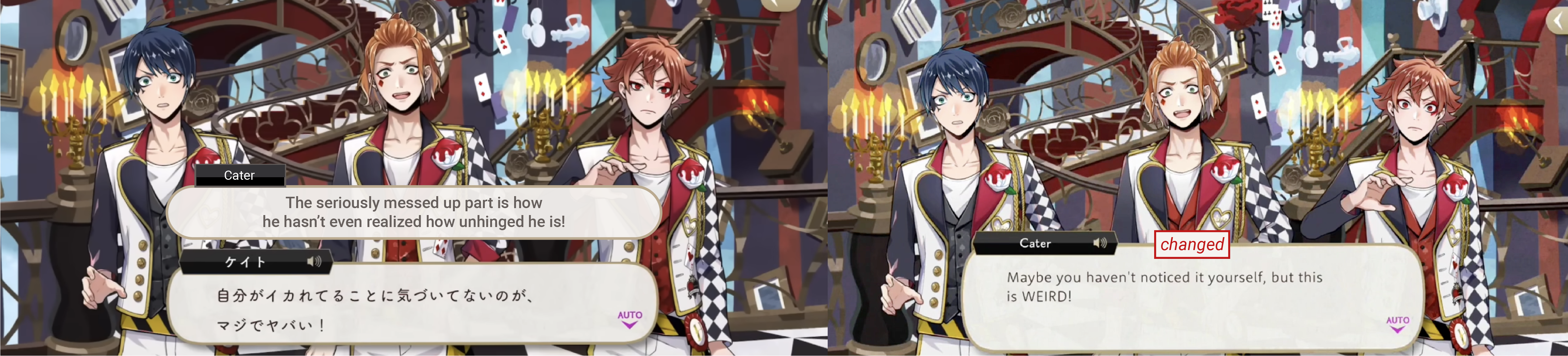
Original Cater: The seriously messed up part is how he hasn’t even realized how unhinged he is!
EN Cater: Maybe you haven’t noticed it yourself, but this is WEIRD!
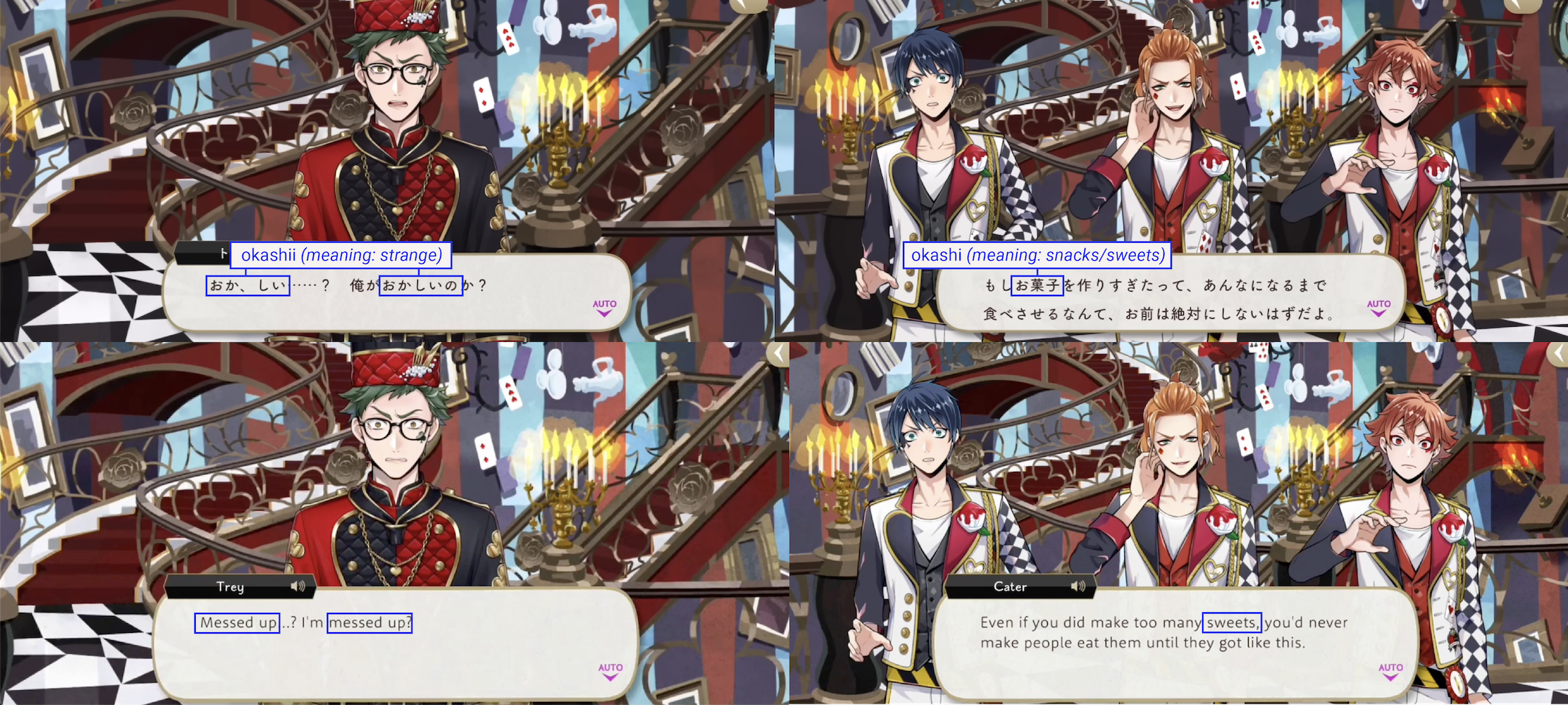
Some wordplay from Yana: the word for strange (okashii) sounds similar to the word for snacks (okashi), and both words come up very often in Trey’s dream.
This snack is weird: this okashi is okashii.

Realizing that they are about to come face-to-face with Riddle’s mother, Deuce originally says that he is getting nervous. His line was changed on EN to, “That’s scary…”

Originally Riddle refers to the police officer in his dream as ossan, a casual and fairly impolite term for an older man. This was localized on EN as, “buddy.”

In the original game the mother of Riddle’s dream consistently refers to him as “Riddle-chan.”
This was localized in three different ways on EN: “Riddle dear,” “darling Riddle” and “sweet Riddle.”

In the original game Riddle refers to his mother as “Mama” as a child, until she refuses to allow him to eat a strawberry tart. In the following flashback child-Riddle has shifted to referring to her as “Mother-sama.” He returns to using “Mama” during the emotional breakdown of his overblot.
On EN this is depicted as Riddle shifting from “Mom” to “mother” and back again.

This is repeated in Riddle’s dream of Book 7, where he refers to his mother as “Mama” in the original game (EN: Mom) until he awakens, at which point he returns to “Mother-sama” (EN: Mother).
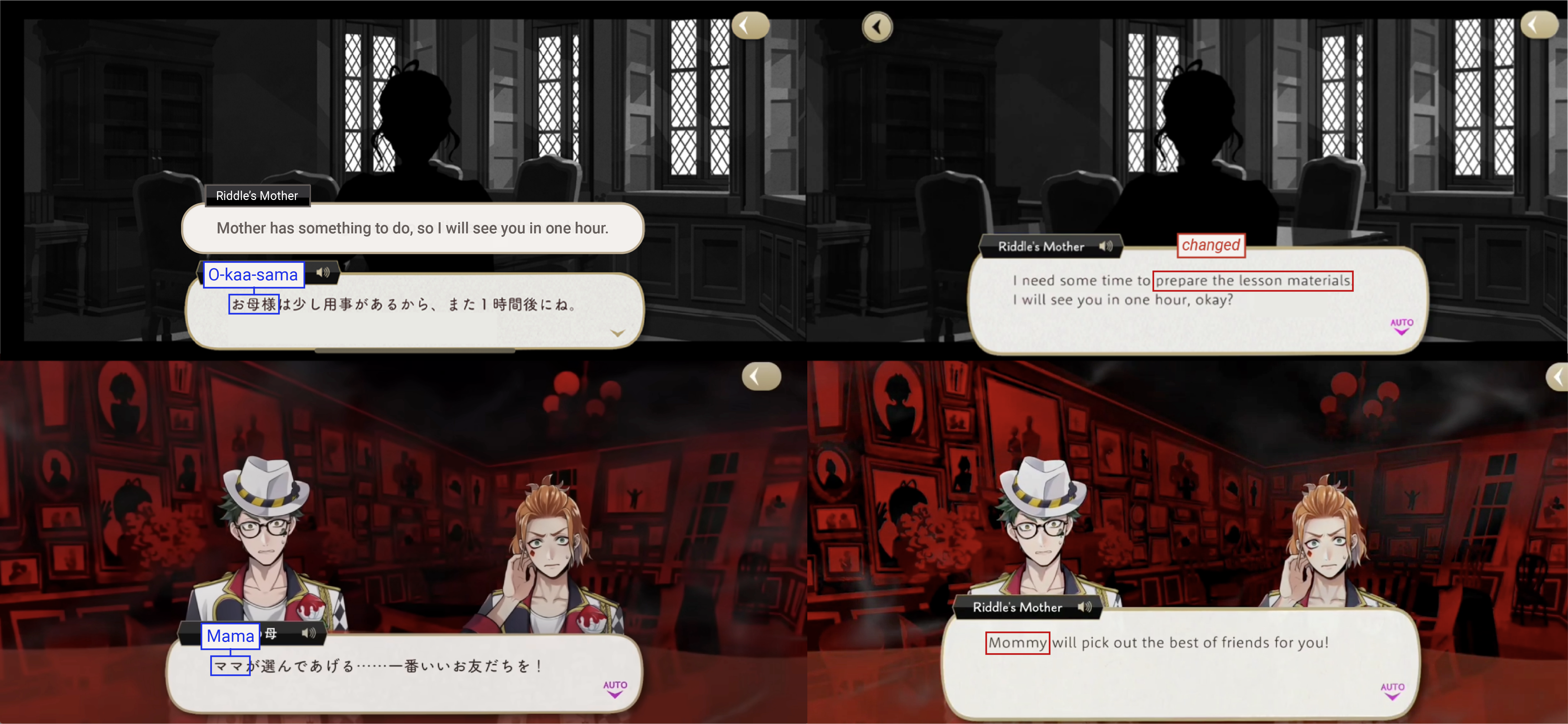
This localization is consistent for all but one line: in the original game Riddle’s mother also refers to herself as “Mother-sama,” which shifts to her referring to herself as “Mama” in Riddle’s dream.
On EN this was changed to her saying “Mommy” in the dream instead, losing the connection to the way that Riddle referred to her as a child and when overblotting.
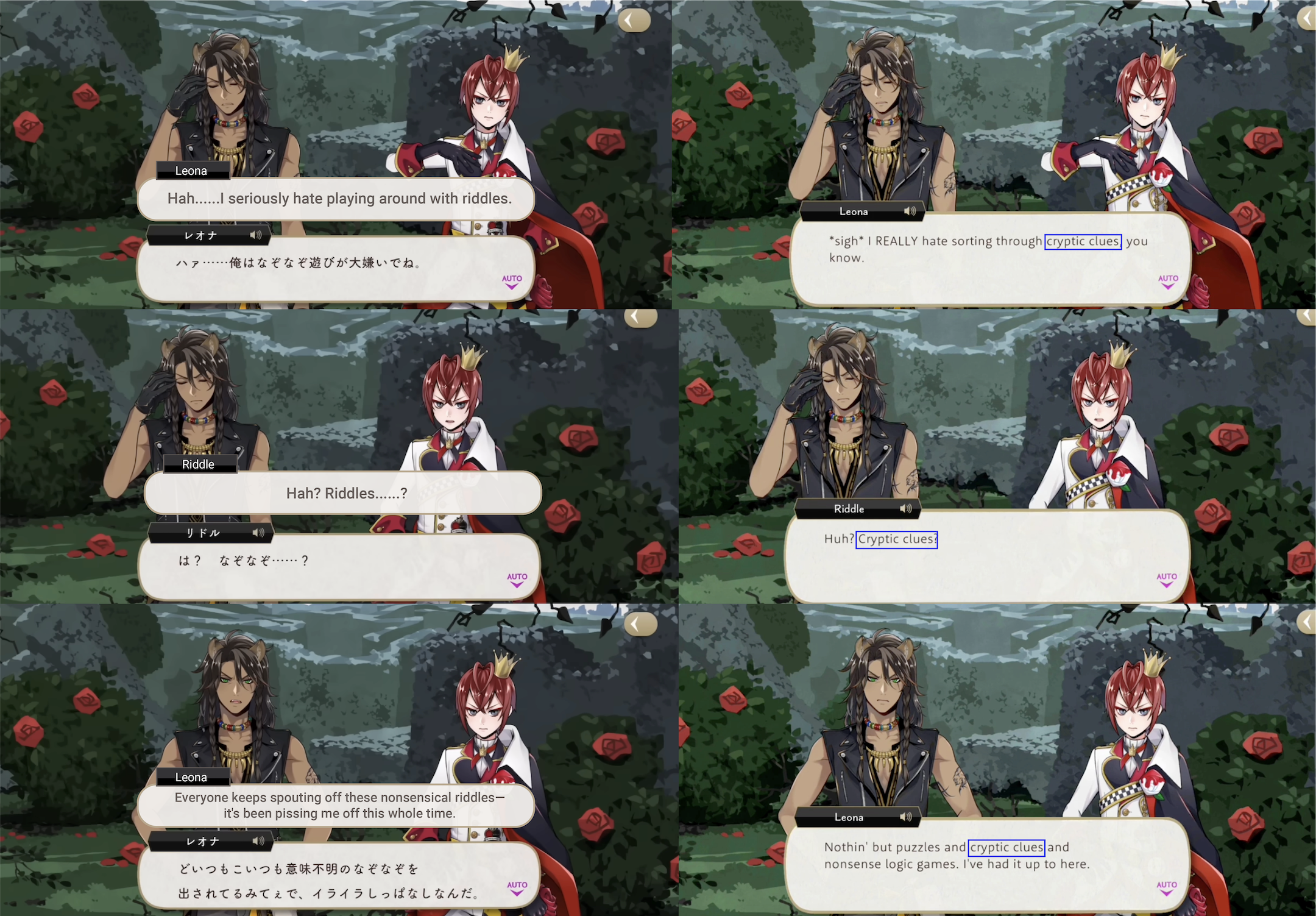
EN localized なぞなぞ as “cryptic clues,” but a more direct translation would be, “riddle.” In what is possibly more wordplay by Yana, more literal phrasing of this exchange between Leona and Riddle could look like this:
Leona: Hah……I seriously hate playing around with riddles.
Riddle: Hah? Riddles……?
Leona: Everyone keeps spouting off these nonsensical riddles—it’s been pissing me off this whole time.
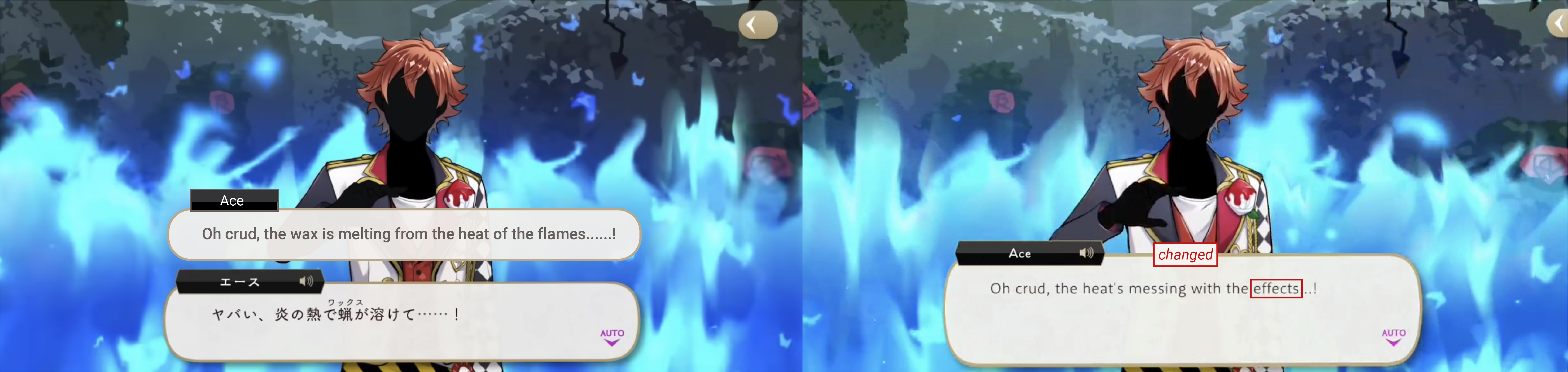
Original Ace: The wax is melting from the heat of the flames…..!
EN Ace: The heat’s messing with the effects…!

On the subject of being with Sebek for so many years Silver says that he does not find the situation particularly inconvenient. This was changed on EN to Silver saying,”It isn’t stifling or anything.”
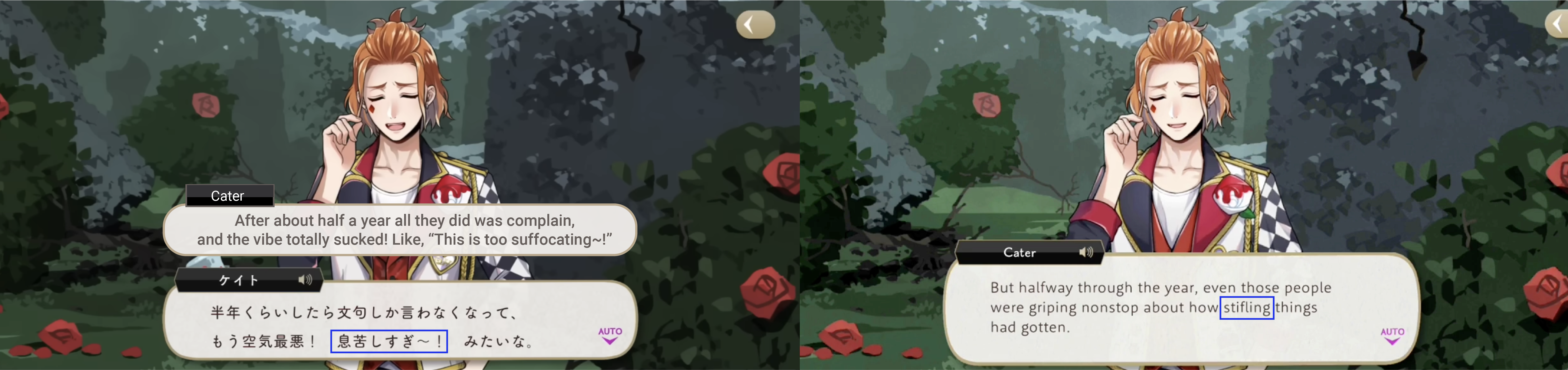
“Stifling” (a different word) is translated accurately at a different point in the same conversation.
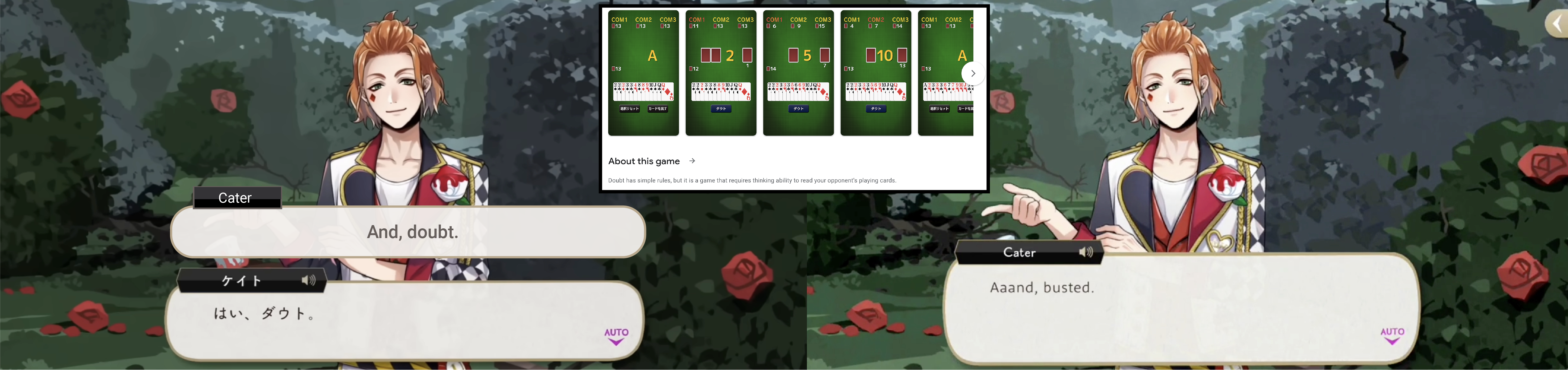
When Cater catches the Dream-Trey in a lie, realizing that Trey is not real, Cater declares, “Doubt,” changed on EN to, “busted.”
While this is a perfectly accurate localization in context, Cater’s original line has a double meaning: “doubt” is the name of a card game where you say “doubt” when you suspect your opponent is lying about their hand (maybe known overseas by names such as “Cheat”, “I Doubt It”, or “Bluff”?”)
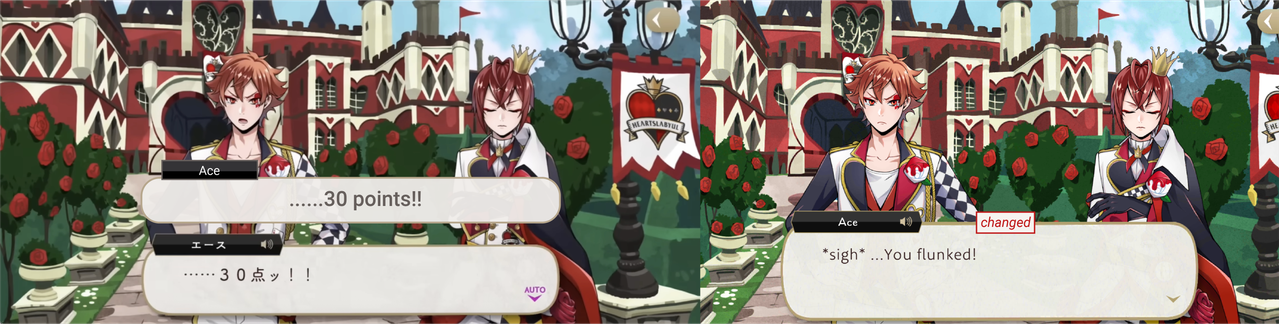
Original Ace: ……30 points!!
EN Ace: *sigh*…you flunked!
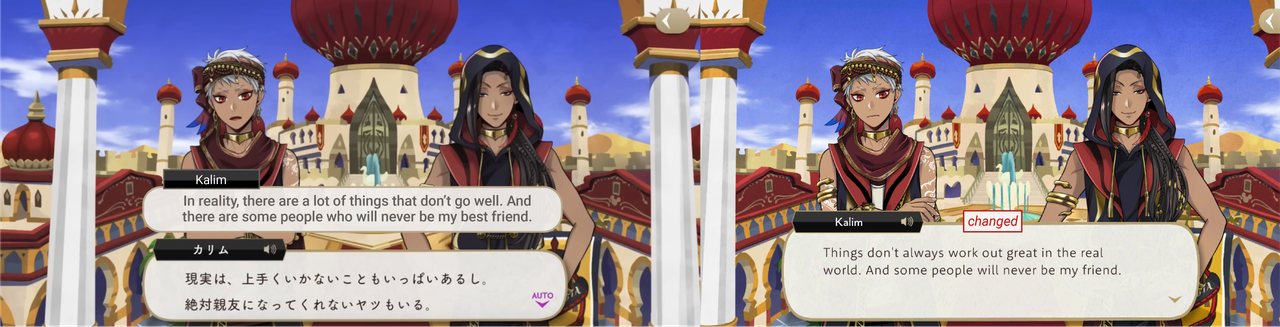
Original Kalim: And some people will never be my best friend.
EN Kalim: And some people will never be my friend.
Kalim is one of very few characters to ever use the word “best friend” (親友), using it to describe Jamil and no one else. More here: Friendships at NRC ▶︎
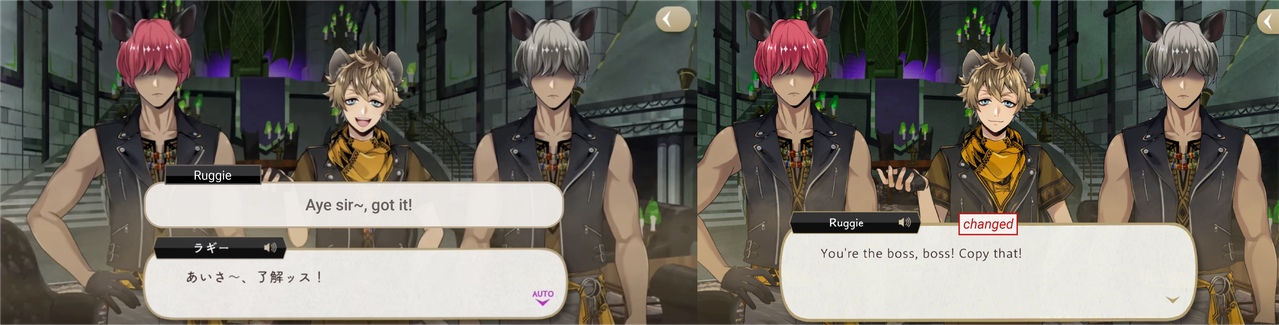
Original Ruggie: Aye sir~, got it!
EN Ruggie: You’re the boss, boss! Copy that!
Ruggie has never actually referred to Leona as “boss” in the main story, though the word will often be added to his dialogue on EN. More here ▶︎
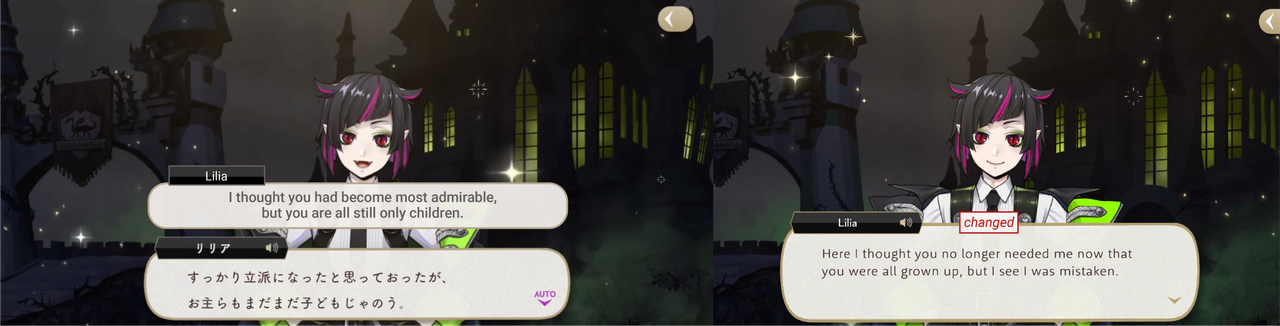
Original Lilia: I thought you had become most admirable, but you are all still only children.
EN Lilia: Here I thought you no longer needed me now that you were all grown up, but I see I was mistaken.
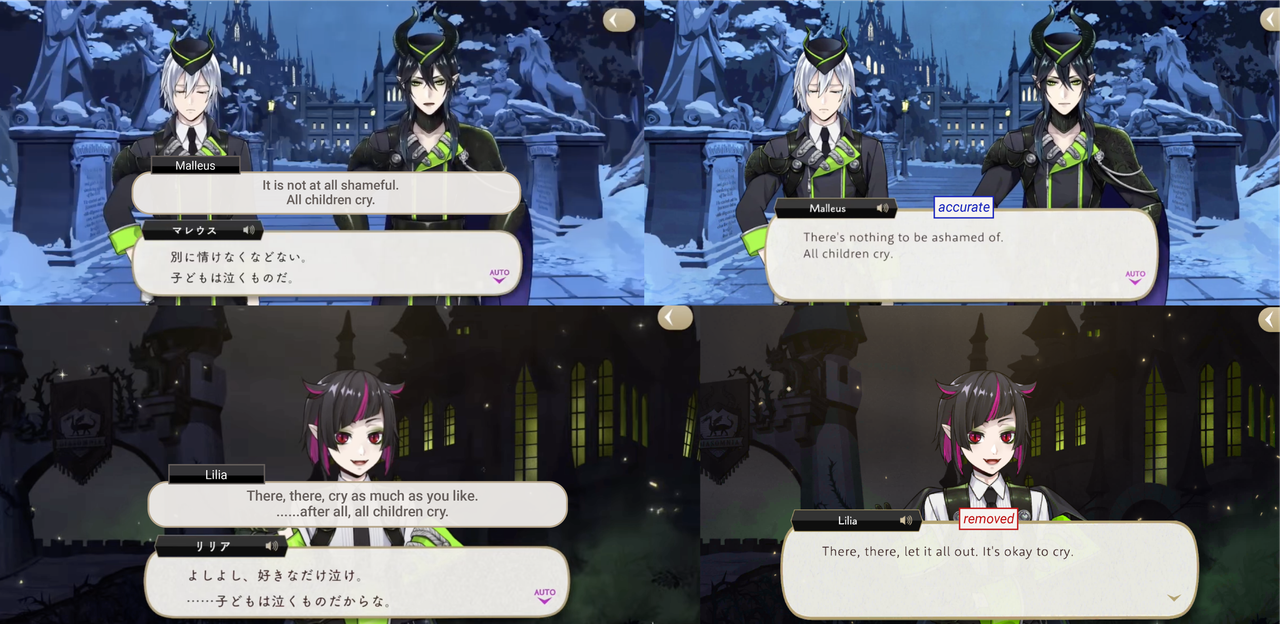
Original Lilia: There, there, cry as much as you like…….after all, all children cry.
EN Lilia: There, there, let it all out. It’s okay to cry.
(In the original game this is a callback to the beginning of Book 7: Malleus tells Silver “All children cry” (retained on EN), and Lilia using the same phrasing back to Malleus at the end of the story, removed from EN.)

Original Leona: Back on the Island of Woe, Vil temporarily turned into some wrinkled up old man, and…….excuse me.
EN Leona: Back on the Island of Woe, Vil briefly turned ol-oh, excuse me.
 Twisted Wonderland Reference Note