

“Actually, I don’t really know what kind of person he is. If he is good or bad, if he has a family…normally I would carefully consider a character’s backstory before recording, but for Crowley I try not to think about it.
I want listeners to decide for themselves what kind of person he is. So when I perform, I don’t try to make him seem villainous, I just focus on keeping him positive. As a result I think he ends up giving a slightly eerie impression (laughs).
But even I, watching the finished animation, discovered things about him: he’s a little suspicious, kind, but cold, yet human…this was a very valuable experience for me. I put my soul into the long monologue at the beginning of episode 1, so I hope people listen to it repeatedly. Regulating my breathing for such long lines was tough, now, performing him in animation five years after the game’s release, but I love long monologues.
– Miyamoto Mitsuru, PASH! magazine (2025)
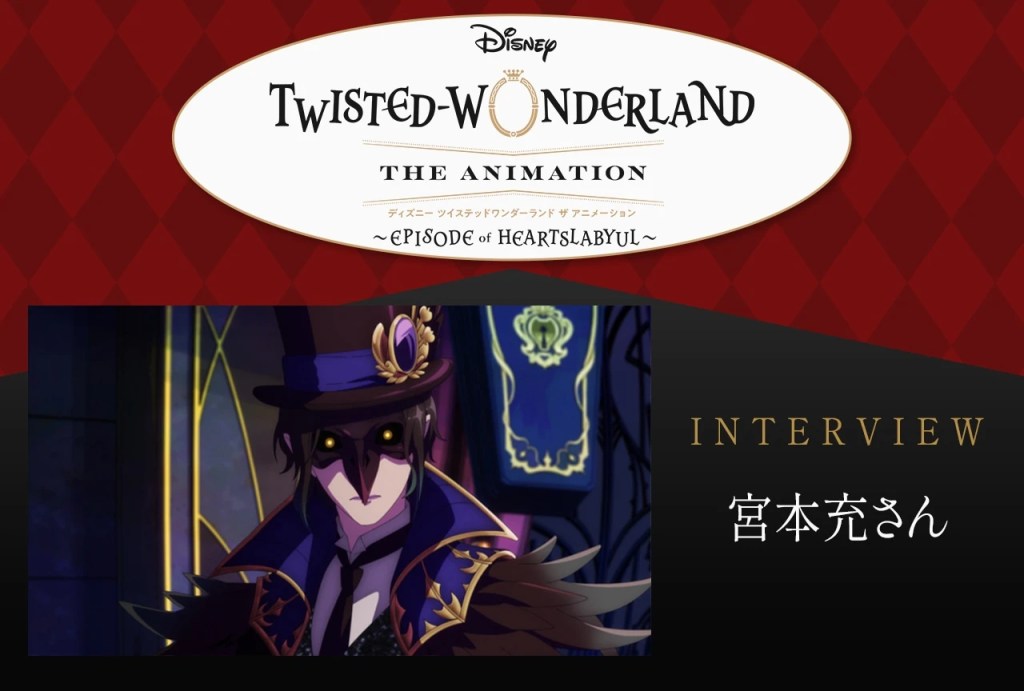
—First reaction to hearing that there would be an anime adaptation:
“I was shocked—’No way!’ was my first reaction. It started as a game, then got a manga adaptation, and now it’s becoming an anime based on that manga.
I was really happy, thinking that this could only happen because the series has become so popular. But at the same time I thought, ‘Uh-oh!’ During game recordings there are no visuals, I receive a script and I record alone. Of course I paid attention to timing, but basically I was able to do whatever I wanted.
That gradually escalated and I started enjoying myself a bit too much. As a result I would be told many times, ‘Please hold it back a little…’ during a single recording session. I was pretty much doing whatever I wanted and thinking, ‘Is this really okay? Well, it’s probably fine!’ So when I heard it was going to be animated I regretted not adjusting my performance to be more suitable for animation from the start (laughs).
To be honest, I still don’t really understand what kind of person Crowley is myself. Is he a good person or a bad one? Does he have a family or not? Those are things you’d normally think about, but with Dire Crowley, I try not to think too much.
Because the lines themselves already contain most of the character’s personality and traits I want to focus as much as possible on how the audience perceives Dire Crowley when they hear him. If Dire Crowley were clearly a bad person I might add more expressive nuances to the lines, but instead I decided to simply perform what was written. And I tried to perform in a positive, upbeat way and avoid making him creepy. But he ends up sounding creepy anyway (laughs).
It’s hard to put into words, but I was careful not to impose my own idea of the character’s atmosphere into my lines. There’s something a little suspicious about him, but also something kind-hearted, and at times even cold. Those aspects just naturally come through. If I had deliberately tried to inject all of that into the lines from the beginning it might have turned out even stranger.
I wasn’t consciously thinking about those things during recording, so being able to listen afterward and discover, ‘This guy’s a bit odd,’ or ‘This imperfectly human side of him is actually nice,’ was a really enjoyable and great experience for me.
It he feels like he has a bit of a naturally airheaded side to him, which we might have in common. There are moments where he can’t read the room, and that’s something people often say about me too (laughs).
This is a bit of a tangent, but back when I was a student I was always wearing a lab coat and shaking test tubes. When I first started acting I didn’t really know what I was doing. I couldn’t time my lines well and I often felt like I stood out in a strange way, like I couldn’t gauge the people around me. I was often told that my lines didn’t feel like they came from the heart. I feel like Dire Crowley has something similar about him.
For example, there’s a scene where Enma Yuuken declares that he’s going back to his original world and rushes off only to find nothing but the ocean stretching out before him. Crowley chose that moment to say, ‘Why don’t you try calling a friend?’ That scene made me laugh. I wondered, ‘Is he serious?’ (laughs)
You honestly can’t tell whether it was a joke or meant to be serious. Did he say it because he knew it was impossible, or was he genuinely worried? When I listened back to my own voice it sounded like he was sincerely concerned. Being surprised by my own lines and realizing that playing them without overthinking makes him come across as even more suspicious was incredibly fun for me.
During the game recordings I never actually saw the other cast members, so this was the first time I met most of them. Everyone except me was young, and I was the only one struggling to keep up (laughs).
This is a bit personal, but I once lived in a dorm myself. There were people from all over the country, and from the very first night it was nonstop, festival-like chaos, full of eccentric upperclassmen. Seeing the hedgehog in Twst reminded me of being taught the dorm song by my upperclassmen. It wasn’t something you absolutely had to do and was more that the upperclassmen just wanted to do it (laughs).
There was also a tradition where we’d be made to sing late into the night, going from one dorm building to another. The smart ones would somehow slip away without anyone noticing, but the underclassmen who couldn’t escape had to keep singing until morning. The strange thing is that everyone always says, ‘When we become upperclassmen, let’s put an end to this,’ but somehow it just keeps going, generation after generation (laughs).”
– Miyamoto Mitsuru, Animate Times (2025)
 Twisted Wonderland Reference Note