
It is not uncommon for subject pronouns like I, you, etc., to be dropped from a sentence when you are speaking in Japanese, but English often requires them in order to make sense, which means JP -> EN translators have to be extra careful: they’re inventing words that don’t exist in the source material.
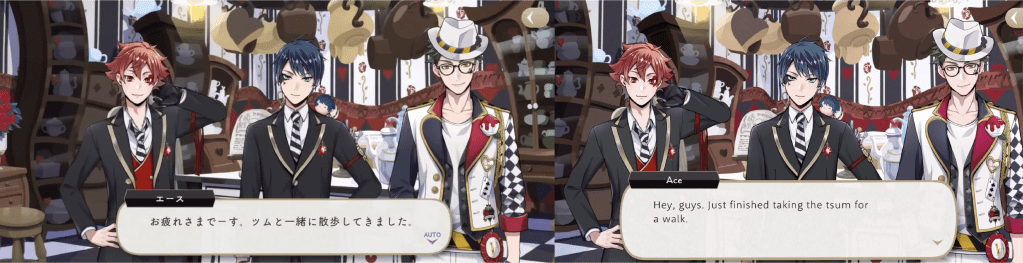
There was a great example of this in the Tsumsted 2 event where Ace and Deuce return from their tsum-based adventure and Ace says, “Just finished taking the tsum for a walk.”
This is almost a literal translation of the original Japanese line, which also does not specify who, exactly, was out with the tsum, because it isn’t necessary. From context we know it was Ace and Deuce without him needing to specify. This is what most sentences are like in Japanese.

Pronouns are also where a lot of changes to the game turn up on EN: In a conversation about when he was a child, for example, Jamil does not actually say that he and Kalim have both attended elementary school.
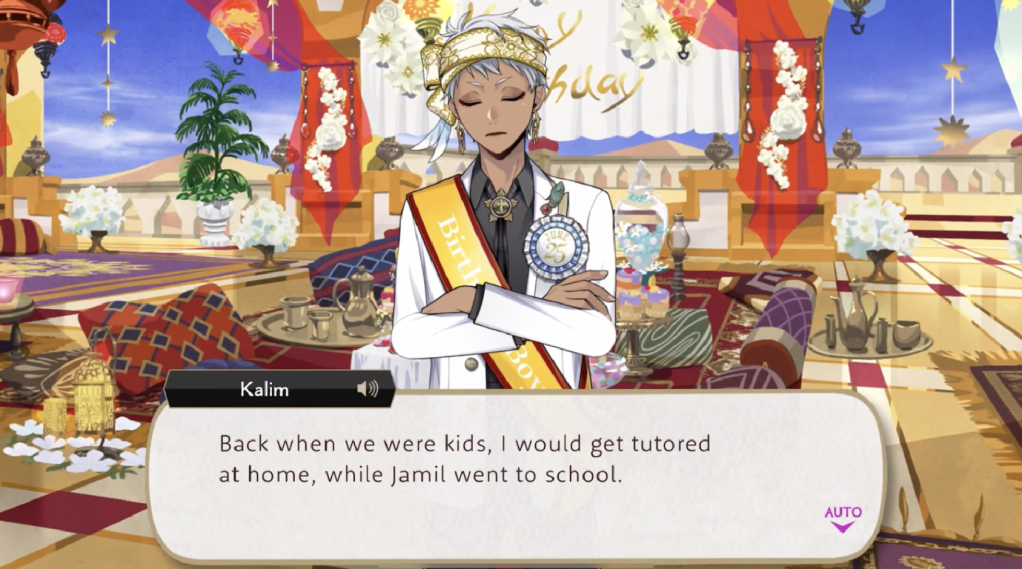
Jamil was talking about himself, so while there was no subject in his sentence, we know he meant himself. This is further confirmed in Kalim’s birthday vignette, where we learn he has only ever been homeschooled.
A similar mistake was made during Spectral Soiree:

Rook introduces Sebek as the subject of a conversation, and EN accurately added “he” to Trey’s response, even though he is technically not saying it.
In his following line, however, EN changed Trey’s subject to “I,” having him say that he was “making fun of Deuce for being a crybaby.”

Not only did we see Sebek, not Trey, mocking Deuce for crying earlier in the event, but Trey even tells Sebek to leave Deuce alone. If you thought it was strange for Trey to make fun of a possessed and crying Deuce, you are correct. This was a mistranslation and is not something that Trey did.

This happens again during the Nightmare Befoer Christmas event where Vil and Jade begin their conversation by referring to Jamil as “he,” discussing him together while Jamil speaks with Jack, but then they suddenly shift to “you” as though speaking to Jamil directly, making it seem as though Jamil is ignoring them.

In Book 1 “we” was added to Ruggie’s line after he wakes up Leona for supplementary lessons, insinuating that both he and Leona need to be taking after-school classes.

But Leona is taking those lessons to compensate for poor attendance, and in the original game it is never insinuated that Ruggie is taking supplementary lessons at all, for poor attendance or otherwise.
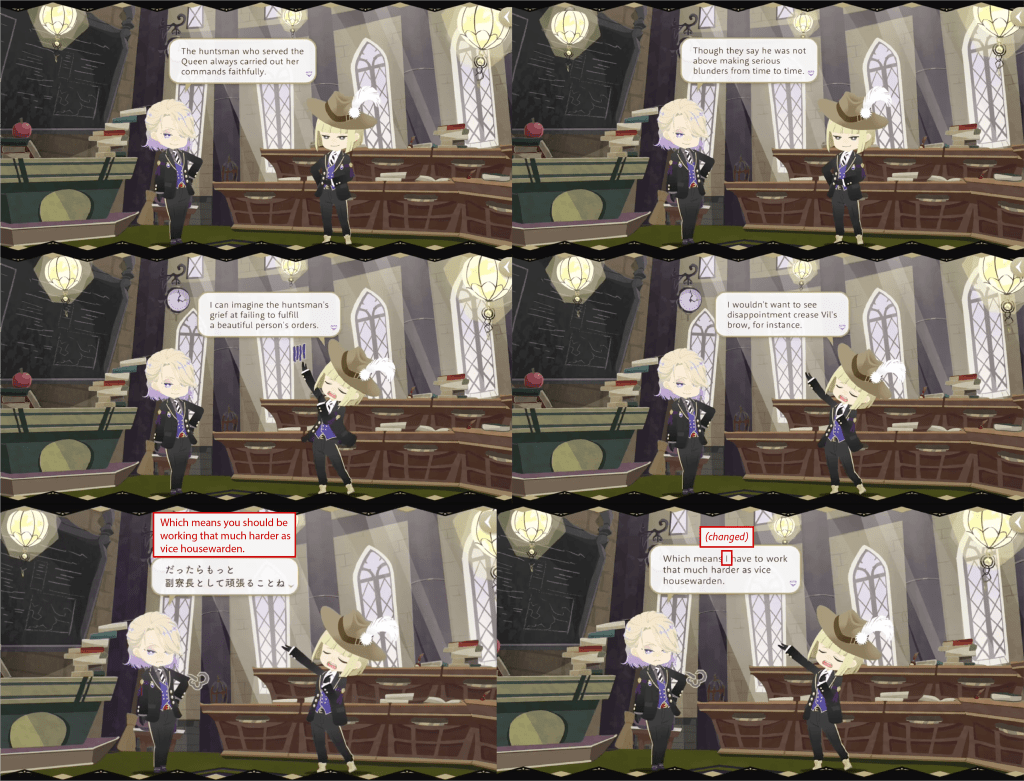
A similar issue arises during a chat between Rook and Vil, where Vil tells Rook that he should be working harder as vice-housewarden.
Vil does not specify “you” or “Rook” in his dialogue but we know he means Rook and not himself, as Rook is who they are discussing. There is also the speech bubble, which is pointing at Vil.
But the subject “I” was added instead of “you,” so EN-Vil is promising to work harder as vice-housewarden.

Vil is caught up in another subject miscommunication in Jade’s dorm vignette, where Jade mentions seeing a note that Vil left in a magazine.
Jade does not specify Vil in his original line and the sentence was written (on EN) as if Vil was the one saying it (“I recall leaving a note,”) but it is Jade who is speaking. As a result, it sounds like EN-Jade was the one who left the note.
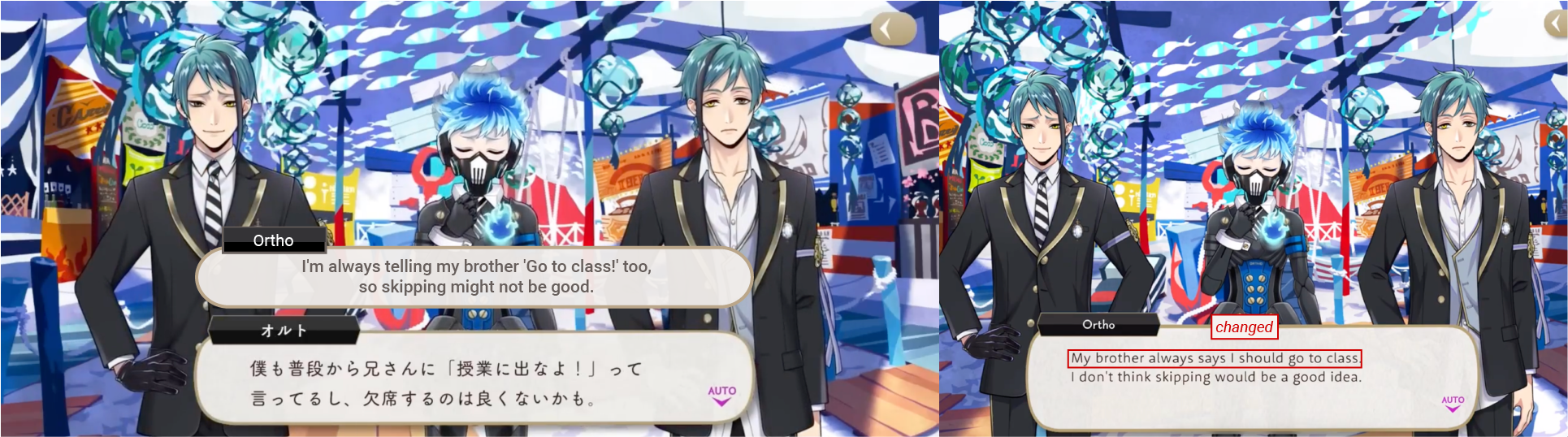
Ortho originally says that he is often having to tell Idia to go to class, which is accurate to their dynamic. (More here ▶︎)
On EN this was changed to Idia always telling Ortho to go to class.
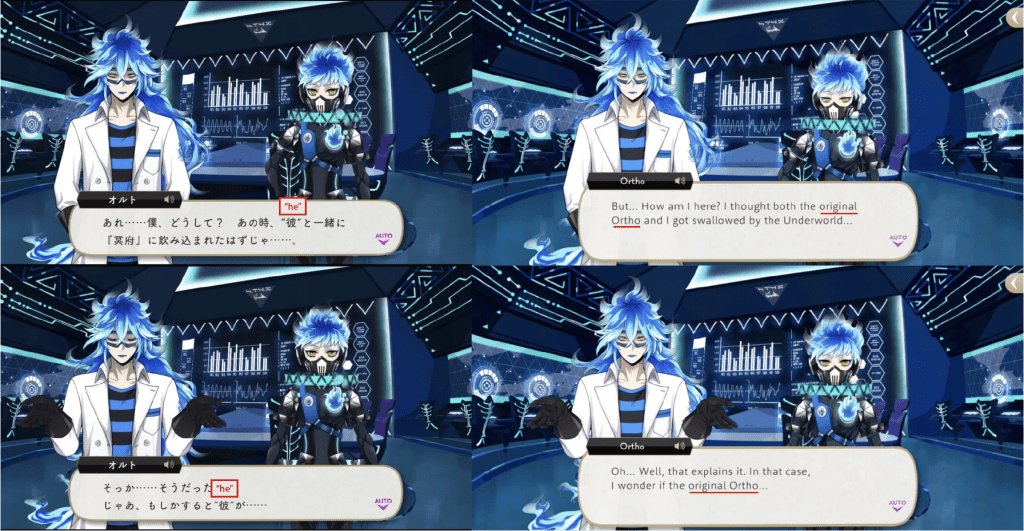
In Book 6 there is a line where Ortho goes out of his way to specify “he,” in quotation marks, as he references dead-Ortho while intentionally not invoking him by name.
This was changed on EN to, “original Ortho.”

Cater has a voice line that was rewritten from asking if the prefect would like to try on his clothes to saying that he should wear them more often himself, but this might have been an intentional change by Aniplex USA rather than pronoun confusion.
Explained in detail here: Changes Made to Cater Diamond in the English-Language Adaptation of Twisted Wonderland

For voice lines, Crowley was removed from Ace’s complaints on EN, while the prefect was removed from Trey’s and Cater’s lines about going out to lunch. It is not clear if these were mistakes or intentional changes.
And these oversights are not limited to I/me, but have also extended to gendered pronouns at least once:

During Fairy Gala IF we have a line by Ortho that confirms the craft faeries are female: he refers to them as 彼女たち (kanojo-tachi), which is a plural form of she/her. Ortho could have said something else (just “the fairies”, for example) if the game did not want to specify gender, but they intentionally chose the plural form of “she/her,” instead.
But then, in Silver’s vignette, he repeatedly refers to the same faerie (or an identical sprite) as “he/him,” and “he/him” was an addition to the English-language adaptation.
In Silver’s original dialogue he never actually specifies any pronoun at all, gendered or otherwise.


The images above include very literal translations which are a bit awkward in English (“Something is being made” etc.) as that is something the Japanese language does that English does not.
So where did “he/him” come from? Possibly from two factors:
- It is possible that the localizations team(s) do not have access to the game’s visuals as they work.
(This is not uncommon in the translation industry. For things like subtitle translation we will often just receive an excel file or .txt file with time codes from the client, and otherwise no context. If it’s a continuation of an ongoing project then we can usually fill in the blanks based on previous experience, but if it’s something new then there will often be a lot of late-stage corrections.)
We have received hints before that this might be the case, such as
・The EN game describing the Diasomnia armband as yellow
・The EN game rewriting Kalim’s “badge” as “armband”
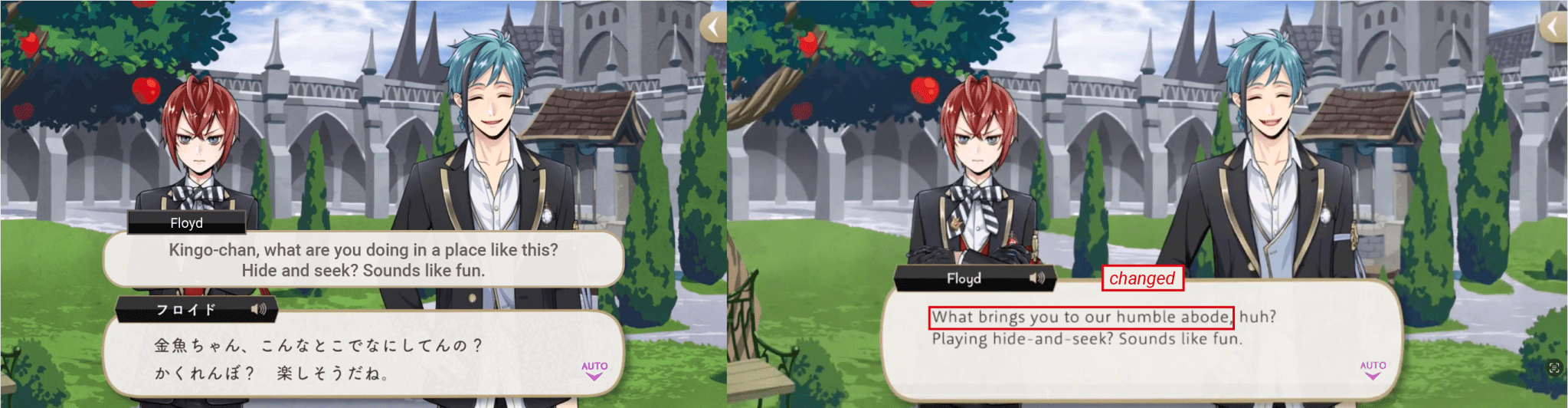
・The EN game adding to Jade and Floyd’s dialogue to make it sound as though they are at Octavinelle when they are actually in the school’s courtyard


2. The craftfairy’s personal pronoun of choice is 俺 (ore), which can be associated with men, but it is not exclusive to men and actually varies by person, situation and region.
More here ▶︎

Technically the faerie could have been of any gender if we were only going off of the dialogue from Silver’s vignette where nothing is ever specified, which would make EN’s interpretation neither right nor wrong.
But as the game has Ortho specify “female” through his choice of word for “they,” this was maybe another example of pronoun confusion for EN.
 Twisted Wonderland Reference Note